


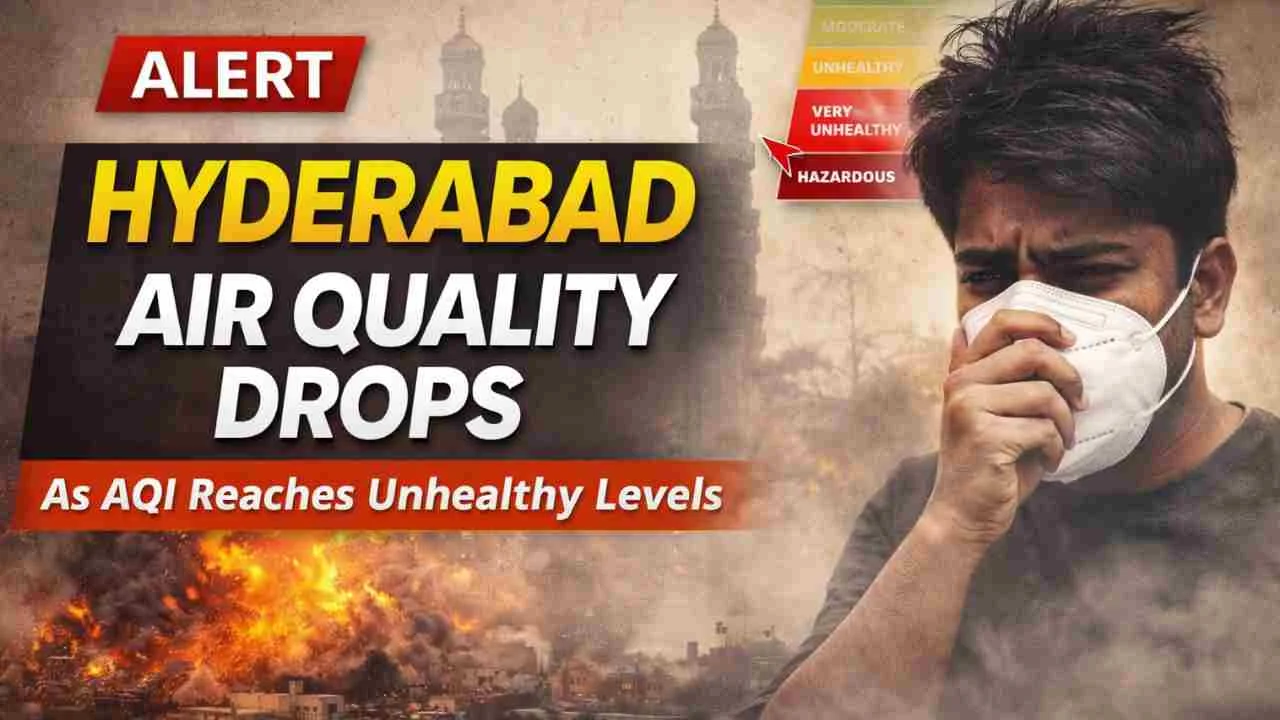
Hyderabad witnessed a sharp deterioration in air conditions on Friday as monitoring stations recorded a surge in pollution levels across several parts of the city. The Hyderabad air quality index crossed into the “unhealthy” category in certain industrial and suburban zones, raising concerns among environmental authorities and public health experts.
Air monitoring data indicated that the most severe readings were reported from the Patancheru industrial belt, where the Air Quality Index climbed above 250 during the morning hours. According to national air quality standards, this level signals conditions that can pose health risks to the general population, particularly vulnerable groups.Environmental specialists say sudden spikes in Hyderabad air quality levels often occur due to a combination of urban emissions and atmospheric conditions. Fine particulate matter—especially PM2.5—remains one of the most harmful pollutants because the particles can penetrate deep into the lungs and bloodstream.Construction activity across expanding residential and commercial zones has been identified as a major contributor to rising dust levels. Hyderabad’s rapid real estate development, particularly in peripheral growth corridors, generates large volumes of airborne particulate matter when mitigation measures are insufficient.
Vehicular emissions remain another significant source of pollution. The city’s expanding road network and increasing vehicle ownership have intensified traffic congestion, particularly during peak commuting hours. Transport analysts note that while new flyovers and road corridors improve mobility, they also highlight the need for stronger investments in mass transit and cleaner mobility options.Waste burning in suburban areas has also been cited as a contributing factor to deteriorating Hyderabad air quality conditions. Such activities release nitrogen oxides and microscopic particles that remain suspended in the atmosphere, especially when wind circulation is weak.Meteorological conditions can further worsen pollution episodes. During early mornings and late evenings, cooler temperatures and lower wind speeds limit atmospheric dispersion, allowing pollutants to accumulate closer to ground level.
Medical professionals warn that sustained exposure to poor air quality can trigger respiratory issues, aggravate asthma and increase the risk of cardiovascular complications. Children, older adults and individuals with existing respiratory conditions are considered particularly vulnerable during periods of elevated pollution.
Urban environmental researchers say Hyderabad’s air quality challenges reflect a broader pattern seen in fast-growing Indian cities. Rapid urbanisation, industrial activity and increased transportation demand often combine to create periodic pollution spikes unless mitigated through coordinated environmental policy.Authorities are continuing to monitor pollution levels through the city’s air quality monitoring network. Environmental experts suggest that long-term improvements will depend on stronger emissions controls, improved waste management practices and expanded public transport systems.As Hyderabad continues its growth trajectory, maintaining healthy Hyderabad air quality will increasingly become a central challenge for urban planners balancing economic expansion with environmental sustainability.
Hyderabad Air Quality Levels Enter Unhealthy Zone
