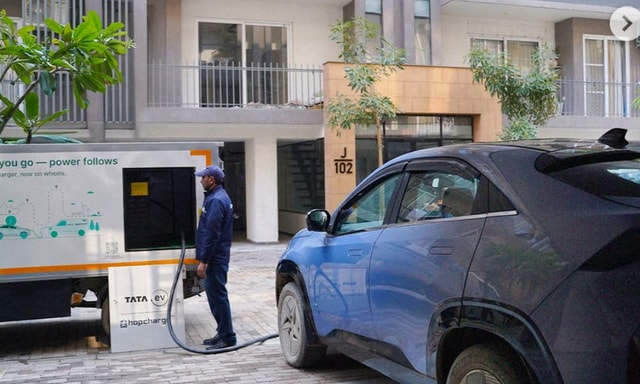
In a strategic move to tackle a persistent barrier in electric vehicle ownership, Tata’s electric mobility division — Tata.ev — has teamed up with mobile charging operator Hopcharge to introduce on-demand, doorstep EV charging services across the National Capital Region (NCR).
This initiative addresses a critical urban mobility challenge in dense metropolitan regions where traditional home charging infrastructure remains limited, especially for residents in high-rise apartments and rented accommodation. Under the partnership, EV owners in Delhi, Gurugram, Noida and Faridabad will be able to book a mobile charging unit that travels to their location to replenish their vehicle’s battery. The service is part of a pilot programme designed to reduce reliance on fixed public charging stations — an infrastructure that, despite expansion, still leaves gaps for a segment of the EV market that lacks dedicated parking or grid access for personal chargers. Officials within Tata.ev view the collaboration as an interim but vital solution that supplements public and workplace charging networks.
By bringing charging to the vehicle rather than the driver, the service is intended to mitigate “range anxiety” — a frequent concern among potential EV buyers who are dissuaded by the absence of convenient charging options within residential complexes and urban housing clusters. The model is particularly significant for rapidly growing Indian cities where urban density and shared infrastructure can limit the deployment of wall-mounted home chargers. Urban planners note that while public charging points are crucial for long-distance travel and workplace charging, first- and last-mile electricity access — the ability to recharge where vehicles are parked overnight — remains a persistent bottleneck for widespread electric adoption. As part of early promotional efforts, Tata.ev buyers at authorised dealerships in the NCR will receive complimentary doorstep charging sessions for a limited period, subject to terms and conditions. This bundled incentive is intended to both familiarise new owners with the service and demonstrate its practical benefits where conventional installation is unfeasible.
Industry observers see this mobile charging approach as complementary rather than substitutive to fixed infrastructure. A balanced charging ecosystem typically includes public fast chargers, workplace chargers, and home units supported by stable grid connections. Innovative additions like mobile vans can ease transitional challenges, particularly in older neighbourhoods or apartment buildings where retrofitting electrical capacity is costly or administratively complex. However, questions remain about the scalability and long-term economics of mobile charging. Factors such as fleet size, scheduling logistics, and integration with existing grids will determine whether this service can broaden across other urban centres beyond the NCR. In densely populated regions like Patna, similar mobility constraints pose challenges for EV adoption, underscoring the need for multi-layered charging strategies that combine fixed and flexible solutions.
Ultimately, the Tata-Hopcharge partnership represents an incremental but noteworthy experiment in urban EV infrastructure. By prioritising user convenience and tackling persistent charging access barriers, the initiative offers a pragmatic pathway toward more inclusive and resilient electric mobility networks.