


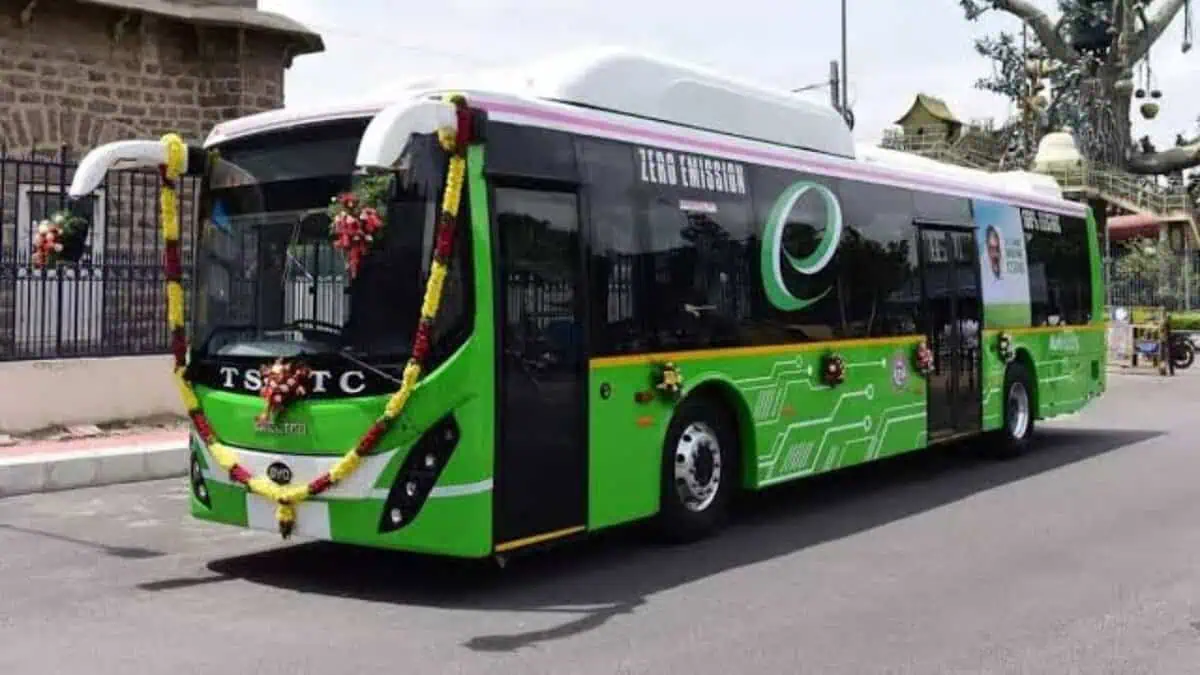
Hyderabad’s public transport network has become more affordable this week after the state-run bus operator reduced Hyderabad AC bus fares across key intra-city services. The revision, effective immediately, lowers ticket prices on air-conditioned Metro Deluxe and e-Metro routes, a move aimed at improving ridership ahead of peak summer demand and strengthening the city’s public mobility ecosystem.
Under the revised structure, fares on Metro Deluxe air-conditioned services have been reduced by ₹5 per four-kilometre slab, while e-Metro air-conditioned buses see a steeper reduction of ₹10 for the same distance band. Transport officials indicated that the adjustment is designed to narrow the pricing gap between conventional and AC services, which had limited passenger uptake despite rising temperatures.Hyderabad’s summers routinely push commuters towards climate-controlled travel. However, higher ticket prices had kept average occupancy on AC services significantly below optimal levels, according to officials familiar with operational data. By recalibrating Hyderabad AC bus fares, the transport corporation is seeking to increase load factors, improve revenue stability through higher volumes, and optimise fleet utilisation.
Urban mobility analysts say the decision carries broader implications beyond seasonal comfort. Air-conditioned public buses, when well patronised, can draw commuters away from private vehicles and app-based cabs. That shift can reduce congestion, lower vehicular emissions, and improve road safety — all central to the city’s long-term sustainability goals. In a rapidly expanding metropolitan region, improving the attractiveness of shared transport is seen as essential to containing transport-related carbon growth.The fare reduction also reflects the financial balancing act faced by state transport undertakings. While input costs — including fuel, maintenance, and fleet modernisation — remain high, underutilised premium services can strain operating margins. By adjusting prices strategically rather than scaling down services, the operator appears to be betting on demand elasticity to drive recovery.
For daily commuters, particularly office workers and students travelling longer distances within Greater Hyderabad, the lower AC fares may ease monthly travel budgets during the hottest months of the year. Transport planners note that affordability plays a decisive role in mobility choices, especially for women, elderly passengers, and those travelling during non-peak hours when comfort and safety are key considerations.The move comes at a time when Indian cities are reassessing public transport models to make them more resilient and people-centric. Hyderabad has been investing in multimodal integration, including metro rail, city buses, and suburban links. Ensuring competitive pricing across segments will be critical to maintaining public trust and sustaining ridership growth.
Whether the fare cut results in a measurable modal shift will become clearer over the coming months. For now, the recalibration of Hyderabad AC bus fares signals a tactical intervention aimed at strengthening public transport’s role in a warming, fast-growing urban landscape.
Also Read:Bengaluru Hyderabad High Speed Rail Launch Advances
Hyderabad AC Bus Fares Reduced
