


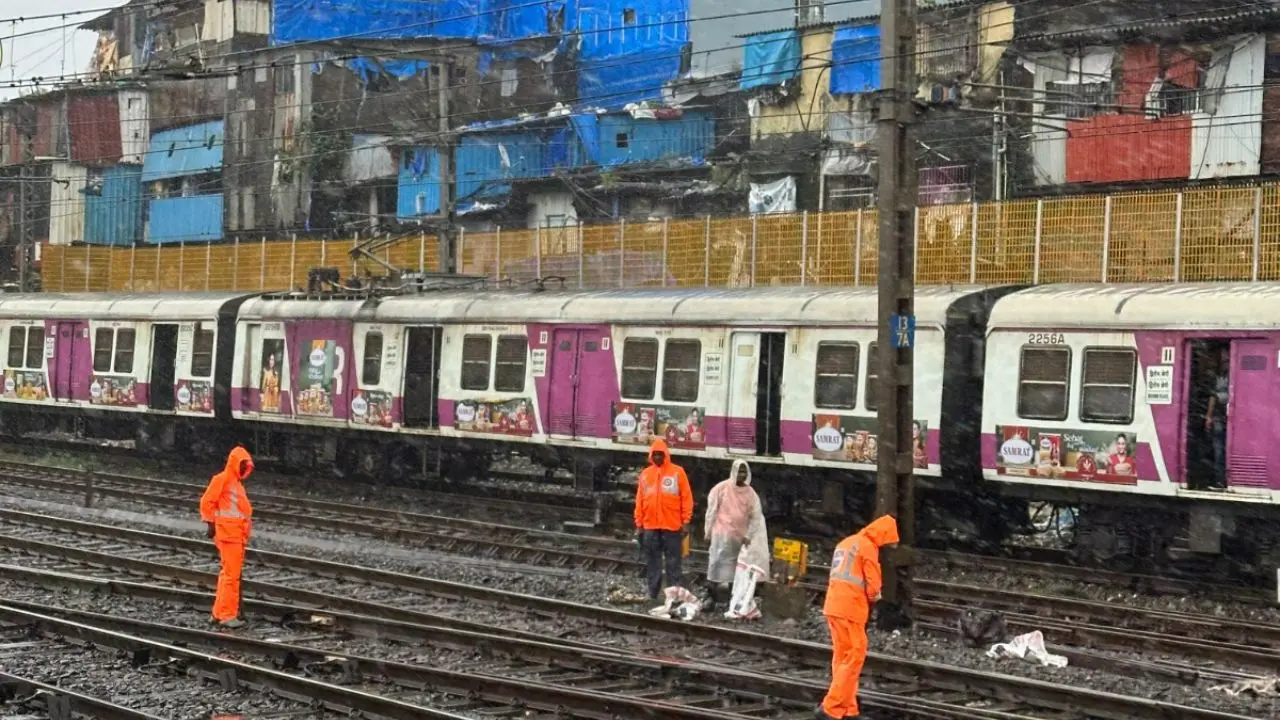
Mumbai’s suburban lifeline continued to function despite three consecutive days of heavy downpour and a red alert issued across the city. Western Railway’s resilience was on display as services operated largely on time, even as neighbourhoods battled knee-deep water and widespread flooding. Officials attributed this success to rigorous planning, continuous monitoring, and the deployment of manpower and machinery on an unprecedented scale.
Over the weekend, several stations, including Grant Road, Dadar, Vasai Road, and Virar, recorded rainfall exceeding 250 mm, while Andheri, Bandra Terminus Yard, and Borivali were battered with over 300 mm. In most parts of the city, such numbers are enough to paralyse train operations. Yet, suburban services ran with minimal disruption, thanks to more than 110 dewatering pumps deployed across vulnerable stretches. These pumps worked without pause, supported by a continuous supply of diesel to avoid breakdowns. The strategy extended far beyond mechanical support. A workforce of more than 180 railway staff, backed by 70 trained pump operators, remained on round-the-clock duty. Teams cleared plastic waste and debris from drains, ensuring water did not accumulate on tracks. Station masters and operations teams stayed on alert to coordinate quick responses to emerging challenges, while watchmen and bridge guards closely monitored rising water levels at bridges and culverts.
Railway experts explained that the intensity of rainfall, coupled with plastic waste in stormwater drains, creates a severe threat to uninterrupted train operations in Mumbai. Preventing waterlogging requires rapid drainage and continuous inspection of tracks and bridges. This year, the preparedness of Western Railway helped maintain commuter confidence during what was otherwise a crippling monsoon spell for the city. Senior officials also conducted on-ground inspections to assess flood-prone areas and review station preparedness. These checks highlighted how decentralised coordination, rather than centralised control, enabled faster problem-solving. Local staff were empowered to take immediate decisions, a factor many insiders believe helped sustain uninterrupted train movement.
Meanwhile, in other parts of the city, road transport services such as BEST buses faced diversions due to waterlogging in Sion, Chembur, and Dadar. This contrast further underscored the critical role suburban trains play as Mumbai’s most reliable lifeline. As climate change brings unpredictable rainfall patterns, Mumbai’s railways are increasingly under pressure to strengthen their flood resilience. While Western Railway’s performance this season has earned praise, experts argue that long-term measures—such as sustainable drainage, eco-friendly water management, and a stronger zero-carbon transport framework—must become part of Mumbai’s broader urban planning. For now, however, the efforts of staff and officials have ensured that millions of commuters were not left stranded, even amid the worst of the rains.
Also Read : Central Railway and MRVC Launch Seven Girders In Record Two Hours Despite Rains
