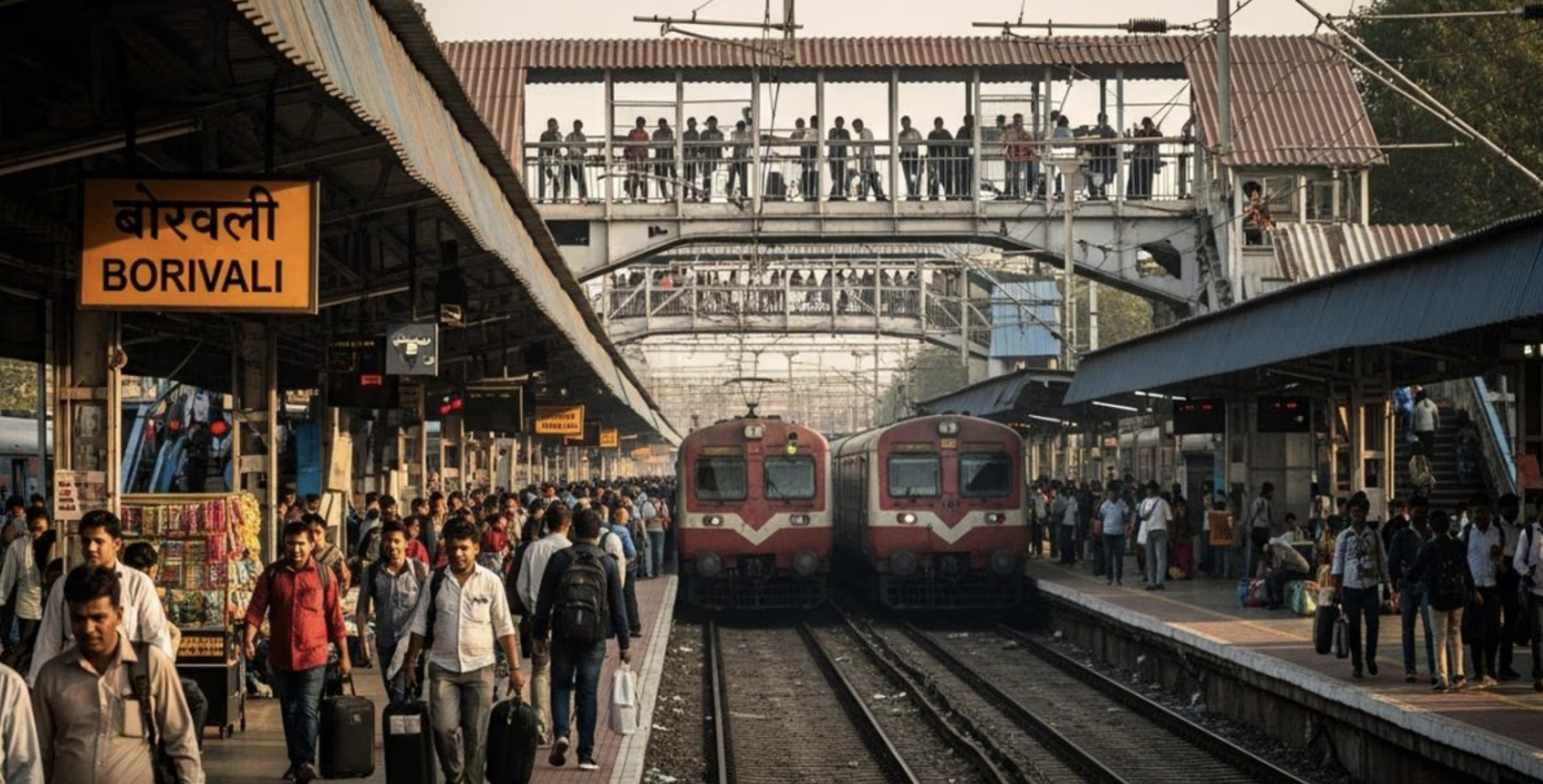
One of Mumbai’s busiest suburban railway stations has quietly undergone a major technological transformation, signalling a shift in how India’s most heavily used urban rail corridor is being managed. Borivali station, a critical node on the Western Railway suburban network, has been integrated with an advanced digital signalling system designed to improve safety, reliability, and capacity on routes that carry millions of daily commuters.
The upgrade replaces a decades-old relay-based signalling setup with a modern electronic interlocking platform, bringing Borivali in line with contemporary global rail operations. Railway officials involved in the project said the change was essential as the existing system, dependent on mechanical relays and manual interfaces, had reached the limits of scalability and operational efficiency. Electronic interlocking functions as a centralised digital brain for station operations. It automatically governs train routing, signal aspects, track switches, and movement authority, ensuring that conflicting train paths are physically impossible to set. At Borivali, the system manages hundreds of operational routes, signals, and track circuits across multiple running lines through a single integrated control environment.
From an operational standpoint, the impact is significant. Real-time monitoring allows controllers to track train positions with greater accuracy and respond faster to disruptions. Industry experts note that such precision is critical on the Western corridor, where trains operate at extremely short intervals during peak hours, leaving little margin for error. The upgrade also has future-facing implications. Urban transport planners say the digital design allows additional lines and services to be integrated without proportionate increases in trackside hardware. This is particularly relevant as capacity expansion projects on the Western Railway corridor progress, requiring signalling systems that can accommodate higher train frequencies without compromising safety.
Beyond rail operations, the modernisation has broader urban consequences. Suburban rail is the backbone of Mumbai’s low-carbon mobility system, moving far more people with a fraction of the emissions associated with road transport. Improving signalling efficiency enables more reliable services, potentially encouraging a shift away from private vehicles and easing congestion on city roads. The new control setup resembles a compact rail operations centre rather than traditional signalling rooms filled with relay racks. Large digital displays offer improved situational awareness for operators, while automated safeguards reduce dependence on manual interventions. Railway safety specialists say this significantly lowers the risk of human error, one of the most common contributors to operational incidents worldwide.
Electronic interlocking platforms are widely deployed across high-capacity rail networks globally and often serve as the foundation for more advanced technologies, including automatic train protection and traffic management systems. Their adoption in Mumbai’s suburban network indicates a gradual but decisive move towards technology-led rail governance. As passenger numbers continue to rise alongside urban expansion, such upgrades may determine how effectively Mumbai’s rail system balances safety, capacity, and commuter comfort. The challenge ahead will be to replicate these improvements across other high-traffic stations, ensuring that digital modernisation keeps pace with the city’s relentless growth.
Western Railway Deploys Next Gen Signalling at Borivali