Vizag Economic Region Eyes MMR‑Style Infrastructure Plan
A high‑level Andhra Pradesh delegation concluded a two‑day study mission in the Mumbai Metropolitan Region (MMR) this week, signalling a strategic shift in how the state plans to finance and govern urban expansion in the Visakhapatnam Economic Region (VER). Government officials examined metropolitan governance models, land‑based financing mechanisms, and transit‑oriented development frameworks with implications for long‑term infrastructure and housing strategy in coastal Andhra.
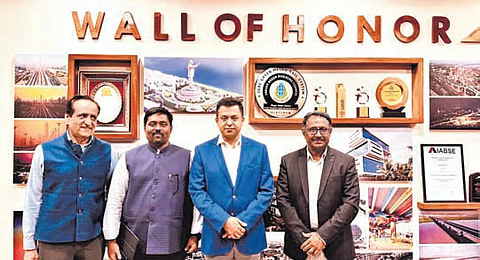
Led by the Principal Secretary of the Municipal Administration & Urban Development (MA&UD) Department, the team included senior representatives from the Visakhapatnam Metropolitan Region Development Authority (VMRDA) and the Directorate of Town and Country Planning. Over January 12–13, they engaged with senior policymakers and urban executives from Maharashtra’s planning bodies to explore self‑sustaining revenue and institutional approaches pioneered in MMR, such as land monetisation and development rights markets. In Mumbai, metropolitan agencies such as the Mumbai Metropolitan Region Development Authority (MMRDA) and the City and Industrial Development Corporation (CIDCO) operate with significant non‑budgetary financing streams. These include land sales, floor space index premiums, and impact fees that have underpinned large‑scale infrastructure delivery and transit‑oriented growth without heavy reliance on state budgetary grants — a potential model for Andhra’s evolving urban finance architecture.
Officials scrutinised land‑value capture strategies, planning controls in major urban projects such as the Bandra‑Kurla Complex, and slum rehabilitation practices to inform Andhra’s policy framework. The exposure to MMR’s experience has accelerated work on a Land Value Capture and Land Monetisation Policy alongside a Slum Rehabilitation and Cluster Redevelopment Policy — policies designed to generate revenue streams for infrastructure and affordable housing across VER. This policy pivot comes as Andhra Pradesh intensifies infrastructure planning across its coastal belt, where the VER — a region that contributes substantially to the state’s GDP and population growth — is touted as a future economic powerhouse. Local planners see the integration of land‑led financing and institutional mechanisms as critical to funding multi‑modal transit corridors, utilities expansion, and housing delivery at scale.
Metropolitan governance experts note that effective land monetisation requires robust planning controls and regulatory transparency to balance public revenue generation with equitable land rights and environmental safeguards. For a region like Vizag, where rapid investment flows are expected across ports, manufacturing, logistics and urban services, embedding strong policy frameworks early could ensure inclusive and climate‑resilient urban growth. However, adapting the MMR model to Andhra’s context poses its own challenges. Mumbai’s revenue‑driven institutions evolved over decades in a highly competitive property market, whereas VER’s development is still taking shape amid multiple competing priorities — from connectivity and port infrastructure to affordable housing and ecological resilience. Policy analysts say that integrating land‑value capture with proactive community engagement and environmental safeguards will be pivotal to ensuring balanced outcomes.
As Andhra finalises its policy toolkit, the focus will turn to formalising institutional mechanisms, calibrating land‑value instruments to local markets, and coordinating across departments to translate strategic vision into deliverable projects. If successfully implemented, these reforms could position Vizag as a self‑funding metropolitan economy, reducing dependency on state budgets while fostering sustainable, people‑first urban growth