


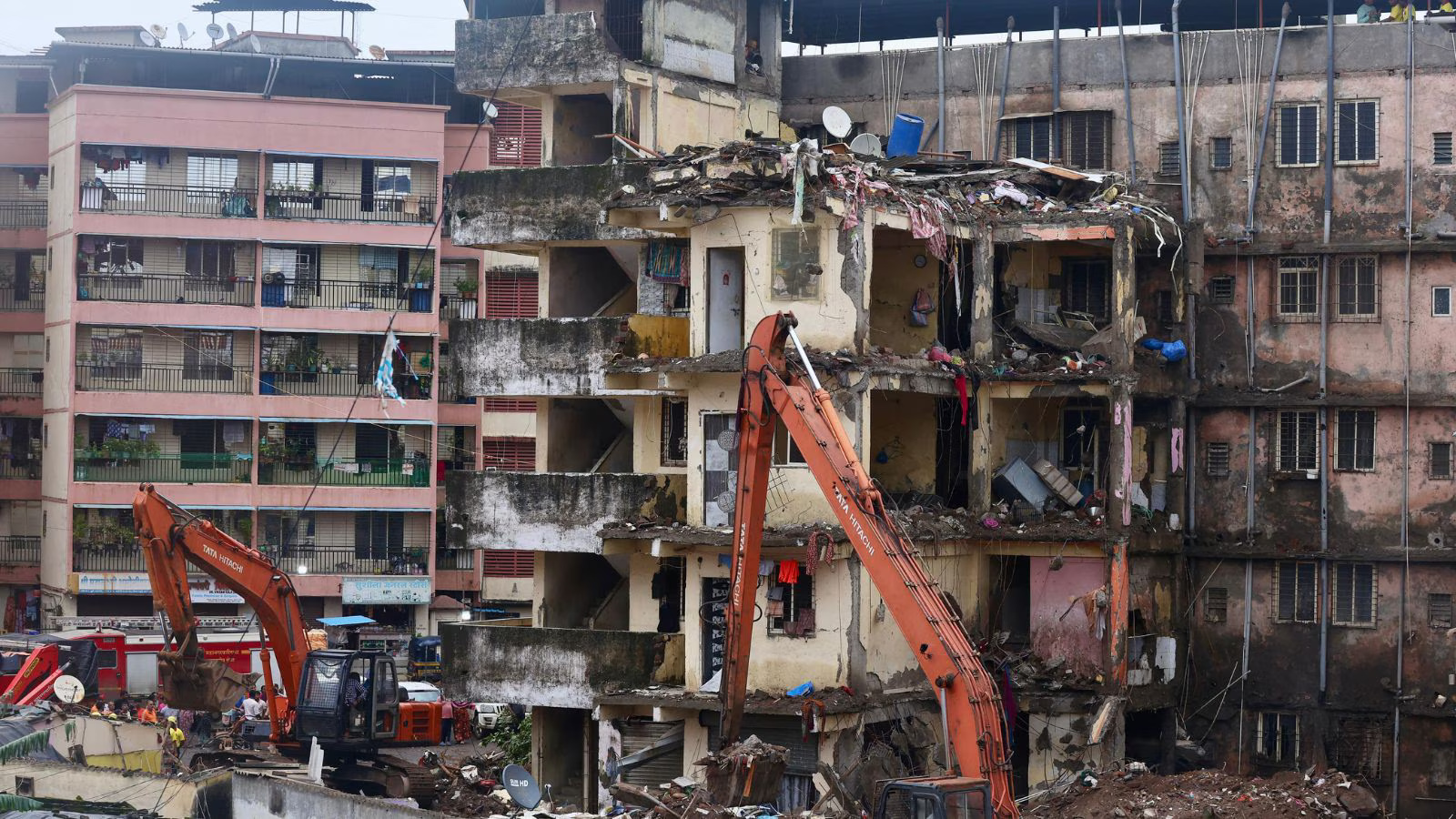
The fatal collapse of a four-storey apartment building in Virar, which claimed 17 lives in August, has exposed how amateur construction, civic neglect, and weak regulatory enforcement continue to undermine housing safety in Mumbai’s extended metropolitan region. The Mira-Bhayander-Vasai-Virar (MBVV) police’s crime branch, in a 4,015-page chargesheet submitted to the Vasai magistrate court, detailed how the Ramabai Apartment was built by an unqualified landowner without architectural guidance or structural expertise.
Investigations revealed that the building’s blueprint was drawn and executed by the landowner, assisted only by a labour contractor. No architect or structural engineer was engaged, and substandard materials were used. Officials said the contractors even altered the layout mid-way, converting one-bedroom units into two-bedroom apartments to maximise profits, severely compromising the structural integrity of the building. A public works official who analysed the recreated plans stated that the structure “was not legally sound and would not have lasted two years” under standard safety norms. Experts found discrepancies in the foundation scale, poor spacing between adjacent structures, and uneven settlement—all indicators of a fatally flawed design. “The construction lacked proper dimensioning and design scaling for its height, leading to instability,” said the official.
The chargesheet also implicates civic negligence. Despite being flagged as unauthorised in 2018, the Vasai-Virar City Municipal Corporation (VVCMC) failed to act beyond issuing notices. No demolition or eviction was carried out even after the building was declared unsafe earlier this year. The police have now named two assistant commissioners, along with former municipal engineers, for procedural lapses and dereliction of duty. Urban planners argue that the tragedy underscores how informal construction and lax oversight have become endemic in Mumbai’s peripheral zones, where rapid population growth outpaces urban planning capacity. “In areas like Virar, self-built housing is common because formal approval systems are slow and costly. But this informality comes at a human cost,” said an urban policy researcher.
The case also raises questions about post-disaster accountability and enforcement. Police have written to the Enforcement Directorate and income tax authorities to investigate financial irregularities among officials linked to the project, with a supplementary chargesheet expected soon. As families continue to seek justice and support, urban experts call for stronger structural audit systems, mandatory professional supervision in all private developments, and legal safeguards for tenants. The Virar collapse, they note, is not an isolated incident—it is a symptom of a broken urban housing ecosystem that prioritises speed and profit over safety and sustainability.
Also Read : Mumbai Rail Network Strengthened As MRVC Completes Key Kalyan–Badlapur Works Overnight
