


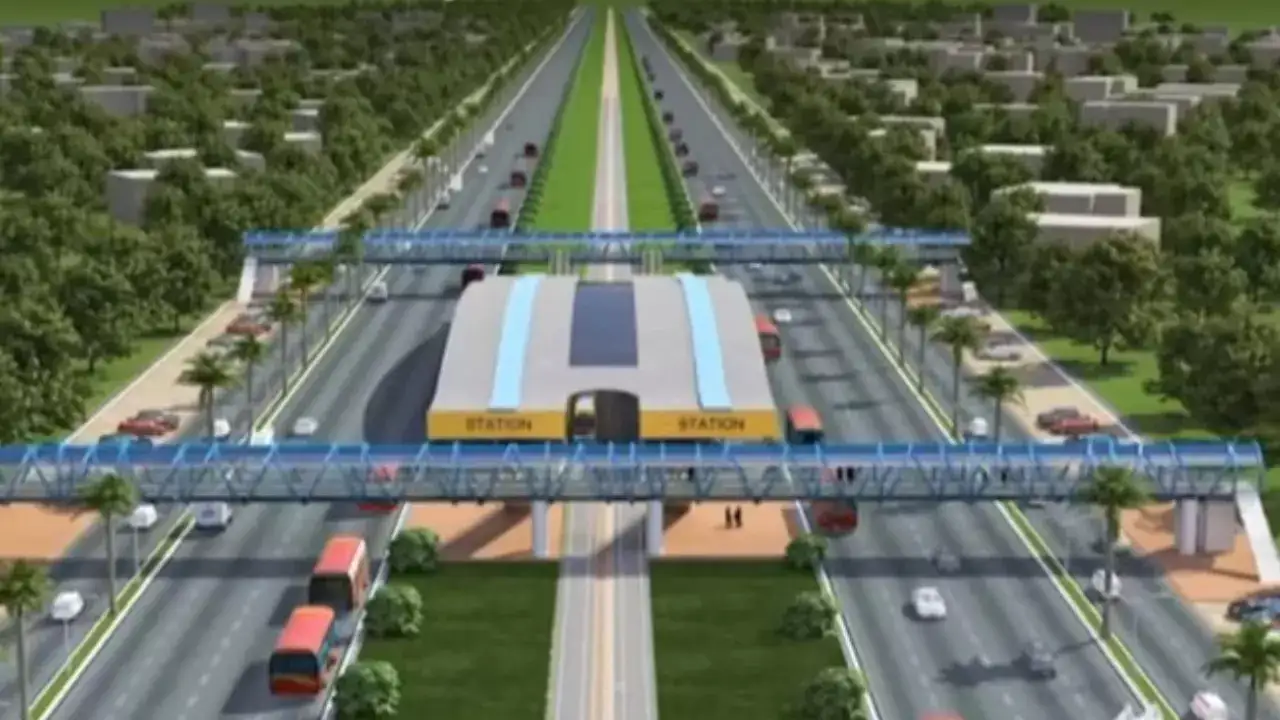
The long-delayed Virar–Alibaug Multimodal Corridor has received a fresh lifeline, with the Maharashtra government approving the first phase of development under the Build-Operate-Transfer (BOT) model. The 126-kilometre corridor, envisioned as one of the state’s most ambitious mobility projects, aims to reduce travel time between Virar and Alibaug from four hours to just 90 minutes, reshaping connectivity across the Mumbai Metropolitan Region (MMR).
The project’s first phase—spanning 96.4 kilometres from Navghar in Palghar district to Balavali in Pen—will be developed at a cost of ₹37,013 crore. Of this, ₹22,250 crore is earmarked for land acquisition and ₹14,763 crore for interest and other costs. Land acquisition has already begun, supported by a state-backed guarantee for the Housing and Urban Development Corporation (HUDCO) loan. Officials from the Maharashtra State Road Development Corporation (MSRDC) confirmed that the BOT model was chosen after earlier tenders under the EPC (Engineering, Procurement, Construction) framework received bids significantly higher than estimates. The revised model allows private players to finance, build, and operate the project, recovering their investment through toll collection before transferring it back to the government.
A senior MSRDC official said the final BOT proposal has been submitted for approval, and tenders will be issued once the government gives its nod. To expedite the process, the state has approved a ₹2,000 crore bank guarantee to support faster land acquisition. The Virar–Alibaug corridor is designed as a multimodal transport spine, connecting key road, metro, port and airport networks. Once operational, it will link the Delhi–Mumbai Expressway, the Mumbai–Pune Expressway, the Mumbai–Ahmedabad and Mumbai–Nashik corridors, and provide direct access to the Navi Mumbai International Airport, Jawaharlal Nehru Port (JNPT), and the Atal Setu sea link.
Experts believe the project could play a transformative role in decongesting Mumbai by creating an alternative high-speed route through the metropolitan region. “This corridor will enable smoother regional travel and strengthen economic linkages between northern and southern MMR, reducing the load on Mumbai’s internal road system,” said an urban transport planner. Phase Two of the project will extend from Balavali to Alibaug, completing the full 126-kilometre corridor. With improved freight and passenger connectivity, the route is also expected to cut fuel consumption and vehicular emissions, contributing to cleaner air and lower carbon output.
By integrating multiple transport modes, the Virar–Alibaug Multimodal Corridor aligns with Maharashtra’s long-term vision of sustainable, seamless, and inclusive mobility across the MMR. If executed as planned, it could emerge as the state’s most transformative infrastructure project in decades—bringing the idea of “connected regions, faster travel” closer to reality.
Also Read: Mumbai Plans Massive Underground Expressway Network To Cut Travel Time And Traffic Congestion
