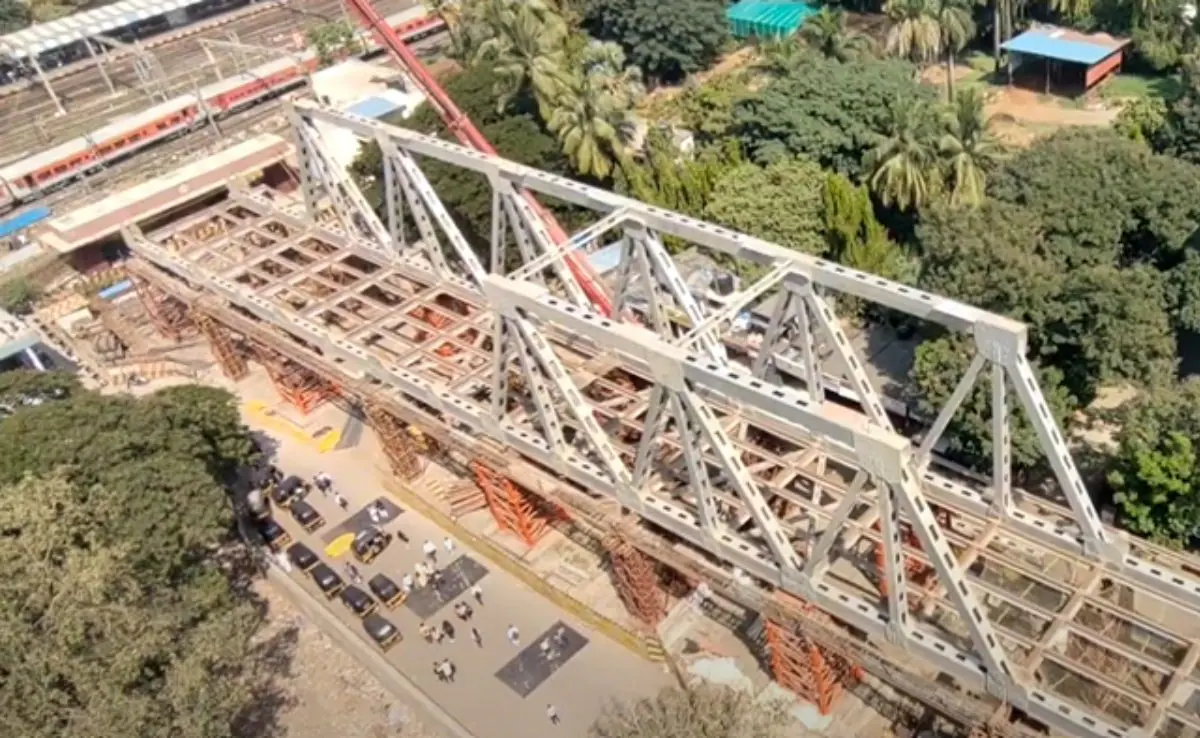
Mumbai’s eastern suburbs may need to brace for continued traffic bottlenecks as the long-awaited Vidyavihar Road Over Bridge (ROB) — which aims to connect Lal Bahadur Shastri Marg to Ramkrishna Chemburkar Marg — is now slated for completion in April 2026.
Initially tabled over three decades ago, this crucial civic infrastructure project has seen years of administrative delays, technical redesigns, and unforeseen obstacles, extending its completion timeline by another two years beyond the previously promised deadline of December 2024. The bridge, envisioned in Mumbai’s 1991 Development Plan, took nearly 25 years to move from blueprint to planning. It wasn’t until 2016 that concrete steps were initiated, only to be slowed again by revised engineering inputs from the Research, Design and Standards Organisation (RDSO) of the Indian Railways, which necessitated alterations in design. Work orders were issued in 2018, but construction momentum faltered due to the COVID-19 pandemic and a host of site-related challenges. For daily commuters from the eastern suburbs, especially in areas such as Ghatkopar, Kurla, and Chembur, the delay translates into long detours to cross the rail lines, intensifying traffic congestion and travel time. The absence of a direct connection has a tangible impact on both personal commute and commercial mobility — contributing to increased fuel consumption, pollution levels, and a strain on parallel infrastructure.
Multiple operational hurdles have dogged the bridge’s progress. Municipal engineers confirmed that around 80 encroachments had to be cleared, underground stormwater drains needed realignment, and railway-related utilities, including ticket counters, had to be relocated. Further delays stemmed from the transplantation and removal of trees, alongside a significant rise in the quantity of steel required — all of which strained timelines and budgets. While several other Road Over Bridges across Mumbai — including those at Vikhroli, Bhandup, and Ghatkopar — are also in different stages of development, few have definitive completion timelines. This piecemeal pace of infrastructure execution has drawn criticism from mobility planners and civic groups, especially in a metropolis that aims to be future-ready and environmentally resilient.
However, urban experts believe that when completed, the Vidyavihar ROB will significantly ease east-west connectivity in Mumbai’s dense suburban sprawl. For a city that depends on a complex lattice of rail and road networks to keep its economic engine running, such connections are not just urban upgrades — they are lifelines. The delay is a sobering reminder of the complex interplay between urban planning, ecological sensitivity, civic coordination, and public patience. While the revised completion target of April 2026 gives clarity to commuters and planners alike, the pressing need for speedier execution without compromising sustainability is evident.
In a city as fast-moving as Mumbai, where every kilometre of new infrastructure can bring down carbon emissions and commuting hours, timely completion of such bridges is more than a logistical milestone — it is a step towards inclusive, equitable, and climate-resilient urban mobility.
Also Read: https://urbanacres.in/bihar-receives-rs-13480-crore-boost-for-infrastructure-housing-and-rail-development/
Vidyavihar Road Bridge Now in 2026