


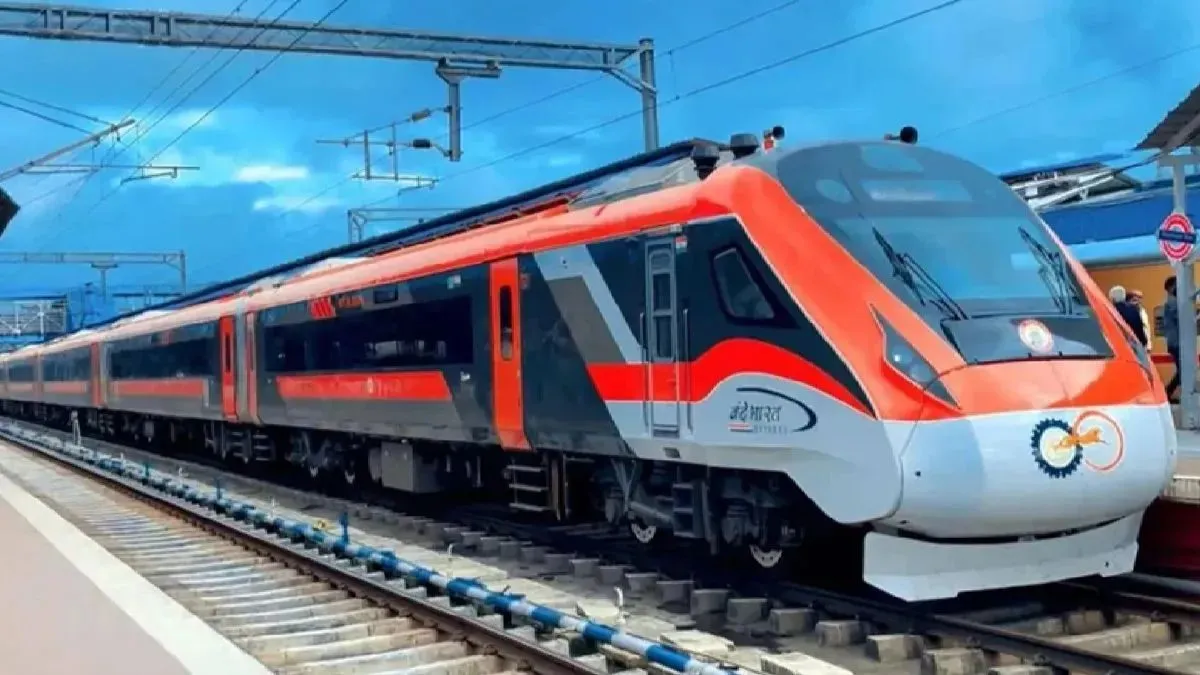
Mumbai’s long-awaited high-speed rail project has entered a crucial phase, with officials clarifying that the Mumbai-Ahmedabad corridor will be exclusively dedicated to the country’s first bullet train and will not host Vande Bharat services. The announcement comes amid growing public speculation that the upcoming high-speed version of the Vande Bharat might share the same track.
During a recent review of the 508-kilometre corridor, which includes a 21-kilometre tunnel breakthrough in Thane, officials emphasised that the bullet train and the Vande Bharat are designed on fundamentally different platforms. While both are viewed as modern solutions to India’s rising demand for fast and sustainable transport, they operate on separate technologies that cannot be merged. Experts note that the Vande Bharat, even in its next-generation version being developed for speeds of up to 250 kilometres per hour, cannot be deployed on the bullet train corridor. Instead, the Mumbai-Ahmedabad line has been engineered to host the Japanese E5 Series Shinkansen model, to be imported and adapted as per bilateral agreements between India and Japan. The clarification effectively closes the door on speculation about dual operations, reinforcing the government’s commitment to dedicated infrastructure for the bullet train project.
The decision also signals India’s intent to build a future-ready rail ecosystem that separates conventional upgrades from international high-speed standards. Rail experts argue that such differentiation is vital for safety, efficiency, and carbon neutrality, as mixing platforms would compromise both design integrity and operational sustainability. Beyond technology, officials also addressed community concerns emerging from large-scale construction. Residents near the tunnel zones in Maharashtra have raised complaints of damage to homes. Responding to these, officials confirmed that independent surveys, including expert inputs from premier institutes, have been carried out on nearly 80 affected houses. Mitigation measures and standardised precautionary documents are being prepared to ensure that residents living within sensitive construction zones are adequately informed and safeguarded. These documents will be shared with state governments for approval before being implemented locally.
The Mumbai-Ahmedabad bullet train, once operational, is projected to significantly cut travel time between the two cities and redefine intercity mobility in western India. Positioned as a flagship project in India’s push for sustainable transport, the corridor is expected to not only deliver speed and convenience but also contribute to reduced carbon emissions by encouraging a shift from air and road to electrified rail. While the Vande Bharat series will continue to evolve as India’s premium semi-high-speed service on conventional routes, the Mumbai-Ahmedabad project will remain a dedicated high-speed rail corridor built to global benchmarks. For commuters, the message is clear: the future of mobility will involve both platforms, but on separate tracks, each with a distinct role in India’s transport transformation.
Also Read : Mumbai Railway Network To Introduce Automatic Doors On Suburban Trains From December 2025
