


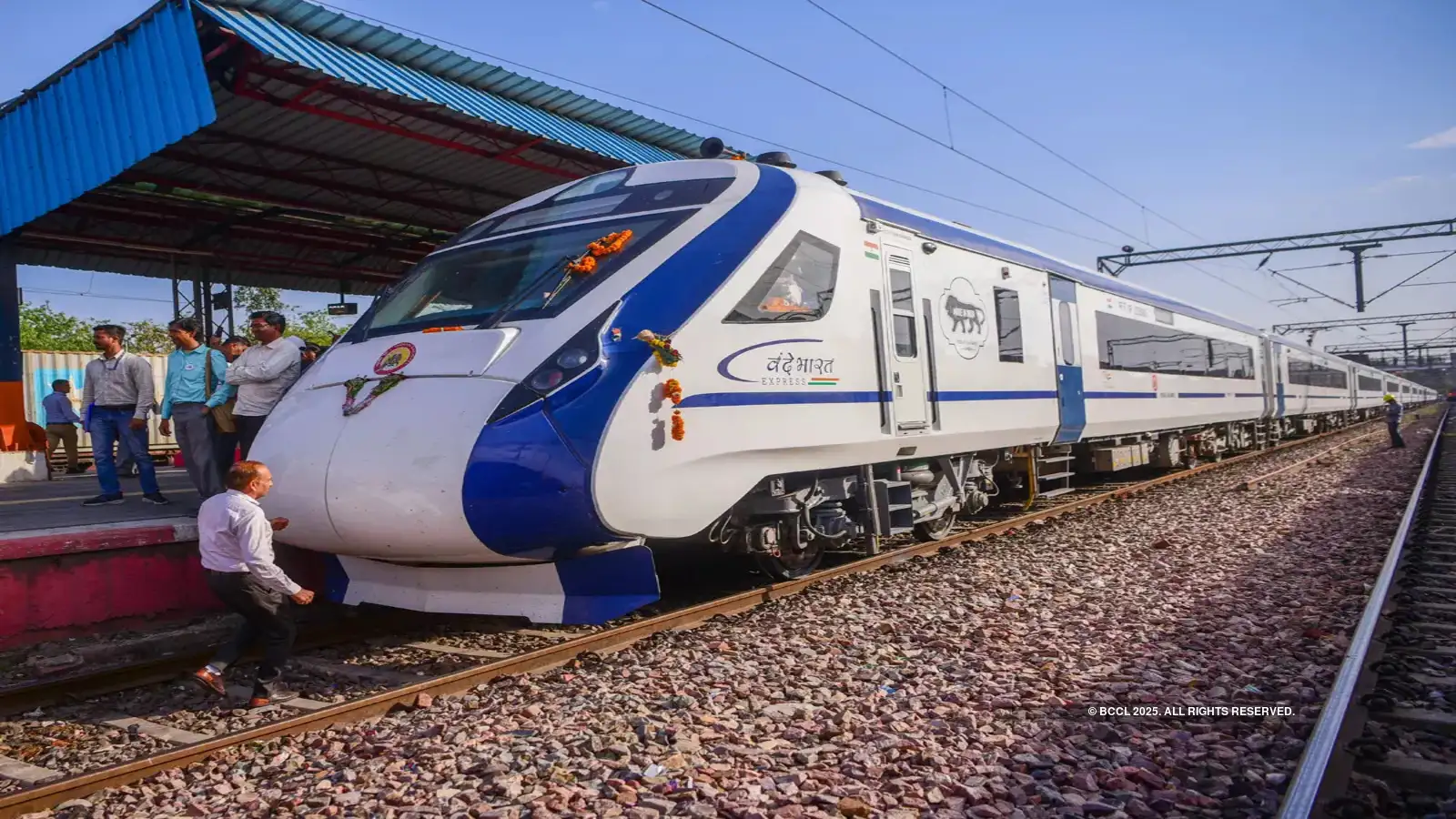
Indian Railways has confirmed that five Vande Bharat Express trains now operate consistently at 130 kilometres per hour across their entire routes, marking a significant step in India’s journey towards faster, more efficient, and sustainable rail mobility.
Since their debut in 2019, Vande Bharat trains have transformed intercity travel with faster turnarounds and improved passenger experience. Manufactured at the Integral Coach Factory in Chennai, these semi-high-speed trains are designed for a top speed of 180 kmph, although operational safety norms limit them to 160 kmph. At present, only five services are able to maintain a steady 130 kmph speed for their full journey, owing to track readiness and route upgrades. The trains currently running at this optimal speed include the Bilaspur–Nagpur, Howrah–Patna, Ahmedabad–Mumbai Central, Howrah–Gaya and Nagpur–Secunderabad services. Officials explained that these corridors have undergone substantial track modernisation, enabling sustained high-speed operations that are both safe and efficient.
While several other Vande Bharat services touch 130 kmph on certain sections, operational constraints such as older track geometry, congestion, and maintenance activity restrict uniform speeds across their routes. For example, the Varanasi–New Delhi service maintains 130 kmph between Delhi and Prayagraj but slows down beyond. Similar limitations exist on the New Delhi–Katra route, where the stretch beyond Ludhiana sees reduced operating speeds. Experts note that the achievement of uniform 130 kmph operations on five corridors signals that Indian Railways’ decade-long investment in track strengthening, advanced signalling, and route electrification is paying dividends. However, they caution that full-scale adoption will require sustained funding and technical upgradation across the network, especially in high-density passenger corridors.
Beyond speed, officials emphasise that Vande Bharat trains align with the national vision for sustainable transport. The fully electrified operations reduce dependence on fossil fuels and cut per-capita emissions compared to road and air travel. Moreover, faster services encourage passengers to shift from private vehicles to railways, easing congestion and lowering urban carbon footprints. Rail experts argue that improved speed also has direct economic benefits, reducing travel time for business travellers and enhancing regional connectivity for emerging economic hubs. With passenger demand for Vande Bharat trains remaining consistently high, operating at full design potential could redefine long-distance mobility in India.
Indian Railways maintains that progressive upgrades are underway, and more corridors will soon support 130 kmph operations end-to-end. The momentum, they believe, is not only about speed but about shaping an energy-efficient, eco-friendly, and future-ready mobility system for the country.
Also Read : Indian Rail Audit Finds Poor Toilet Cleanliness And Coach Hygiene Troubling Passengers
