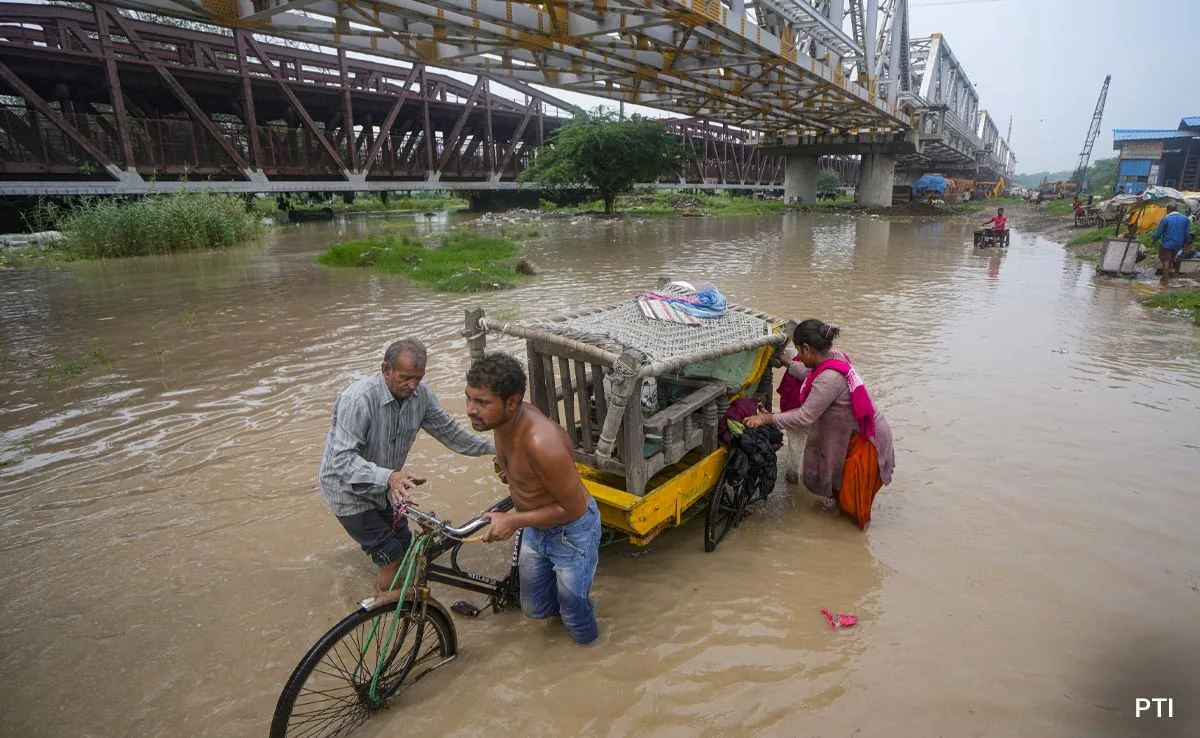
Uttar Pradesh battered by monsoon fury as highways crumble rivers swell and flood alerts hit multiple districts
Uttar Pradesh is grappling with one of its most chaotic monsoon seasons in recent years, as relentless rains have triggered a cascade of disasters across the state. From highways collapsing to rivers breaching danger marks, districts are on high alert and emergency response teams are racing against time to contain the mayhem. On Thursday morning, the Lucknow-Varanasi highway turned into a disaster zone when a 20-foot stretch caved in near the Gilat Bazaar police outpost in Varanasi.
The incident injured one person and sent concrete debris crashing around police barricades. Locals, without waiting for authorities, jumped into action to rescue the injured man — an eerie reminder of how infrastructure fragility and weather volatility continue to collide with disastrous consequences in the state. This collapse wasn’t an isolated event. Just two days earlier, a roadways bus had gotten stuck at the same spot — a near miss that raised serious concerns about the condition of critical intercity highways. With the monsoon only intensifying, such events may become alarmingly frequent.
In Gonda, the Saryu river overflowed its banks unexpectedly, submerging portions of a major road and swallowing a bulldozer parked nearby. The heavy construction equipment had to be retrieved with a crane as floodwaters continued to rise around the area. Authorities have since declared a flood alert in two tehsils of the district, fearing that low-lying villages might soon be inundated. Farrukhabad is walking a tightrope as the Ganga river rises ominously, currently flowing at 136.60 meters — a mere 50 centimeters short of the official danger mark. Agricultural land in Amritpur and Kayamganj has already been submerged, threatening the livelihood of hundreds of farmers who now stare at the prospect of crop failure just as the kharif season gains momentum.
Meanwhile, in Prayagraj, the twin rivers — Ganga and Yamuna — are creeping toward danger levels. Local authorities have suspended boat services as a precautionary measure, and flood shelters are being prepared on a war footing. The district administration has also warned locals to avoid riverbanks and congested slum areas vulnerable to flash floods. In spiritual capital Varanasi, the situation is no better. The Ganga is rising at a concerning rate of 10 centimeters per hour and is currently flowing at 62.52 meters. Several ghats have already been consumed by water, including parts of Dashashwamedh and Assi Ghats. The Ratneshwar Mahadev Temple, often used as a gauge of the Ganga’s wrath, is now 60% submerged — an ominous sight that has locals worried and pilgrims visibly anxious.
The India Meteorological Department (IMD) has sounded the alarm for continued rainfall across the state, forecasting heavy showers for at least five more days. Ten districts — including Lakhimpur Kheri, Bahraich, Barabanki, Sitapur, and Shravasti — are under orange alert, with the possibility of very heavy rain and localized flooding. Over the last 24 hours alone, Lakhimpur Kheri recorded 212 mm of rainfall, the highest in the state and more than double the seasonal norm. This has contributed to rapid water accumulation in both urban and rural pockets. The statewide rainfall average has been recorded at 6.2 mm in the last 24 hours — which is 13% above the normal average for this period. While rainfall is a lifeline for agrarian Uttar Pradesh, the sheer intensity and erratic distribution of this season’s downpour are proving destructive. Rainwater drainage systems in most towns remain overwhelmed, and many village-level roads have either washed away or become dangerously slippery, cutting off entire hamlets from essential services.
In response to the crisis, the State Disaster Response Force (SDRF) has been activated in multiple districts. Teams equipped with boats, ropes, and first-aid kits have been deployed in Gonda, Barabanki, and Varanasi, among others. The National Disaster Response Force (NDRF) has also been put on standby, especially in districts where river levels are expected to breach danger marks within the next 48 hours. Chief Minister Yogi Adityanath has directed district magistrates to remain on high alert and ensure that early warning systems are functional. Relief materials, including dry rations, potable water, tarpaulins, and medicine kits, have been stocked in flood-prone areas. The state government has also instructed the Public Works Department (PWD) to carry out emergency assessments of key roads and bridges.
Social media platforms are abuzz with images and videos of inundated farmlands, waterlogged roads, and vehicles struggling through waist-deep water. Citizens have been urged to avoid unnecessary travel, especially at night, and to report any structural damages or landslides to the nearest local authority. Environmental experts warn that this could be a preview of monsoons to come, as climate change continues to exacerbate rainfall patterns in northern India. “We’re seeing more high-intensity rain over shorter durations,” said a climate scientist at the Indian Institute of Science. “This is particularly dangerous in regions like Uttar Pradesh, where infrastructure isn’t built to handle such sudden stress.”
For now, the focus remains on survival and response. With floodwaters showing no signs of receding and the IMD’s radar flashing red, Uttar Pradesh stands on the edge of a watery emergency — one that could intensify without swift, coordinated action.