


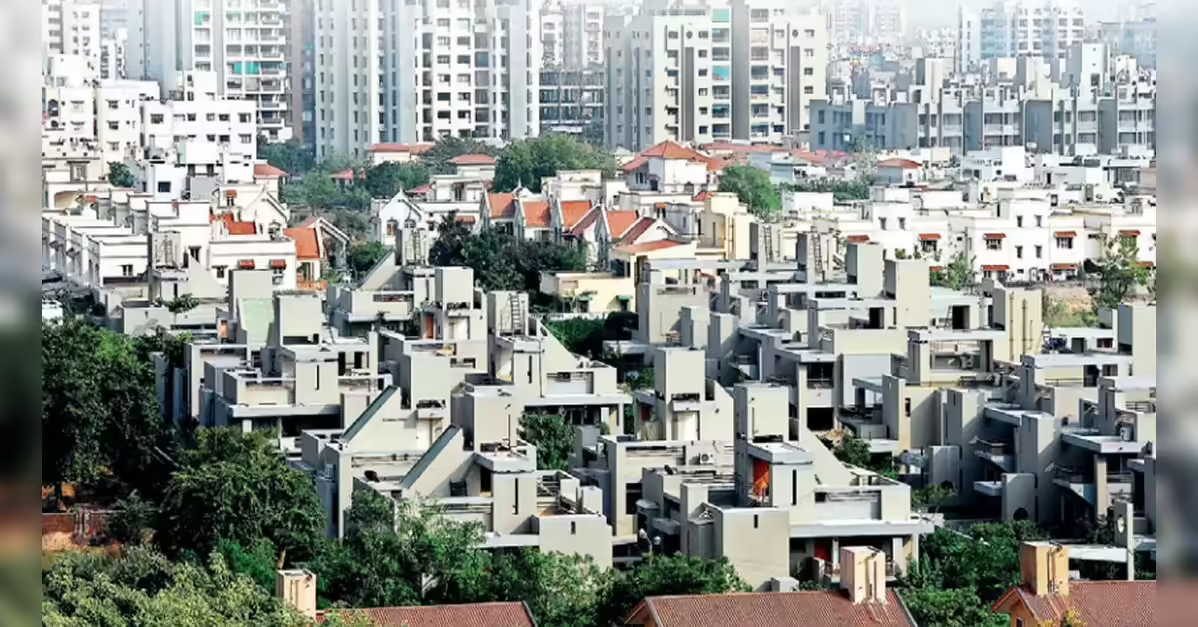
Uttar Pradesh’s real estate sector recorded a decisive upswing in 2025, marked by a sharp rise in project registrations, capital deployment and approved housing and commercial supply. The expansion reflects a structural shift in how India’s most populous state is urbanising moving beyond speculative growth towards regulated, infrastructure-led development with implications for housing access, employment and long-term city resilience.
Project approvals increased significantly over the year, accompanied by a steep jump in investment value, signalling renewed confidence among developers and financial institutions. While the National Capital Region continued to anchor activity, growth was not limited to its traditional urban core. A rising share of new projects emerged from non-NCR districts, indicating a more geographically balanced development pattern aligned with state-led transport and urban renewal programmes. Noida remained the single largest contributor, driven by scale, connectivity and sustained demand for mid-to-premium housing and mixed-use assets. However, Tier-2 cities such as Lucknow, Agra, Mathura and Bareilly demonstrated increasing traction, supported by highway expansion, metro extensions, logistics corridors and public investment in civic infrastructure. Urban planners note that this dispersion reduces pressure on megacities while creating new employment centres closer to where people live. The surge in approved residential units points to a gradual correction in supply shortages that have historically pushed affordability out of reach for many households. A parallel rise in commercial units shops, offices and small-format workspaces suggests cities are preparing for localised economic ecosystems rather than commuter-dependent urban models.
This approach aligns with climate-resilient planning principles by lowering travel distances and energy demand. Investment momentum was also visible in pilgrimage and heritage cities, where redevelopment, tourism infrastructure and public realm upgrades have improved economic viability. Analysts caution, however, that such growth must be accompanied by strict environmental safeguards to prevent strain on water systems, waste management and fragile urban fabrics. Compared with mature markets such as Bengaluru where land scarcity and regulatory complexity have slowed new supply Uttar Pradesh currently offers scale, policy clarity and lower entry barriers. Yet experts argue that sustaining this advantage will depend on timely project delivery, enforcement of buyer protections and integration of green building norms.
Looking ahead, the challenge for Uttar Pradesh will be to convert volume-driven growth into quality urban outcomes. As cities expand, the focus must shift towards inclusive housing, last-mile infrastructure, climate adaptation and governance capacity. If executed well, the state’s 2025 performance could mark a turning point in how large Indian regions urbanise steadily, transparently and with people at the centre.
Also Read:
UP Housing And Commercial Supply Expand Sharply In 2025
