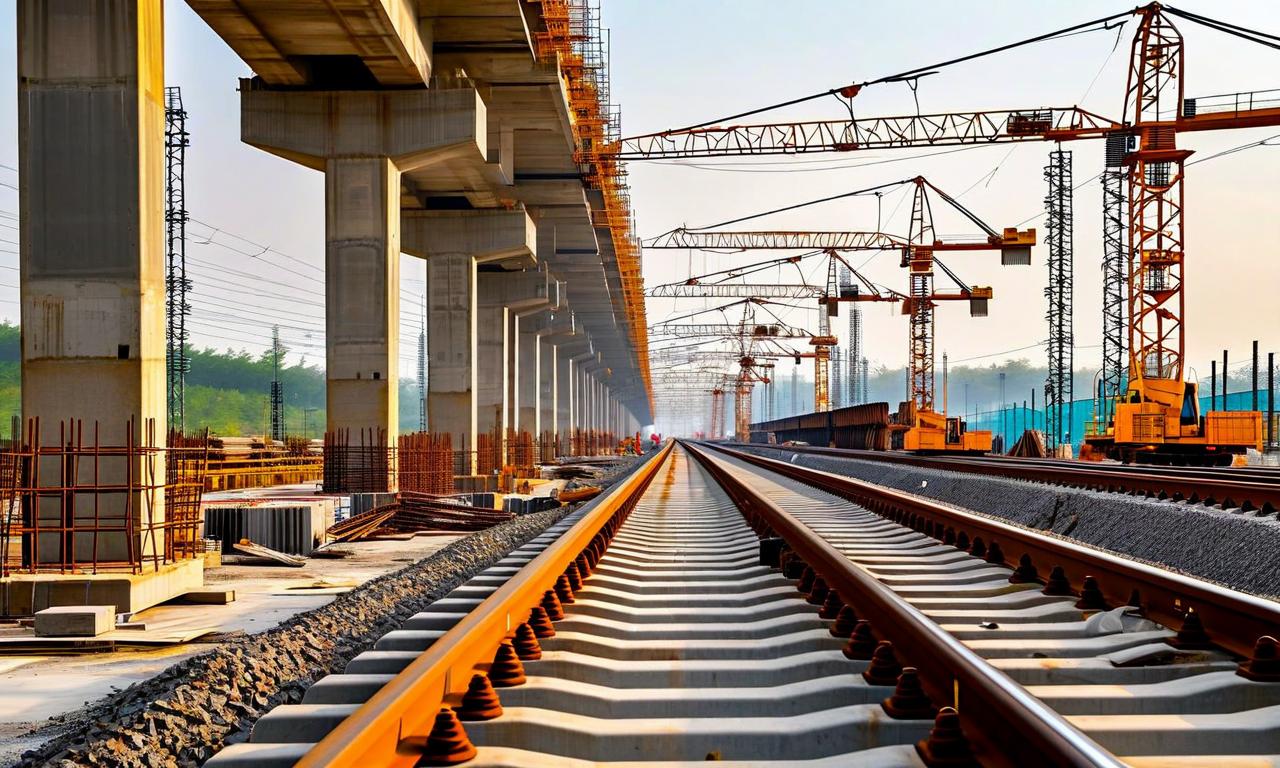
Univastu India has secured a new civil construction assignment linked to India’s flagship high-speed rail programme, marking a strategic milestone for the infrastructure contractor as it deepens its presence in complex railway projects. The contract, awarded by a leading engineering and construction major, relates to traction power infrastructure for the Mumbai–Ahmedabad High Speed Rail corridor and adds near-term visibility to the company’s execution pipeline.
The scope of work involves constructing civil buildings for traction power supply installations at two designated locations along the high-speed rail alignment. These facilities form a critical part of the railway’s electrical backbone, enabling stable power distribution for train operations. The project is scheduled for completion within a four-month timeframe, indicating a fast-track execution cycle typical of specialised railway packages. Urban infrastructure experts note that while the contract value is modest in comparison to large viaduct or station works, its significance lies in the nature of the assignment. High-speed rail systems demand strict adherence to technical standards, precision in civil execution and close coordination with electrical and systems contractors. Participation in such packages signals growing capability among mid-sized Indian firms to deliver components of advanced rail networks.
The Mumbai–Ahmedabad corridor, implemented using Japanese Shinkansen technology, is widely viewed as a test case for future high-speed rail lines in India. Beyond intercity travel, planners see the project as a catalyst for lower-carbon mobility by shifting long-distance passengers away from road and air travel. Supporting infrastructure such as traction substations and integrated depots plays a vital role in ensuring energy efficiency and operational reliability. For Univastu India, the order also strengthens its relationship with tier-one contractors and enhances its credentials in power-linked railway works. Industry analysts point out that such associations often improve pre-qualification prospects for larger tenders, particularly as India accelerates investment in rail electrification, metro expansion and high-speed corridors.
Financially, the company has reported steady growth in recent quarters, supported by a healthy order book with a strong concentration in Maharashtra. This geographic focus aligns with the state’s sustained infrastructure push across metro rail, highways and logistics corridors. However, analysts also flag the importance of diversification across regions and asset classes to manage execution risk and market cycles. From a broader urban development perspective, the steady flow of contracts into rail and power infrastructure underscores a structural shift in public investment priorities. Electrified rail systems are increasingly central to climate-resilient transport strategies, reducing emissions while improving regional connectivity and economic integration.
As construction activity on the high-speed rail corridor gathers pace, attention will turn to execution quality and coordination across multiple contractors. For firms like Univastu India, timely delivery on technically demanding packages could open doors to more complex roles in India’s evolving rail infrastructure landscape.
Univastu India Enters High Speed Rail Works