


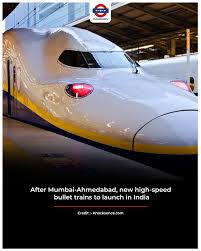
India’s ambitious high-speed rail projects are poised to redefine the nation’s transportation landscape, driving economic growth and promoting sustainable mobility.
With a focus on enhancing connectivity between major urban centers, these initiatives aim to reduce travel time, alleviate road congestion, and contribute to environmental goals. The Indian government has allocated significant resources to the development of high-speed rail corridors. The Mumbai–Ahmedabad High-Speed Rail Corridor, India’s first bullet train project, is under construction with an expected completion date of 2028. This 508-kilometer corridor will utilize Japan’s Shinkansen technology, including rolling stock, signaling, and design standards, with technology transfer to support the ‘Make in India’ initiative.
In the 2025/26 Union Budget, the Ministry of Railways received an allocation of ₹2.65 lakh crore, underscoring the government’s commitment to modernizing the railway sector. This funding supports the expansion of the rail network and the addition of 400 high-speed Vande Bharat trains by March 2027. Alstom, a global leader in smart and sustainable mobility, has been instrumental in advancing India’s high-speed rail capabilities. The company supplied traction components and maintenance services for the Vande Bharat sleeper trains, aligning with the country’s ‘Atmanirbhar Bharat’ vision.
Furthermore, Alstom’s involvement in the NaMo Bharat project introduced the world debut of European Train Control System (ETCS) Level 3 signaling, enhancing safety and efficiency in India’s rail network. The implementation of high-speed rail systems is expected to stimulate economic growth by improving productivity and creating job opportunities. By providing a viable alternative to air and road travel, high-speed trains can reduce carbon emissions, contributing to India’s sustainability goals. As Sudhanshu Mani, former General Manager of Integral Coach Factory, noted, “Rail as a mode of transport is much cleaner than road and air and, therefore, it is a necessity for the future.”
Despite the promising prospects, the development of high-speed rail in India faces challenges, including land acquisition, financing, and integration with existing infrastructure. However, the government’s commitment to infrastructure development and the involvement of private players like Alstom are expected to address these issues. With the continued focus on innovation and sustainability, India’s high-speed rail projects are set to transform the nation’s transportation system, fostering economic growth and contributing to environmental preservation.
Also Read: Thane-Vashi Train Services Suspended Following Girder Tilt, Causing Commuter Chaos
