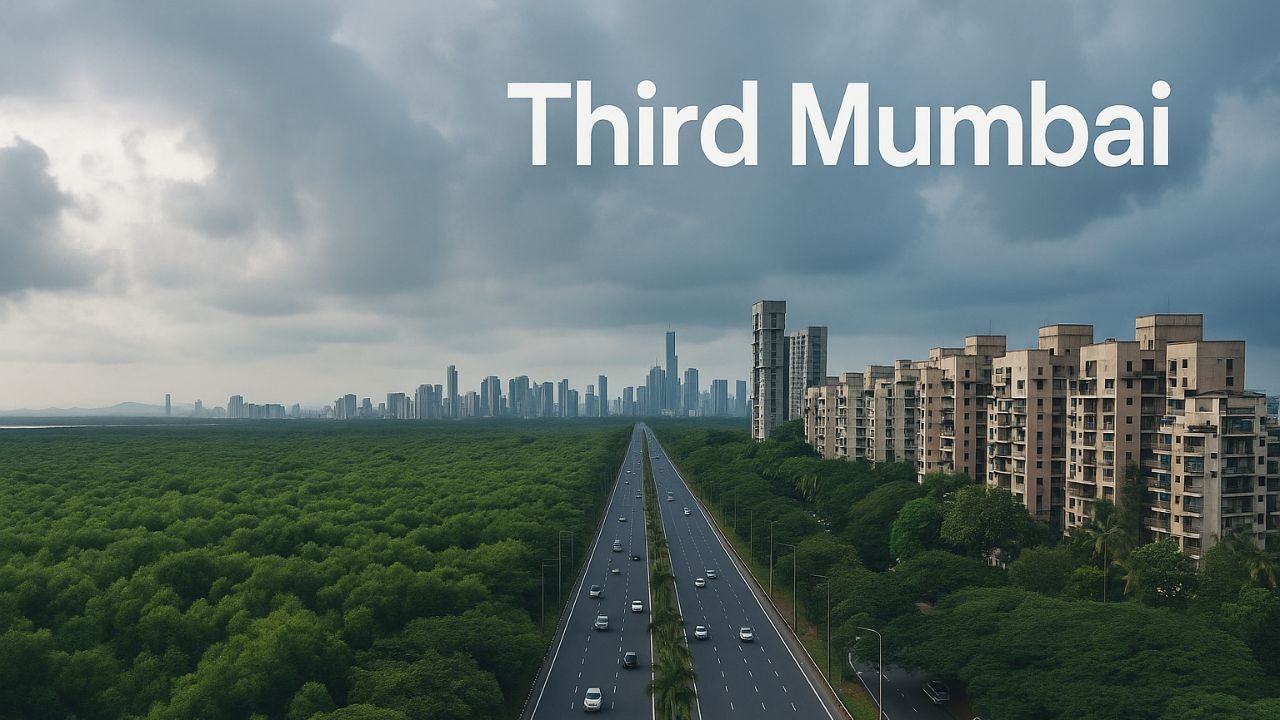
Maharashtra’s long-term urban expansion strategy received a significant boost at the World Economic Forum in Davos, with the state announcing investment commitments worth nearly ₹1 lakh crore for the Third Mumbai region. The proposed urban cluster, planned beyond the existing Mumbai Metropolitan Region, is being positioned as a future-ready economic zone aimed at easing pressure on the current financial capital while creating new centres of employment and housing.
Senior state officials confirmed that the Raigad–Pen belt has been identified as the first designated growth centre within Third Mumbai. This zone is expected to anchor the initial phase of development, with plans for integrated industrial, residential, educational, and healthcare infrastructure. Urban planners involved in the project describe it as a deliberate move away from fragmented urban sprawl towards structured, infrastructure-led city building. Third Mumbai is being conceptualised at a scale larger than the existing metropolitan core, reflecting the state’s assessment that incremental expansion alone can no longer address Mumbai’s housing shortages, congestion, and environmental stress. By directing large investments into a planned greenfield region, policymakers aim to distribute economic activity more evenly across the wider region while reducing daily migration pressure on the island city and suburbs.
Industry experts note that the investment announcements signal growing investor confidence in long-horizon urban projects linked to logistics, manufacturing, services, and knowledge-based sectors. Proximity to upcoming transport corridors, ports, and the new international airport is expected to play a critical role in shaping land use and real estate demand in the Raigad district. However, analysts caution that timely delivery of trunk infrastructure—roads, rail links, water supply, and power—will determine whether projected investments translate into on-ground development. From a sustainability perspective, Third Mumbai is being framed as an opportunity to embed climate resilience into city planning from the outset. Officials indicated that future development would prioritise public transport, mixed-use zoning, and resource-efficient infrastructure. Urban economists point out that building compact, transit-oriented growth centres could lower long-term emissions and infrastructure costs compared to retrofitting dense, already-built urban areas.
The designation of Raigad–Pen as the first growth centre is also expected to have socio-economic implications for surrounding towns and villages. If managed carefully, the transition could generate new livelihoods and improve access to social infrastructure. However, experts emphasise the need for transparent land policies, affordable housing provisions, and skills development to ensure that local communities benefit from rising investment flows. As planning moves from announcements to implementation, the success of Third Mumbai will depend on governance coordination across agencies and sustained public investment alongside private capital. For Maharashtra, the project represents both an economic opportunity and a test case in whether large-scale urban expansion can be delivered in a more balanced, inclusive, and climate-conscious manner than past growth cycles.
Third Mumbai Emerges As New Growth Corridor