


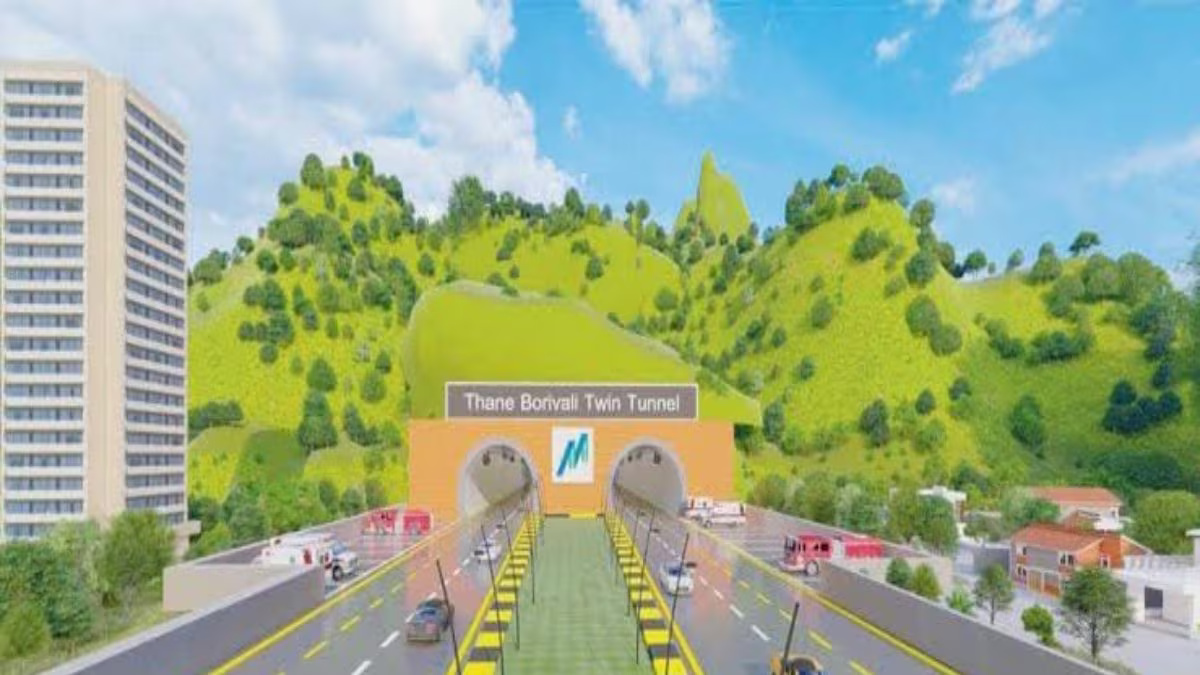
The Mumbai Metropolitan Region Development Authority (MMRDA) is set to begin the most technically demanding phase of the Thane–Borivli twin tunnel project, as boring work through the eco-sensitive Sanjay Gandhi National Park (SGNP) commences under strict environmental supervision. Once complete, the 11.8-kilometre tunnel will slash travel time between the eastern and western suburbs from 90 minutes to just 15 minutes, significantly improving mobility and reducing vehicular congestion across Mumbai’s northern corridor.
Officials confirmed that the ramp structure for lowering two massive tunnel boring machines (TBMs) at the Thane site is nearing completion. These TBMs, sourced from Chennai, will advance roughly 11 metres per day through the basaltic hills beneath SGNP at an average depth of 60 metres. The project, which carries a late-2029 completion target, is being implemented by MMRDA and executed by Megha Engineering and Infrastructures Ltd (MEIL). According to senior officials, monsoon-related disruptions had briefly slowed progress, but with the onset of dry conditions, construction activity has accelerated. The Thane casting yard is fully operational, while the Borivli casting yard is nearing readiness. Land acquisition at Thane has been largely completed, with rehabilitation of project-affected families progressing on the Borivli side.
Given the tunnel’s alignment beneath SGNP—Mumbai’s largest green lung—comprehensive environmental safeguards have been integrated into every construction stage. The Wildlife Institute of India (WII), Dehradun, will oversee all drilling operations, monitoring potential effects on wildlife habitats and migration patterns. “The use of advanced tunnel boring technology will ensure minimal surface vibration and negligible disturbance to the park’s ecosystem,” a project engineer said. Each of the two tunnels will include three lanes—two for traffic and one for emergency use—along with cross-passages every 300 metres for safety. The design also includes sophisticated ventilation and fire-safety systems, real-time air quality monitoring, smoke detection, and illuminated digital signboards for dynamic guidance.
Urban mobility experts have hailed the Thane–Borivli tunnel as a transformative link for Mumbai’s overburdened road network. “This project will significantly decongest the Ghodbunder Road and Western Express Highway corridors while cutting emissions from idling vehicles,” said an infrastructure analyst. The reduced travel time is also expected to spur inter-suburban economic activity and improve access to employment hubs. While the project remains a technical and environmental challenge, it represents a key milestone in Mumbai’s efforts to build sustainable transport infrastructure. By combining mobility improvement with ecological protection, the Thane–Borivli tunnel could set a precedent for future urban tunnelling projects across India.
Also Read: Dadar’s Walking Woes Addressed in Priority Repair Drive
