


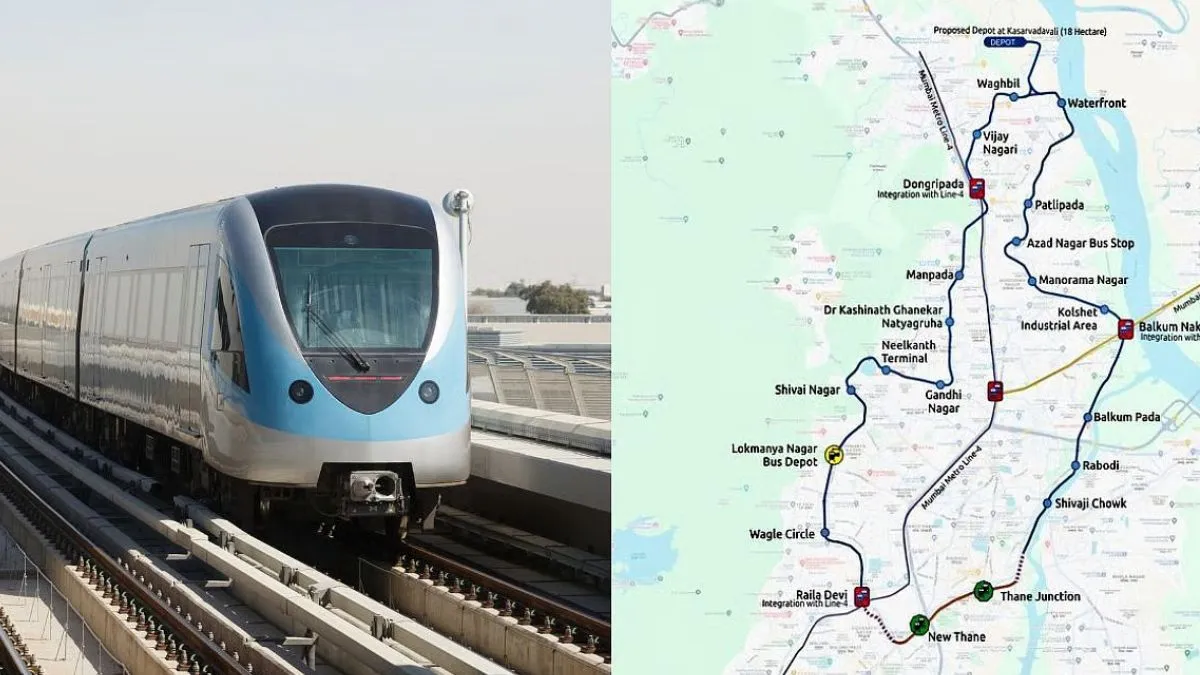
Thane’s much-awaited Internal Ring Metro project is set to enter its execution phase, with civil work expected to commence in November. The 29-kilometre circular corridor, worth ₹12,200 crore, aims to redefine urban mobility across the city by creating a seamless and eco-friendly public transport network connecting major residential, business and transport hubs.
Officials from the Maharashtra Metro Rail Corporation Limited (Maha Metro), the implementing agency, confirmed that pre-bid formalities have been completed and tendering activities are now underway. The project received final approval from the Union Cabinet in August 2024 and is projected to be operational by 2029, serving nearly 6.5 lakh passengers daily. The Thane Internal Ring Metro will form a loop around the city’s western belt, linking key areas such as Wagle Estate, Lokmanya Nagar, Kolshet Industrial Area, Manpada and Thane Junction. The corridor will have 22 stations, including 20 elevated and two underground ones, covering the stretch between the Ulhas River and Sanjay Gandhi National Park. This design aims to ensure both functional efficiency and minimal environmental disruption during construction.
According to transport experts, the metro will significantly reduce traffic congestion, which currently plagues arterial roads such as Ghodbunder Road and Pokhran Road. By shifting daily commuters from private vehicles to mass transit, the project will also help curb vehicular emissions, contributing to Maharashtra’s broader clean mobility and zero-carbon targets. Officials highlighted that funding for the project will come through a multi-source model—featuring contributions from the Centre, the State, bilateral agencies and revenue generation through innovative mechanisms like station naming rights and asset monetisation. Such a model aligns with the government’s focus on sustainable infrastructure financing, ensuring long-term viability beyond fare-based revenue.
Urban planners note that the Thane Metro represents a critical step in developing integrated urban transport within the Mumbai Metropolitan Region (MMR). It complements existing suburban rail, BEST and MSRTC networks, improving first- and last-mile connectivity. The line will particularly benefit working professionals, students, and residents travelling between residential pockets and business hubs like Wagle Estate and Manpada. Experts believe that once operational, the system will not only enhance Thane’s accessibility but also reshape its economic geography. Improved connectivity is expected to boost real estate development, attract new businesses, and make the city more liveable by reducing commute times and pollution levels.
The project underscores the government’s intent to deliver people-centric, sustainable infrastructure that balances growth with environmental sensitivity. If executed efficiently, the Thane Internal Ring Metro could become a model for mid-sized Indian cities striving to create integrated, low-carbon mobility systems.
Also Read: Mumbai footpath uprooted again as Santacruz residents protest civic chaos
