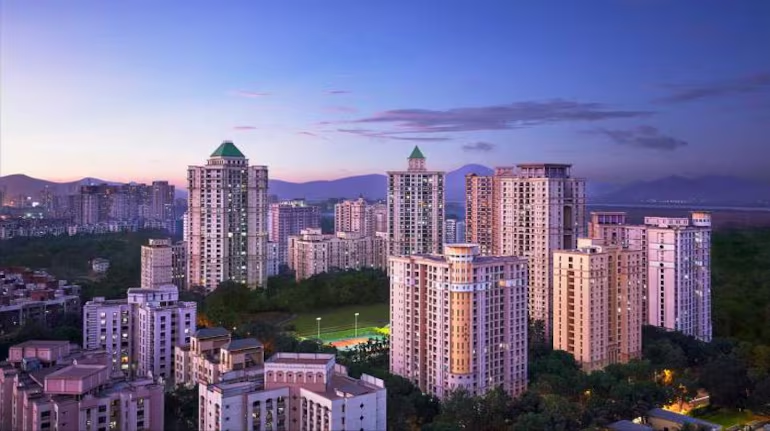
Thane Hiranandani Estate Expands With Cinema Experience
A new luxury cinema launch at a large integrated township in Thane is highlighting how residential developments are evolving into self-contained urban ecosystems, where lifestyle infrastructure is increasingly embedded within housing projects.
Real estate developer House of Hiranandani has partnered with Devgn CineX to introduce a multi-screen cinema within Hiranandani Estate, marking the first such facility inside the 375-acre township. The multiplex, located at The Walk within the development, is designed to serve a resident base of over 10,000 families alongside the surrounding urban catchment. The facility comprises five screens with a seating capacity of nearly 1,000 and is equipped with advanced digital projection and sound systems. This addition reflects a growing trend where residential townships are integrating entertainment, retail, and social infrastructure to reduce dependence on external urban centres.
Hiranandani Estate, with more than 150 residential towers and a mix of commercial, educational, and healthcare facilities, already functions as a micro-urban cluster. The inclusion of a cinema completes what planners describe as a “last-mile lifestyle layer”—bringing leisure and cultural amenities closer to where people live and work.Urban development experts note that such integrated planning models are becoming increasingly relevant in metropolitan regions like the Mumbai Metropolitan Region. As cities expand and commute times lengthen, there is rising demand for neighbourhoods that offer access to daily needs—including recreation—within a walkable radius.
The partnership also signals the convergence of real estate and experiential infrastructure. Cinema operators are increasingly looking to tap into captive residential audiences within large townships, while developers are using such amenities to enhance the long-term value and attractiveness of their projects.The concept aligns with broader principles of compact urban growth. By embedding social and entertainment infrastructure within residential clusters, such developments can reduce travel demand, lower congestion, and improve quality of life. This approach is particularly relevant for peripheral urban zones like Thane, which are witnessing rapid population growth and infrastructure expansion.
At the same time, the model raises questions about inclusivity and accessibility. While integrated townships offer convenience, they can also create semi-contained environments that may not always be accessible to the wider public. Urban planners emphasise the need to ensure that such developments remain connected to broader city systems rather than functioning as isolated enclaves.From a sustainability perspective, reducing travel for leisure activities can contribute to lower emissions and more efficient urban resource use. However, the long-term impact will depend on how these developments integrate with public transport networks and surrounding infrastructure.The entry of Devgn CineX into Thane also reflects the changing dynamics of the entertainment sector, where premium viewing experiences are being localised within residential and mixed-use developments rather than concentrated in standalone malls.
As Indian cities continue to densify, the integration of housing with lifestyle infrastructure is likely to become a defining feature of urban development. Projects like this suggest a shift towards neighbourhood-centric planning, where the focus is not just on building homes, but on creating complete, self-sustained urban environments.