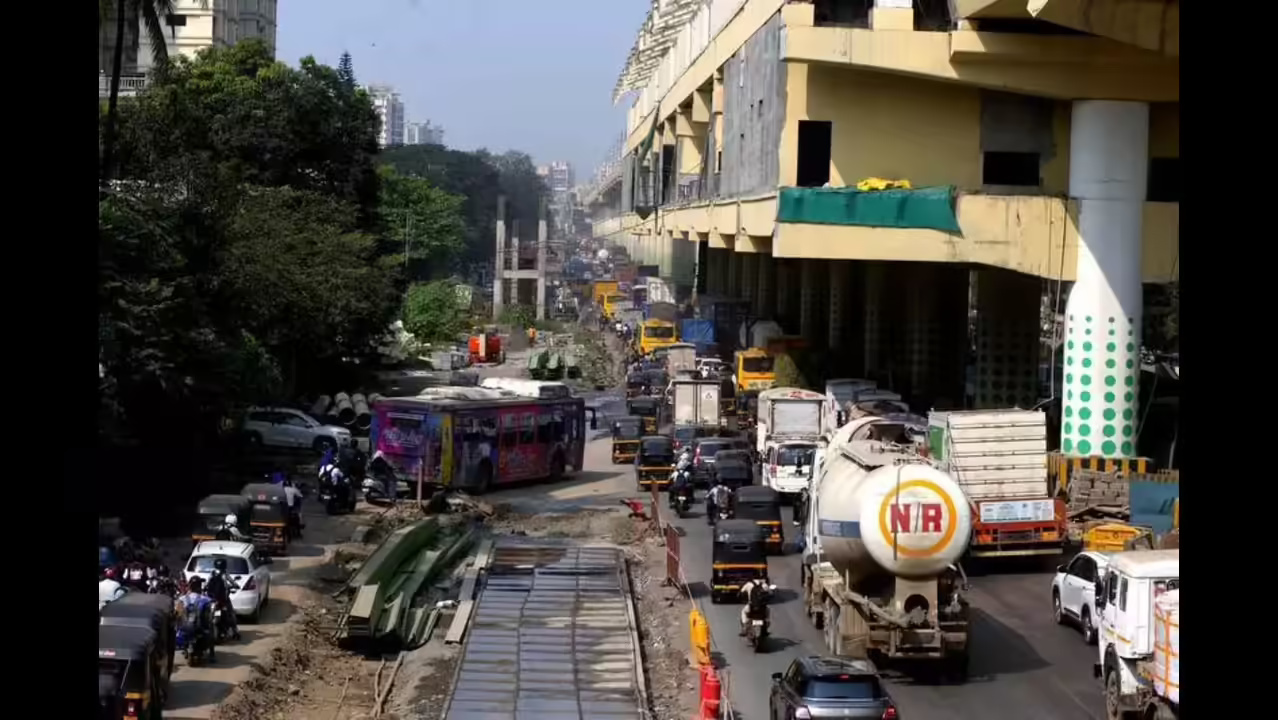
Thane’s Ghodbunder Highway widening project has run into another setback, with officials confirming that a vast network of overhead and underground electricity lines was not accounted for in the original design. The oversight is expected to raise project costs by nearly ₹90 crore and push timelines well beyond the previously stated January 2026 target, raising concerns about planning quality and long-term mobility outcomes for one of the region’s busiest corridors.
The project, already costing more than ₹600 crore, has been underway for several years and involves widening a key arterial road that connects Mumbai’s western suburbs with Thane and beyond. Commuters have endured prolonged disruptions, including dust, noise and traffic diversions, while thousands of trees have been felled to make way for the expansion. Officials now admit that nearly 22km of power lines running along both sides of the highway between Kapurbawdi and Gaimukh must be relocated—a task that will require fresh approvals, procurement rounds and coordination among multiple agencies. According to officials involved in the review, several electricity poles that once stood along the footpath or service roads now sit in the middle of the expanded carriageway. This has already resulted in safety hazards, including a recent accident where a city bus struck a pole near Manpada. While there were no injuries, the incident underscored the risks of incomplete utility planning on an already congested stretch.
The delay has triggered friction between the implementing agencies, with neither the regional development authority nor the city corporation willing to absorb the additional relocation cost. A proposal has now been sent to the state government seeking financial support. An official described the situation as a “planning gap that could have been avoided with integrated design audits”, noting that fragmented decision-making continues to undermine large-scale infrastructure execution across metropolitan regions. Urban planners say the situation reflects a persistent challenge in Indian cities, where infrastructure development advances without holistic assessments of existing utilities or future mobility needs. Experts emphasise that utility mapping, climate resilience and citizen safety must be institutionalised within major transport projects, particularly in rapidly growing regions like Thane where road networks are already under pressure. More sustainable approaches—such as prioritising mass transit and designing for lower carbon mobility—should also guide long-term strategies to reduce dependence on highway expansion alone.
Officials concede that the January 2026 completion target is “no longer realistic”, though no agency is willing to formally acknowledge another extension. The project’s difficulties follow earlier criticism directed at a regional transport authority for design flaws on a nearby metro corridor, where stairways were found to open directly onto the highway. While corrective work was later ordered, urban analysts argue that the recurring lapses point to deeper systemic issues around coordination and accountability. For now, commuters may face continued delays as authorities rework timelines. Observers note that resolving the utility challenge swiftly, while strengthening integrated planning frameworks, will be essential if Thane is to build infrastructure that supports safe, sustainable and equitable urban growth.
Thane Ghodbunder Highway Expansion Delayed After Power Line Issues Surface Again