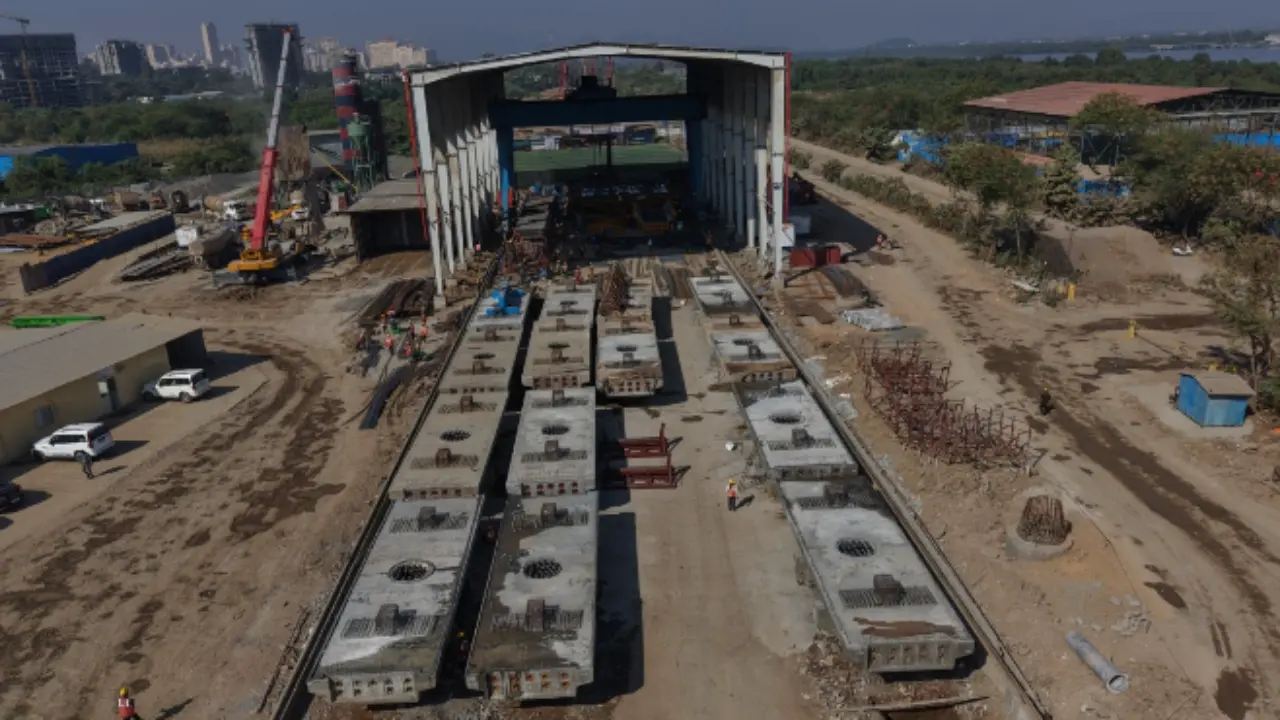
Construction of a long-awaited alternative road corridor in Thane has crossed a key structural milestone, signalling steady progress on a project expected to reshape mobility along the city’s eastern waterfront. Authorities overseeing the Thane Coastal Road have confirmed that half of the foundation work for the project’s elevated viaduct is now complete, with superstructure activities gradually gaining pace.
The 13.45-kilometre, six-lane coastal road is being developed by the Mumbai Metropolitan Region Development Authority as a parallel north–south artery between Kalwa and Gaimukh. Once operational, it is designed to divert a significant share of traffic away from the chronically congested Ghodbunder Road, one of Thane’s most critical yet overstretched transport spines. For daily commuters, this could translate into substantially shorter travel times and improved journey reliability. Officials involved in project execution said that while foundation work is nearing the halfway mark, construction teams have also begun work on pier caps and girder erection along select sections. The phased approach reflects both engineering sequencing and environmental safeguards, given the project’s proximity to sensitive coastal ecosystems along the Vasai Creek.
Environmental considerations have played a defining role in the road’s design. To reduce disturbance to mangrove belts and tidal flows, the elevated structure is being supported on a single-pier configuration instead of wider conventional footprints. Urban planners say this approach mirrors a growing emphasis on infrastructure that balances mobility needs with ecological resilience—an increasingly urgent priority for coastal cities facing climate risks and land scarcity. The project, with an estimated cost exceeding ₹2,200 crore, is also being positioned as a strategic connector rather than a standalone road. At its southern end, the alignment is planned to link with a tunnel near Gaimukh, while the northern end connects to the Mumbai–Nashik Highway near Kalwa. Over time, it is expected to integrate with proposed transport investments such as a ring metro corridor, additional coastal road phases and elevated east–west connectors within Thane.
At present, commuters travelling between Kalwa and Gaimukh rely almost entirely on Ghodbunder Road, a stretch known for traffic bottlenecks, heavy freight movement and inconsistent road conditions. Transport analysts note that even marginal disruptions on this corridor ripple across the wider Mumbai Metropolitan Region, affecting logistics, public transport punctuality and fuel consumption. By offering a faster, signal-free route along the creek, the Thane Coastal Road is expected not only to cut travel times but also to reduce vehicular idling and emissions on existing roads. Real estate consultants add that improved connectivity could gradually rebalance growth pressures, supporting employment and housing clusters beyond traditional hotspots.
As construction moves into more visible phases, the project’s next challenge will be maintaining timelines while safeguarding coastal ecology. For Thane’s rapidly growing population, the road represents more than faster commutes—it reflects how future infrastructure must reconcile scale, sustainability and everyday urban life.
Thane Advances Coastal Road Construction Milestone