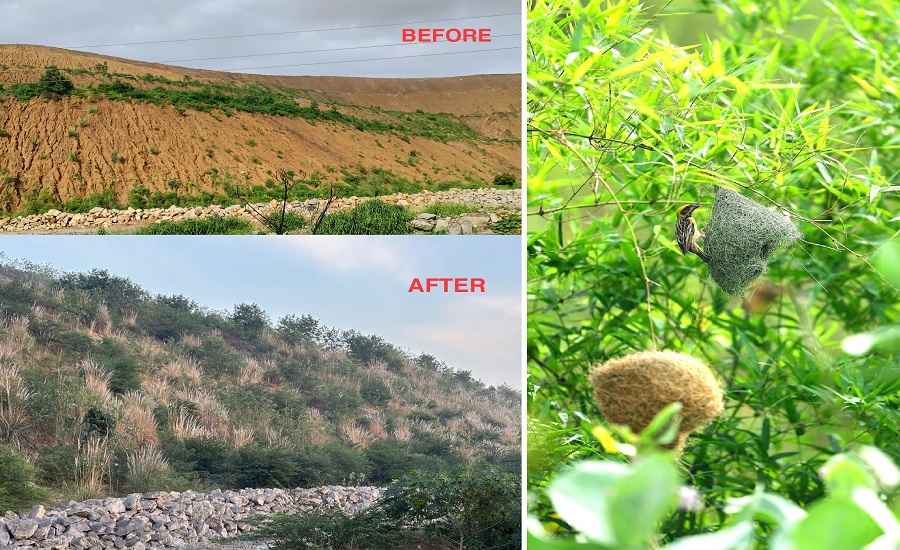
Telangana Transforms Coal Mines Overburden Into Thriving Green Ecosystems With Biodiversity Revival
Telangana is turning its coal mines from barren landscapes into thriving green ecosystems as Singareni Collieries Company Limited (SCCL) restores over 4,100 lakh cubic metres of overburden annually. Through scientific slope stabilisation, native vegetation planting, and bio-remediation, sites like RG-1 now host grasses, trees, and returning wildlife, demonstrating how large-scale mining operations can integrate biodiversity recovery while supporting local communities and environmental sustainability.
Open-cast coal mining inevitably generates large volumes of soil, known as overburden, which are often stacked into artificial hills. Untreated, these dumps are prone to erosion and ecological degradation. SCCL, a government-owned company producing roughly 70 million tonnes of coal per year, has adopted a structured approach to overburden management, transforming these once barren sites into functioning ecosystems. “Scientific stacking, slope stabilisation, and careful soil management form the foundation of our restoration efforts,” said a senior environmental advisor at SCCL.The restoration process involves mechanical reshaping of slopes to safe angles, backfilling excavated pits, and installing gully-control measures to manage water flow. These physical interventions are complemented by bio-remediation, where native grasses are planted on slopes and trees such as Bamboo, Hardwickia, Neem, and Sesbania are introduced on flat areas. The company nurtures seedlings in its own nurseries, ensuring they reach a minimum height of 1.5 metres before transplantation to maximise survival rates.Within two years, areas such as the RG-1 overburden dump have transformed dramatically. Bare, erosion-prone hills are now covered with grasses and young trees, while small streams and micro-habitats have begun forming naturally. “Birds and small wildlife are returning, indicating that these areas are developing into functioning ecosystems,” the SCCL advisor noted. The visible recovery demonstrates that mining by-products, when treated strategically, can support biodiversity and enhance local environmental quality.
The scale of SCCL’s operations makes these achievements particularly noteworthy. With nearly 16 open-cast mines across Telangana and over 500 hectares of overburden rehabilitated annually, the company balances substantial coal production with ecological responsibility. Only native species are used in plantations, preserving regional biodiversity, and every intervention is monitored closely to ensure long-term sustainability. Experts observe that such initiatives can serve as replicable models for other mining regions seeking to reconcile economic activity with environmental stewardship.Beyond ecological recovery, these restored landscapes offer social and community benefits. They reduce soil erosion, improve microclimates, and create green spaces that buffer surrounding areas from environmental stress. SCCL’s sustained efforts illustrate how industrial operations can evolve from purely extractive activities to integrated sustainability programmes that prioritise zero-carbon, inclusive, and biodiversity-friendly outcomes.
Founded in 1920, SCCL operates 40 mines across six districts of Telangana and contributes over 9% of India’s coal output. Today, its focus on overburden restoration demonstrates a forward-looking vision: one where large-scale mining and environmental responsibility coexist, setting new benchmarks for sustainable industrial practices in India.