


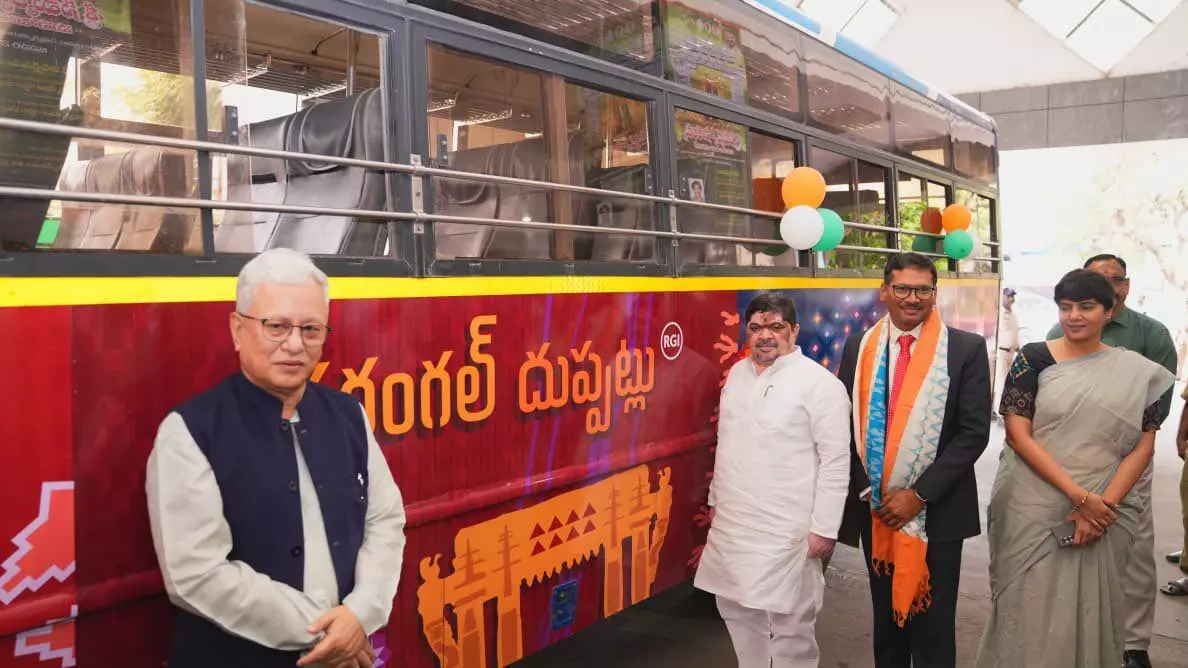
Telangana has rolled out a state-backed cultural mobility initiative that turns public transport into a platform for artisan-led economic visibility. The state-run Telangana State Road Transport Corporation has introduced “GI on Wheels”, deploying specially designed buses that showcase Geographical Indication (GI)-tagged crafts from across the region.
The programme was inaugurated at Mahatma Gandhi Bus Station in Hyderabad and positions Telangana as the first state to integrate GI promotion directly into everyday mass transit infrastructure. Six express buses have been artistically wrapped to represent distinct craft traditions and will operate on intercity routes linking Hyderabad with major cultural centres including Pochampally, Narayanpet, Hanamkonda, Karimnagar and Nirmal.Each vehicle features visual narratives inspired by celebrated craft clusters: Pochampally Ikat weaving, Warangal dhurries, Karimnagar silver filigree, Narayanpet sarees, Cheriyal scroll painting and Nirmal artworks. The designs were conceptualised by students of Jawaharlal Nehru Architecture and Fine Arts University, underscoring collaboration between public institutions and creative academia.
Officials described the initiative as a strategic effort to broaden market awareness for rural artisan communities while reinforcing regional identity. Telangana currently holds 18 GI registrations, a legal recognition that links products to specific geographies and safeguards them from imitation. Policy advisers note that GI labelling enhances brand value, supports tourism circuits and strengthens pricing power for traditional producers.From an urban policy perspective, GI on Wheels reflects a growing trend of activating public infrastructure for cultural and economic messaging. Rather than confining heritage to museums or seasonal fairs, the programme embeds craft narratives within daily commuter flows. With lakhs of passengers using state buses each day, transport corridors become mobile exhibition spaces connecting rural production clusters with urban consumers.
Economists suggest such visibility interventions can influence purchasing behaviour and open new distribution channels, particularly when paired with digital commerce platforms and state-supported marketing drives. For artisans facing competition from mass-produced substitutes, sustained exposure is critical to maintaining demand.The initiative also intersects with sustainable development objectives. Handloom weaving, natural dye painting and small-scale metalwork typically have lower carbon footprints than industrial manufacturing. By promoting GI crafts, the state indirectly supports low-impact production systems rooted in local knowledge.
Transport officials indicated that the model could be expanded if it generates measurable economic benefits for artisan groups. For Hyderabad and the wider state economy, GI on Wheels demonstrates how mobility infrastructure can be repurposed to advance inclusive growth — blending culture, commerce and connectivity into a shared public space.
Telangana GI on Wheels transforms buses
