


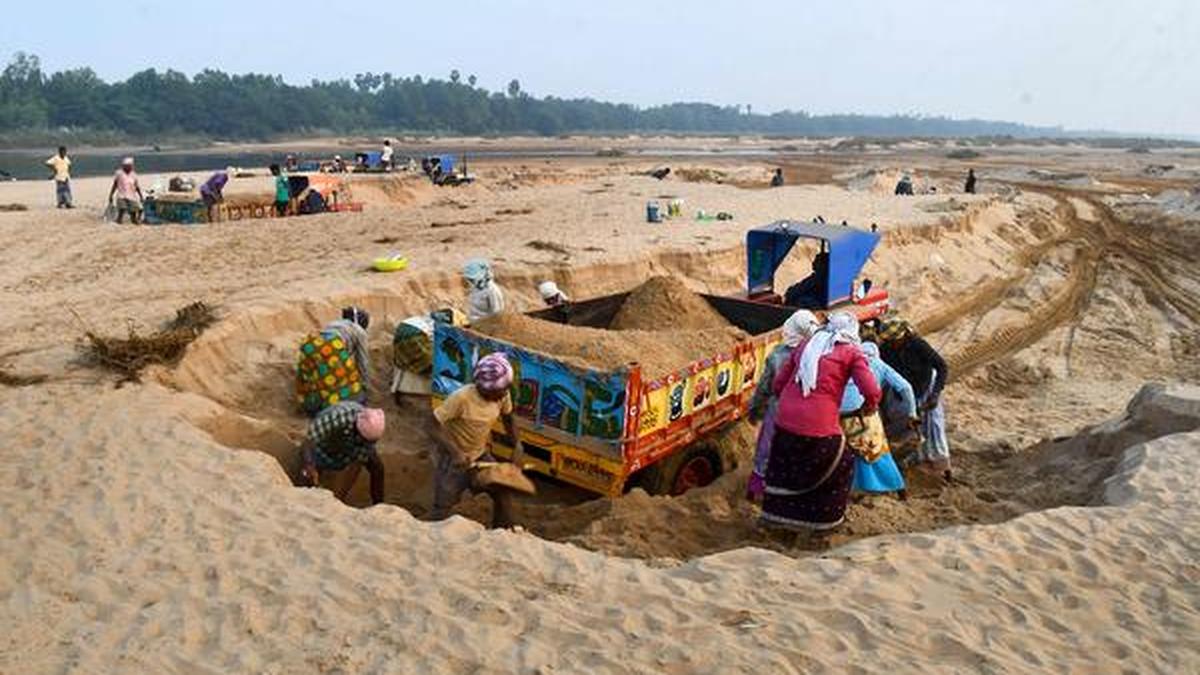
Telangana has begun deploying an artificial intelligence-driven monitoring network to curb illegal extraction and transport of construction sand, a critical but environmentally sensitive resource. The Telangana AI Sand Mining initiative, developed by researchers at International Institute of Information Technology Hyderabad in collaboration with the state IT department, is now operational on a key highway corridor linking Hyderabad with Vijayawada.
Installed at a checkpoint near Chityal, the system automatically scans and verifies registration numbers of trucks transporting sand into the state. Each vehicle is cross-checked in real time against an approved database maintained by the Telangana Mineral Development Corporation, which oversees authorised mining and transport activity.Illegal sand mining has long posed environmental and fiscal challenges. Unregulated extraction accelerates riverbank erosion, reduces groundwater recharge and disrupts local ecosystems, while depriving state agencies of royalty revenues. Urban planners warn that as Hyderabad expands and construction demand rises, unchecked sand supply chains can undermine both climate resilience and responsible urban growth.
What sets the Telangana AI Sand Mining system apart is its ability to interpret non-standard vehicle number plates. Unlike many countries with uniform, machine-readable plates, Indian trucks often feature hand-painted registration details with inconsistent fonts and spacing. Commercial automatic number plate recognition solutions typically struggle with such variability and can be expensive to scale across multiple checkpoints.Engineers at IIIT Hyderabad adapted a research-grade computer vision model to address these challenges. The system uses deep learning frameworks to detect and read irregular characters even in low-light conditions. Built by a compact technical team, the platform integrates into open-source infrastructure, reducing licensing and maintenance costs for government deployment.
Officials familiar with the rollout say the technology processes thousands of vehicles daily and continues to refine accuracy as it ingests live traffic data. Real-world conditions — from garlands obscuring plates to night-time glare — have tested the system’s resilience. Continuous model training aims to improve detection reliability without requiring new hardware.From a policy perspective, the Telangana AI Sand Mining project signals a shift toward data-driven enforcement in extractive industries. By creating a digital audit trail of authorised trucks, authorities can better regulate mineral flows and identify suspicious patterns. Economists note that transparent resource monitoring can stabilise supply chains for the construction sector, which underpins housing and infrastructure development.
The research team is reportedly exploring expansion into traffic enforcement applications, including automated detection of two-wheeler violations in partnership with state police.For a rapidly urbanising state, the convergence of AI and resource governance could redefine how natural assets are managed. If scaled responsibly and paired with ecological safeguards, such systems may help balance infrastructure growth with environmental accountability — a prerequisite for sustainable city building.
Also Read:Kolkata Metro Invests In Modern Commuter Infrastructure
Telangana AI Sand Mining Monitoring System
