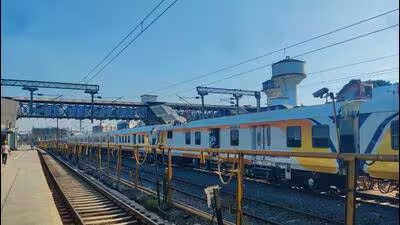
Surat Mumbai Corridor Eyes Suburban‑Style Rail Service
The Mumbai–Surat corridor is on the verge of a transformation as Indian Railways considers introducing suburban‑style local trains along the 280‑kilometre route, signalling a significant shift in long-distance commuter mobility. The move, which would combine upgraded MEMU (Mainline Electric Multiple Unit) services with advanced rolling stock like the Namo Bharat trainsets, aims to make rail travel more frequent, reliable, and commuter‑friendly between two of western India’s busiest economic hubs.
Officials from Western Railway have confirmed plans to expand station infrastructure along the route, including additional platforms at key transit points, while retrofitting existing stations for faster boarding and alighting. The proposal reflects growing recognition that traditional long-distance passenger services alone cannot meet rising demand from daily or weekly commuters who traverse this industrial and business corridor.Suburban-style trains, designed for shorter intervals between stops and high-frequency service, could reduce dependence on private vehicles, ease pressure on highways, and lower carbon emissions. Equipped with modern amenities such as onboard toilets, improved seating, and automated doors, the upgraded trains are expected to enhance comfort while addressing operational challenges typical of long corridor routes.The adoption of Namo Bharat trainsets, which have already demonstrated efficiency in semi-high-speed corridors such as Delhi–Meerut, marks a strategic pivot. These trains offer higher acceleration, energy efficiency, and enhanced passenger safety compared to conventional MEMUs, making them suitable for extended suburban routes like Mumbai–Surat. Experts note that integrating advanced rolling stock with existing MEMU infrastructure could set a precedent for other regional corridors across India.
Economic analysts say that improved rail connectivity along the Mumbai–Surat corridor is likely to stimulate regional development. Surat, a major industrial hub, and Mumbai, India’s financial capital, are linked by strong commercial and human resource flows. High-frequency commuter trains could expand labour mobility, increase access to educational institutions, and enhance economic integration, benefiting both cities while relieving congestion on intercity road networks.However, planners caution that suburban-style long-distance services bring unique challenges. Scheduling must account for high passenger volumes, intermediate stabling requirements, and maintenance facilities. Additionally, stations along the route must be upgraded to manage throughput efficiently without compromising safety or accessibility. Integration with local transport modes at both ends, such as bus networks and feeder services, will be critical for maximising commuter convenience.Environmental sustainability also remains a key consideration. Rail transport along this corridor offers a lower-emission alternative to highway travel, aligning with national climate goals and broader urban mobility strategies. Planners emphasise that combining energy-efficient trainsets with electrified infrastructure can significantly reduce the carbon footprint of intercity travel in this densely populated industrial belt.
As feasibility studies and preliminary planning advance, the Mumbai–Surat suburban rail proposal highlights a new model for regional mobility: long-distance corridors adapted to commuter needs, combining high-capacity infrastructure with climate-conscious, people-first design. Its success could inform similar projects linking emerging urban clusters across India’s fast-growing western corridor.