


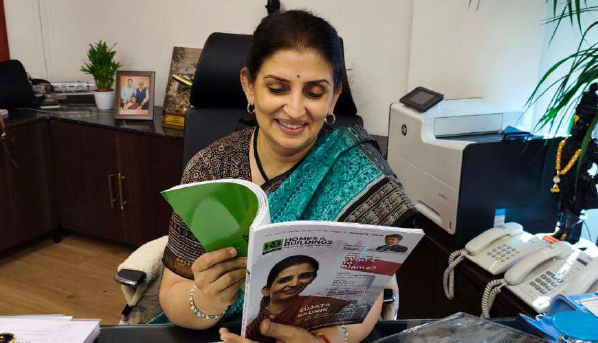
A Civil Servant Who Made the System Breathe
In the annals of Indian administration, some names represent power.
Fewer still represent poise, patience, and purpose.
And then, there is Sujata Saunik—a civil servant who made public service feel ethical, intelligent, and deeply human.
When she entered the Indian Administrative Service in 1987, the path for women was narrow, the glass ceiling almost opaque, and the unwritten rules harsher than the written ones. But she didn’t walk into the system to challenge it with slogans—she redefined it from within.
And on July 6, 2025, as she retires as Maharashtra’s first woman Chief Secretary, she leaves not just a vacancy, but a vocabulary—of governance, dignity, and deeply embedded reform.
Beginnings
Born into a generation that still saw bureaucracy as the exclusive domain of men, Sujata’s pursuit of public service was not just a career choice—it was an act of courage. She cleared the UPSC in a batch where women were few, and mentors were fewer.
But Sujata didn’t just pass the exam. She rewrote the meaning of being a bureaucrat in India. Her earliest postings were far from glamorous—but they shaped her into a listener, not just a leader.
She learned early that governance was not about power; it was about presence.
Administrator with a Conscience
Over 36 years, Sujata Saunik became a rare force in Indian public life—holding senior positions at the state, national, and international levels, including the World Bank, United Nations, and WHO. Yet, at every step, her work remained grounded in the most vital idea: that policy must be felt, not just formulated.
Her fingerprints are quietly present on some of Maharashtra’s most transformative frameworks:
- The post-COVID public health roadmap that emphasized local systems, tele-health, and dignity of care.
- Gender-responsive budgeting and governance, placing women at the centre of development metrics.
- Climate-resilient urban planning with disaster risk preparedness as an integrated mandate.
- The re-haul of public grievance redressal mechanisms with data-led governance and citizen trust.
She was not a reformer of the spotlight. She was a reformer of the spreadsheet, the silence, the unspoken protocol. She turned the invisible into policy, and the ignored into priority.
A Woman at the Top—And Ahead of Her Time
When Sujata Saunik became the first woman in Maharashtra’s history to be appointed Chief Secretary, it wasn’t just a newsflash. It was a generational sigh of relief.
The state had taken 60 years to trust a woman with its top bureaucratic post. Sujata carried that trust with dignity—not dominance.
She chaired inter-departmental task forces with zero posturing and full clarity. She spoke rarely—but when she did, her words had the weight of thoughtfulness and the restraint of wisdom.
She was never driven by performance optics. She was driven by outcome architecture.
And that made her a north star for hundreds of young officers—especially women—who finally saw a leadership style they could inherit.
Global Perspective, Grassroots Touch
Her years with international organizations could’ve made her distant. But Sujata returned to India’s systems more rooted than before.
At the UN and WHO, she worked on cross-border frameworks for health, governance, and disaster preparedness. But in Maharashtra, she implemented those lessons in the language of local dialects, ground realities, and public patience.
Whether it was training frontline workers during COVID or redesigning urban vulnerability maps post-floods, Sujata always merged the global with the granular.
Words to Remember Her By
“In public service, what you do matters. But how you do it matters more.”
“Leadership is about holding space—for others to grow, speak, and take charge.”
“Systemic change is not a revolution. It is repetition, empathy, and resolve.”
Her Real Legacy
Sujata Saunik retires with no scandals, no controversies, and no overstatements.
And that—in today’s time—is the rarest legacy of all.
She leaves behind:
- A bureaucracy that breathes better.
- A generation of officers more comfortable with kindness.
- A state that saw power held not by fear—but by quiet force of integrity.
Her story isn’t one of noise. It’s one of clarity.
Not of grand gestures. But of granular justice.
Not of titles she wore. But of trust she earned.
