


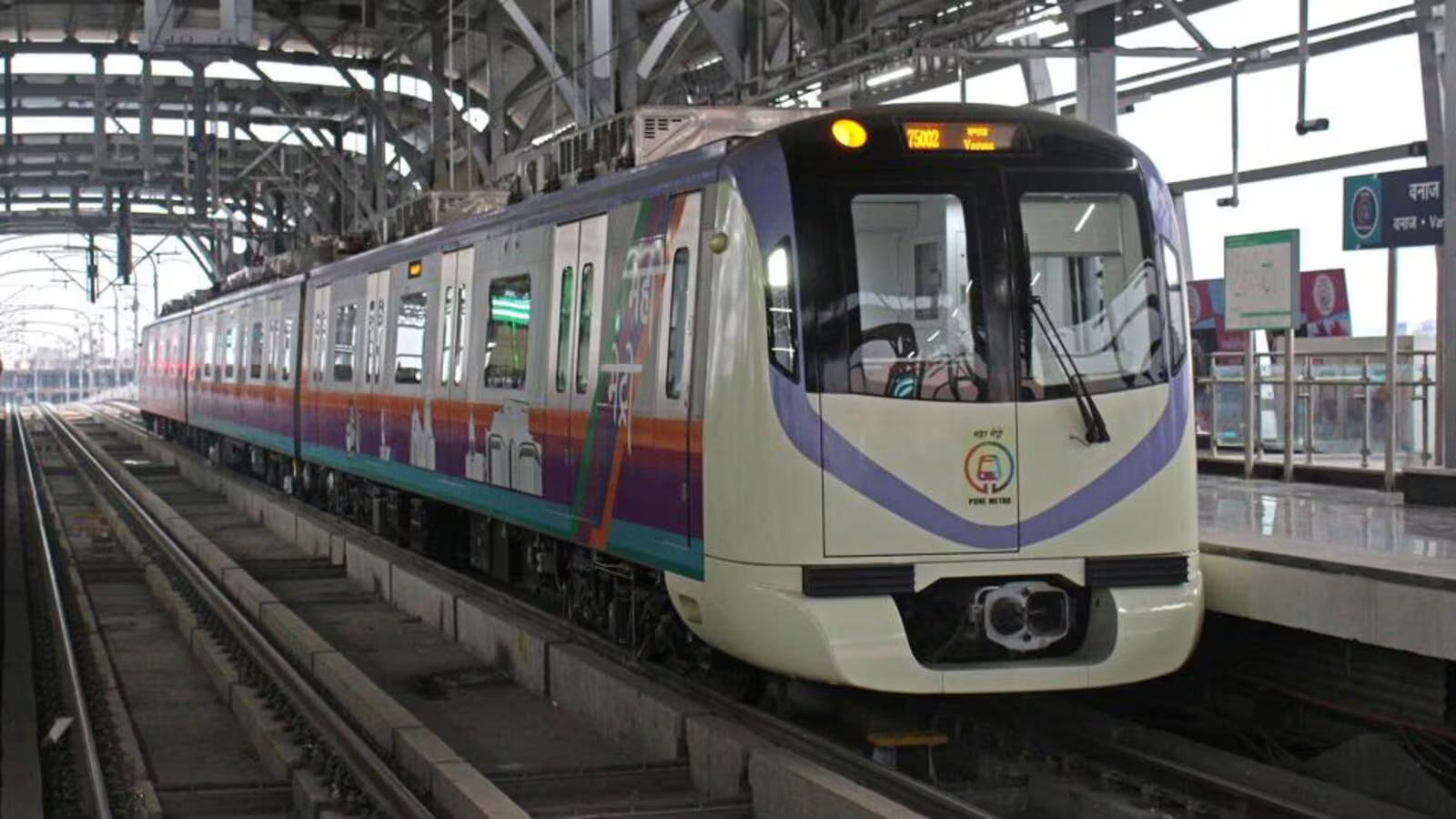
Pune Metro extension to Chandni Chowk and Wagholi receives financial clearance with a revised project cost, marking a critical step in transforming the city’s transport landscape.The state government has cleared the long-pending proposal to extend the Vanaz–Ramwadi Metro corridor towards Chandni Chowk in the west and Wagholi in the east. With this approval, the ambitious project, designed to address Pune’s growing congestion and provide cleaner mobility alternatives, is finally set to move forward.
Officials confirmed that the revised project cost has been fixed at ₹3,626.24 crore, marginally lower than the earlier estimate of ₹3,756.58 crore. The revised allocation ensures that no essential features are compromised, while achieving efficiency in project expenditure. The financial structuring will be shared between multiple stakeholders. Both the central and state governments will contribute ₹479.71 crore each, while a major portion of ₹1,867 crore will be raised through bilateral and multilateral lending agencies. The state government has also committed an interest-free loan of ₹656 crore, earmarked specifically for land acquisition, rehabilitation, and civil works, while the Pune Municipal Corporation will provide ₹24 lakh. According to senior officials from Maharashtra Metro Rail Corporation Limited (MahaMetro), the project will include essential infrastructure such as signalling systems, rolling stock, platform screen doors, cyber security, and multi-modal integration.
The expansion will not only help decongest arterial roads but also offer an eco-friendly alternative for thousands of daily commuters in the fast-growing urban clusters of Chandni Chowk and Wagholi. Urban development experts note that the extension plan aligns with broader sustainability goals, as Metro systems contribute to reducing carbon emissions, fuel consumption, and dependence on road-based transport. The integration of this corridor with existing and upcoming Metro lines is also expected to enhance connectivity across Pune, thereby strengthening the case for public transport as the primary mode of city travel. The approval follows a series of evaluations, with the Centre clearing the revised cost in mid-July and the state cabinet granting its final nod in August. Officials clarified that cost optimisation has been achieved without cutting back on commuter safety, accessibility, or key technical requirements.
Transport analysts emphasise that the decision comes at a crucial juncture when Pune, one of India’s fastest-growing urban centres, faces rising pressure on its road infrastructure. By extending the Metro to densely populated catchments, the project seeks to provide equitable access to sustainable mobility while supporting the city’s economic and environmental priorities. With work now slated to commence under MahaMetro’s supervision, stakeholders believe the extension will not only ease urban commutes but also drive long-term behavioural change towards greener travel choices in Pune.
Also Read : Railways To Operate Special Trains Between Coimbatore And Key Cities For Passengers
