


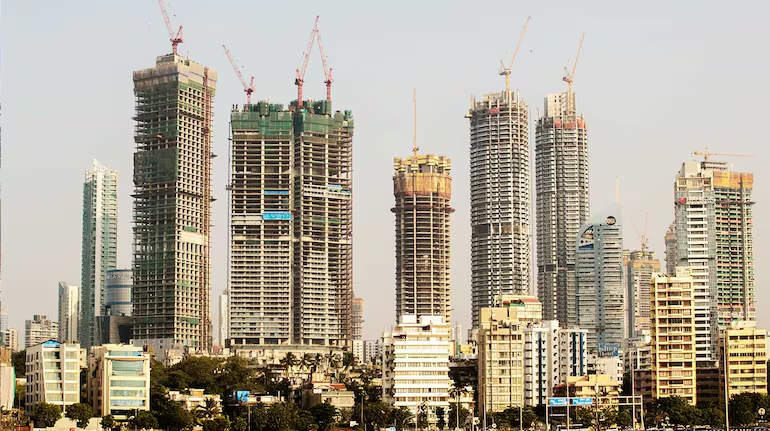
Even as India’s top housing markets witnessed a moderation in overall sales volumes, South India emerged as a clear outlier in 2025, with Bengaluru, Hyderabad and Chennai collectively recording a 15 per cent rise in residential sales, underscoring a structural demand shift rather than a cyclical rebound.
According to data released by PropTiger, housing sales across these three southern metros rose to more than 1.33 lakh units in the calendar year 2025, driven by improved supply alignment, steady end-user demand and relatively stable pricing. In contrast, total housing sales across India’s eight largest cities declined 12 per cent year-on-year to 3.86 lakh units, reflecting a broader market recalibration. Industry analysts say the divergence highlights how India’s housing market is increasingly fragmenting along economic, employment and affordability lines. Bengaluru remained the strongest performer, with residential sales rising 13 per cent to 54,414 units. The city continues to benefit from its deep technology-driven employment base, resilient white-collar income growth and a steady pipeline of mid-income and premium housing projects. Chennai recorded the sharpest growth, with sales jumping 55 per cent to nearly 25,000 units. Developers attribute the surge to improved infrastructure execution, a revival in manufacturing-led employment, and relatively affordable ticket sizes compared to western metros. Hyderabad posted a more measured 6 per cent growth, closing the year with over 54,000 units sold. While the city has seen some investor caution amid regulatory and policy uncertainty, end-user demand in well-connected suburban corridors remained intact.
Together, these three cities accounted for over one-third of total housing sales among the top eight metros in 2025. By contrast, western and northern markets saw notable declines. Mumbai Metropolitan Region (MMR) recorded a steep 26 per cent fall in housing sales, while Delhi-NCR, Pune, and Ahmedabad each saw double-digit contractions. Market participants point to affordability pressures, higher base prices, selective supply launches and buyer fatigue after a multi-year upcycle as key reasons. Importantly, PropTiger emphasised that 2025 should not be seen as a year of demand erosion, but rather one of market discipline. Developers consciously moderated new launches, with total housing supply across the eight cities falling 6 per cent to 3.61 lakh units the lowest annual addition since 2021. “This was a year of recalibration, not correction,” said Onkar Shetye, Executive Director at Aurum PropTech, which acquired PropTiger last year. Buyers remained active but more selective, while developers avoided excess inventory build-up, helping maintain price resilience despite lower transaction volumes. Urban economists note that South India’s performance reflects deeper fundamentals: diversified job creation, stronger end-user participation, and less speculative overheating compared to legacy metros.
As India’s housing market matures, 2025 may be remembered as the year when growth decisively tilted southward reshaping how developers, investors and policymakers assess regional opportunity in residential real estate.
Also Read: Haryana RERA Tightens Grip on Property Agents
Southern Cities Defy Slowdown as Housing Sales Rise in 2025
