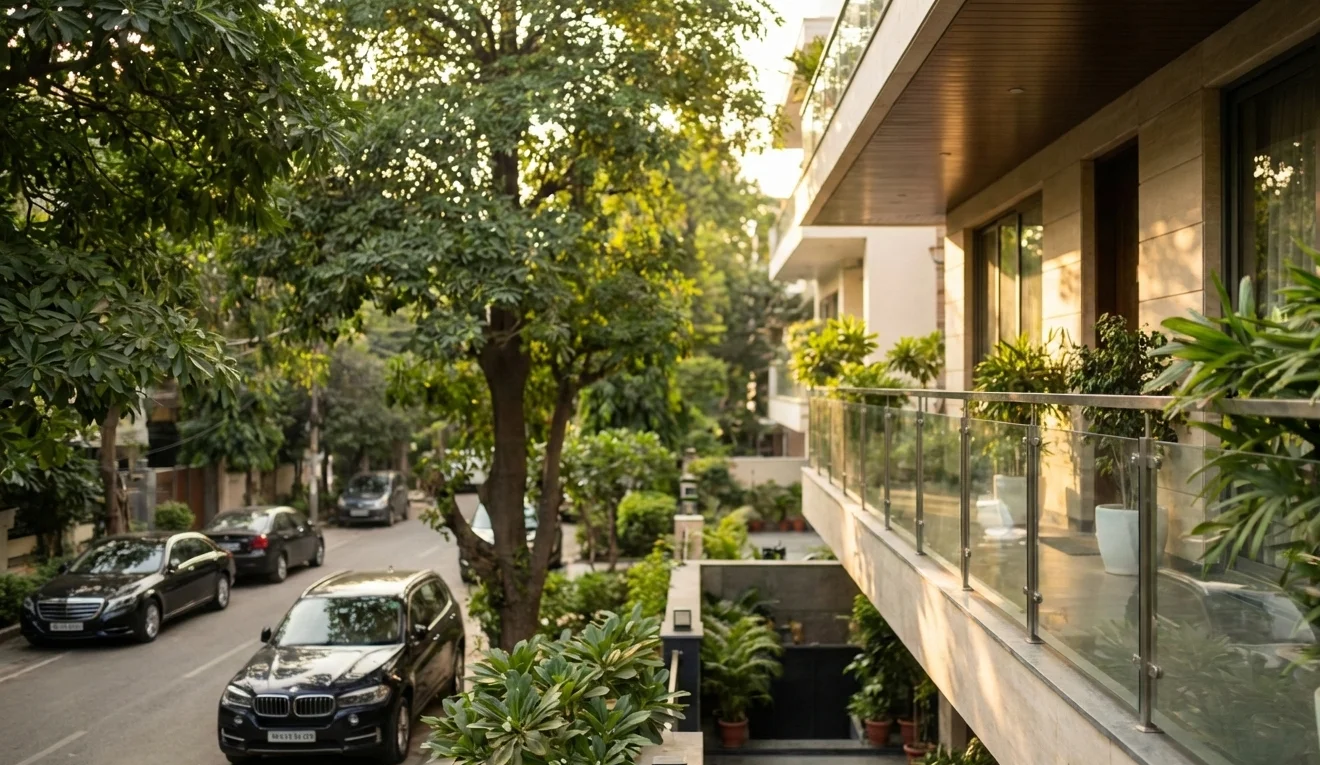
South Delhi’s most established neighbourhoods are witnessing an accelerated rise in property values, with South Delhi luxury floors recording year-on-year increases of up to 34 percent in 2025. The surge comes even as several micro-markets across the wider National Capital Region (NCR) show signs of moderation, underscoring the capital’s deepening price divergence within the same metropolitan region.
Market assessments reviewed by Urban Acres indicate that premium plotted colonies in Categories A and B as defined under the Municipal Corporation of Delhi’s property classification framework are driving this upswing. These include diplomatic and legacy residential enclaves where supply remains structurally constrained due to redevelopment-led construction rather than fresh land release.
In high-value Category A localities, average ticket sizes for a 2,500 sq ft independent floor have moved decisively upward over the past year. Larger formats exceeding 6,000 sq ft have also seen notable appreciation, reflecting sustained appetite among ultra-high-net-worth households.
Category B neighbourhoods have followed a similar, though slightly moderated, trajectory. Industry executives tracking the segment attribute the growth in South Delhi luxury floors to a tight supply pipeline combined with consistent demand from affluent buyers seeking low-density housing. Unlike vertical apartment towers emerging in peripheral zones, independent floors are typically constructed on redeveloped plots. Land parcels are finite, and redevelopment cycles are gradual, limiting inventory expansion.
Urban planners point out that this redevelopment wave is reshaping South Delhi’s built fabric. Ageing single-storey bungalows are being replaced with multi-level residences featuring lifts, basements, enhanced fire safety systems and energy-efficient façades. While the physical footprint of these colonies remains unchanged, built density and asset value are rising. This transformation, however, also places pressure on local infrastructure, including parking, drainage and tree cover, raising questions about climate resilience and neighbourhood carrying capacity.
Policy architecture plays a reinforcing role. Circle rates, stamp duty and taxation structures are aligned with colony categorisation, effectively institutionalising the area’s premium status. The regulatory clarity has provided confidence to investors treating South Delhi luxury floors not merely as homes but as long-term capital preservation instruments. Another driver is intra-city migration. Real estate advisors report that established business families and professionals from other parts of Delhi are consolidating assets within South Delhi for proximity to central business districts, diplomatic zones, established schools and mature social infrastructure. The floor-wise ownership model offers privacy comparable to a bungalow while reducing maintenance burdens.
Yet, the pace of appreciation raises sustainability concerns. Markets insulated by wealth can remain resilient, but they are not immune to macroeconomic shifts, regulatory tightening or environmental constraints. As redevelopment accelerates, questions around equitable access, infrastructure upgrades and green urban design will shape the next phase of growth. For now, South Delhi continues to chart a distinct course within NCR’s property landscape one defined by scarcity, legacy appeal and concentrated capital.
South Delhi luxury Floors Surge 34 Percent