


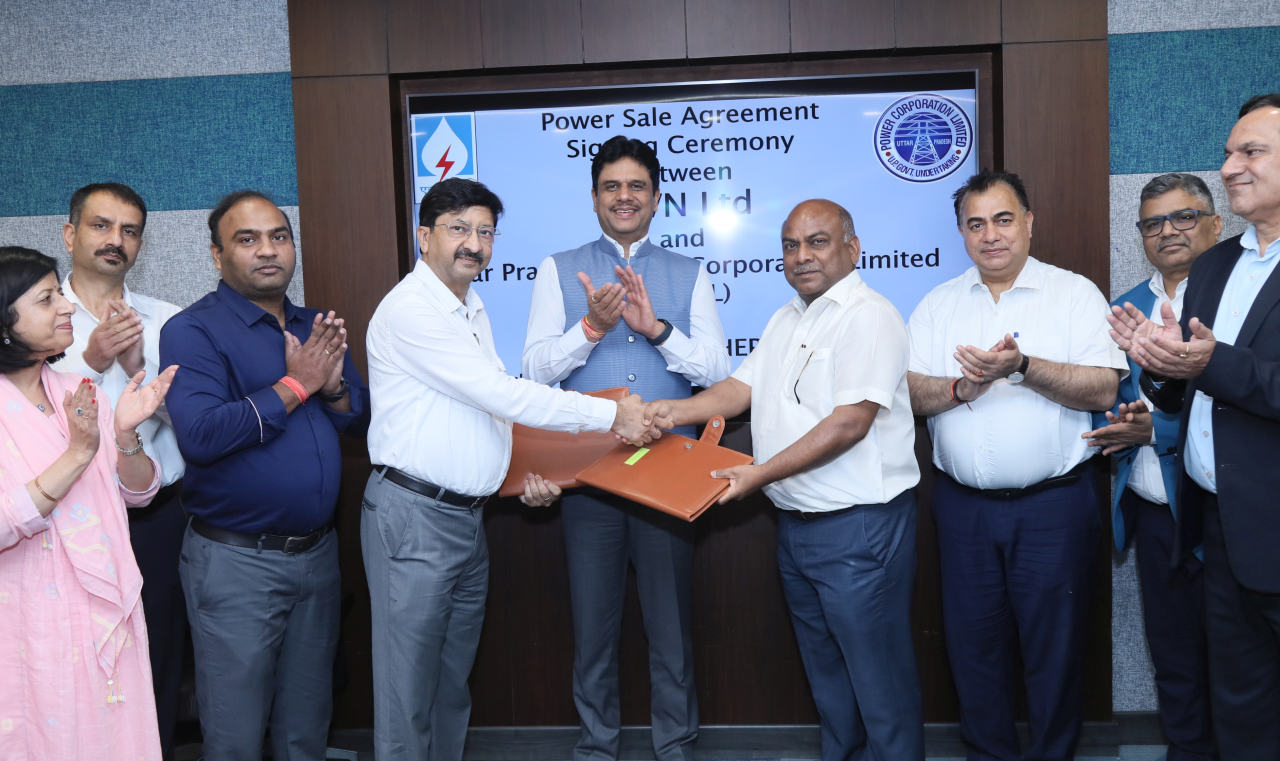
In a strategic push to expand clean energy access across northern India, public sector power major SJVN has signed power agreements totalling 1,492 MW with the Uttar Pradesh Power Corporation Limited (UPPCL) and the New Delhi Municipal Council (NDMC). The deals cover the supply of hydroelectricity from the under-construction Arun-III project in Nepal and two major projects in Himachal Pradesh, marking a major milestone in regional energy cooperation and India’s low-carbon urban transition.
The series of agreements, signed in New Delhi, include a Power Sale Agreement (PSA) for 900 MW from the Arun-III Hydro Electric Project and Power Purchase Agreements (PPAs) for 210 MW from the Luhri Stage-I Hydro Electric Project and 382 MW from the Sunni Dam Hydro Electric Project, both located in Himachal Pradesh. The agreements reflect a deepening collaboration between SJVN and key state utilities to secure reliable, non-fossil electricity for India’s expanding urban and industrial base. The Arun-III project, a landmark transnational hydroelectric initiative, is being developed in Nepal’s Sankhuwasabha district through SJVN’s wholly owned subsidiary. Once operational, the 900 MW project will export electricity directly into India’s grid, strengthening bilateral energy cooperation while fulfilling a critical portion of Uttar Pradesh’s future demand. Scheduled for commissioning in the 2027–28 financial year, the project is expected to play a pivotal role in India’s clean energy sourcing from the Himalayan region.
In parallel, SJVN is accelerating construction of the Luhri Stage-I and Sunni Dam Hydro Electric Projects, both situated on the Satluj River in Himachal Pradesh. Together, these projects will add 592 MW of green capacity to the National Grid and are estimated to generate over 2,140 million units of electricity annually. Their commissioning is targeted for December 2028. The Himachal Pradesh installations are designed to harness peak river flow and seasonal hydrology to stabilise supply during critical demand periods. The Power Purchase Agreements for these two Himachal projects were signed with UPPCL, while the New Delhi Municipal Council entered into a separate PPA with SJVN for power procurement from the Sunni Dam Hydro Electric Project. These deals are part of a broader energy shift among state and urban authorities toward securing long-term, renewable electricity sources as cities seek to reduce dependence on fossil-fuel-based generation.
Officials involved in the signing emphasised that these agreements reflect both the policy direction and investment strategy required to build a resilient and environmentally responsible electricity grid. With the Indian government targeting 500 GW of non-fossil fuel energy capacity by 2030, these hydroelectric additions are viewed as a dependable, grid-stabilising component of India’s evolving energy mix. By securing clean energy supply lines now, UPPCL and NDMC aim to shield themselves from future volatility in coal prices and ensure that electricity access in Uttar Pradesh and New Delhi remains uninterrupted during seasonal fluctuations. Experts say this transition to hydropower will particularly benefit industrial zones, government services, and residential sectors, which are increasingly vulnerable to energy price hikes linked to global fuel supply disruptions.
The financial model for these projects is structured around long-term energy purchase agreements, ensuring predictability of returns for SJVN while locking in stable tariffs for the procuring agencies. This public-sector-driven framework creates an enabling environment for green energy expansion, especially in states with high population densities and peak electricity demand. Energy analysts have welcomed the inclusion of the Arun-III project in the mix, citing it as a crucial example of cross-border energy diplomacy. Once complete, it will be one of the largest Indian-executed infrastructure ventures in Nepal, offering mutual economic and environmental benefits. It also enables India to diversify its energy portfolio with Himalayan hydro resources, which are less carbon-intensive and more sustainable over the long term.
The urban-centric focus of the NDMC agreement underscores the growing urgency among city authorities to decarbonise power supply in municipal limits. As Delhi grapples with worsening air quality and growing electricity consumption, the move to incorporate hydroelectricity into its procurement plans signals a practical shift towards sustainable civic energy management. Officials noted that beyond environmental benefits, these projects are expected to generate substantial socio-economic value across the regions involved. Employment generation during the construction phase, local infrastructure development, and skill enhancement for workforce in Himachal and Nepal are among the expected spillover outcomes. The NDMC’s participation is also expected to encourage other urban civic bodies to explore similar tie-ups for green energy.
Although challenges remain—particularly around timely construction, ecological safeguards, and grid integration—the projects have been prioritised by SJVN under its corporate expansion roadmap. The power utility, a joint venture between the Centre and the Government of Himachal Pradesh, has been steadily scaling its renewable energy assets across India and neighbouring countries as part of its mission to become a major regional clean power player. The 1,492 MW of green power secured through these agreements is not just a numerical boost to India’s renewable tally—it is a strategic reinforcement of energy resilience at a time when urban electricity demands are outpacing the growth of traditional supply systems. With extreme weather events, fuel shortages, and climate change concerns mounting, these hydroelectric sources offer both reliability and climate compatibility.
The agreements represent a broader shift in how India’s power infrastructure is being realigned—away from short-term fixes and towards long-term, sustainable, and regionally integrated solutions. For citizens, this means more reliable electricity, fewer outages, and cleaner air. For planners and policymakers, it is a signal that green energy investment is not only feasible but necessary to meet the development needs of a rapidly urbanising nation.
Also Read : UPEIDA Bans Land Transactions to Fast-Track Noida Industrial Corridor
