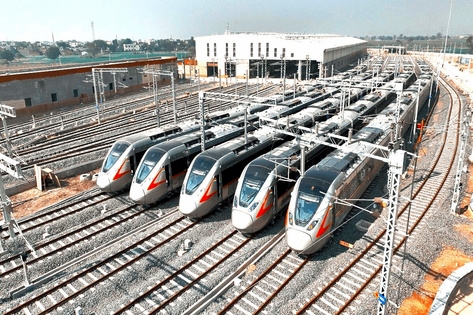
Fresh attention has returned to the long-pending Sirsa–Delhi rail corridor, as political and civic voices renew calls for the introduction of a high-speed daytime passenger service on the completed route. The demand centres on starting an Intercity Express or semi-high-speed train that would allow same-day travel between Sirsa and the national capital, a connection seen as critical for economic participation and social mobility in western Haryana.
The rail line linking Sirsa to Delhi has existed for more than a decade, having been conceived to support future passenger growth, regional trade and workforce movement. However, despite the physical infrastructure being in place, the absence of a suitably timed fast train has limited its usefulness for daily commuters. Current services are largely overnight or irregular, making them impractical for professionals, students and small traders who rely on predictable schedules. Urban mobility experts note that rail connectivity plays an outsized role in shaping regional economies beyond major metros. Sirsa, along with neighbouring districts such as Hisar, sits within an agrarian and emerging industrial belt that increasingly depends on access to Delhi for education, healthcare, wholesale markets and administrative services. Without efficient rail options, residents are often pushed towards long road journeys, increasing travel costs, congestion and carbon emissions.
Transport planners argue that a modern, time-bound train on the Sirsa–Delhi rail route could significantly alter travel behaviour. A morning departure with an evening return would integrate the region more closely into the capital’s economic ecosystem, enabling daily commuting rather than forced relocation. Such connectivity often supports local employment retention, as residents can access higher-value jobs while continuing to live in their home districts.From an infrastructure policy perspective, the issue also raises questions about asset utilisation. Rail corridors represent substantial public investment, and underused lines reflect missed opportunities for inclusive growth. Industry analysts point out that incremental operational decisions such as train scheduling and service type can deliver high economic returns without major new capital expenditure.
The discussion around connectivity has also intersected with broader civic concerns in Sirsa district. Public representatives have highlighted persistent health challenges in villages along the Ghaggar river belt, where access to advanced medical facilities often requires travel to larger cities. Reliable daytime rail services could improve access to treatment and follow-up care, especially for lower-income households dependent on public transport. Railway officials have not yet indicated a timeline for introducing a new service on the corridor. However, transport economists suggest that passenger demand modelling, combined with regional development indicators, could support the case for an Intercity Express or upgraded train category aligned with India’s broader rail modernisation agenda.
As India’s transport strategy increasingly emphasises sustainable mobility and balanced regional development, the Sirsa–Delhi rail route presents a test case. Whether the corridor evolves into a functional economic lifeline or remains an underleveraged asset will depend on policy decisions that prioritise people-centric connectivity over mere infrastructure completion.
Sirsa Region Seeks Faster Rail Link To Delhi