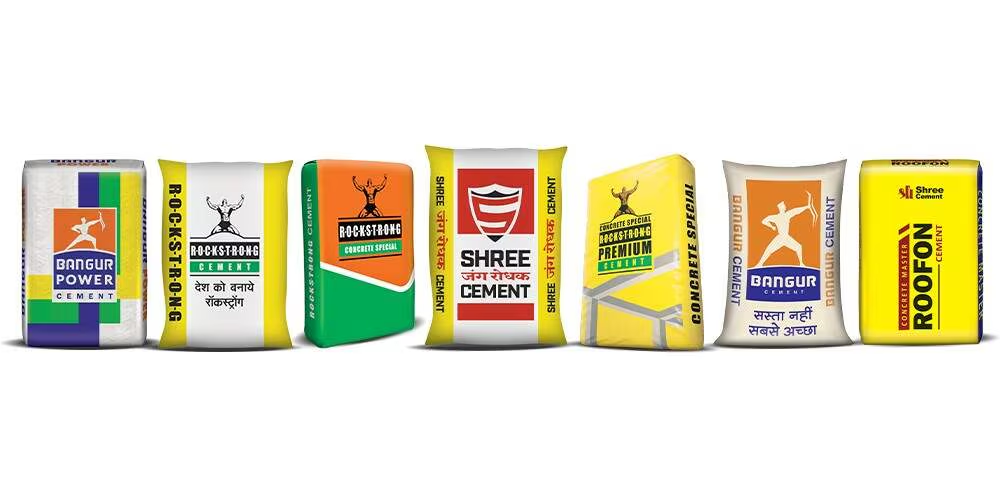
Shree Cement’s latest operational performance points to a measured slowdown in construction demand across key urban and semi-urban markets, even as pricing stability has helped maintain overall revenue momentum. The trend, reflected in the company’s recent quarterly results, highlights changing dynamics in India’s built environment, where developers and infrastructure agencies are recalibrating project timelines amid cost pressures and uneven on-ground execution.
During the December quarter, cement dispatch volumes recorded only marginal growth compared to the previous year. Industry observers note that while demand has not collapsed, new project starts have moderated, particularly in housing and non-core urban infrastructure. This has led producers such as Shree Cement to rely more heavily on price discipline and product mix optimisation rather than volume-led expansion.Operational data indicates that average cement realisations improved sequentially, supported by selective price adjustments in core regions. However, lower capacity utilisation diluted operating efficiencies, leading to pressure on per-tonne profitability. Energy and logistics costs remained largely stable, offering limited relief from volume-related margin stress. Urban planners tracking construction inputs say this reflects a broader pause as cities absorb earlier waves of development before scaling further.
Across the first nine months of the financial year, Shree Cement’s performance remained mixed. Cost controls and a higher share of premium products supported operational resilience, but total output growth trailed broader industry potential. Analysts tracking urban construction cycles suggest this lag mirrors slower absorption of housing inventory and delayed public works execution, especially in tier-II cities where infrastructure rollout is closely tied to municipal financing.Looking ahead, the company has indicated that full-year volumes are likely to fall below earlier internal expectations. This cautious outlook aligns with feedback from contractors and developers facing working capital constraints and phased procurement schedules. While large national infrastructure programmes remain active, their translation into material demand has been uneven across regions.
At the same time, Shree Cement continues to move forward with capacity additions, including a major manufacturing unit in southern India and incremental expansion in overseas markets. These projects reflect long-term confidence in India’s urban growth trajectory, even as near-term indicators signal consolidation rather than acceleration. Urban development experts note that such expansions will need to align closely with energy efficiency, water stewardship, and lower-emission production processes to remain viable in a climate-constrained future.For India’s cities, cement consumption remains a key barometer of construction health. The current emphasis on stability over scale suggests a transition phase — one where the focus is shifting toward optimising existing infrastructure, improving build quality, and preparing for the next cycle of sustainable urban expansion.