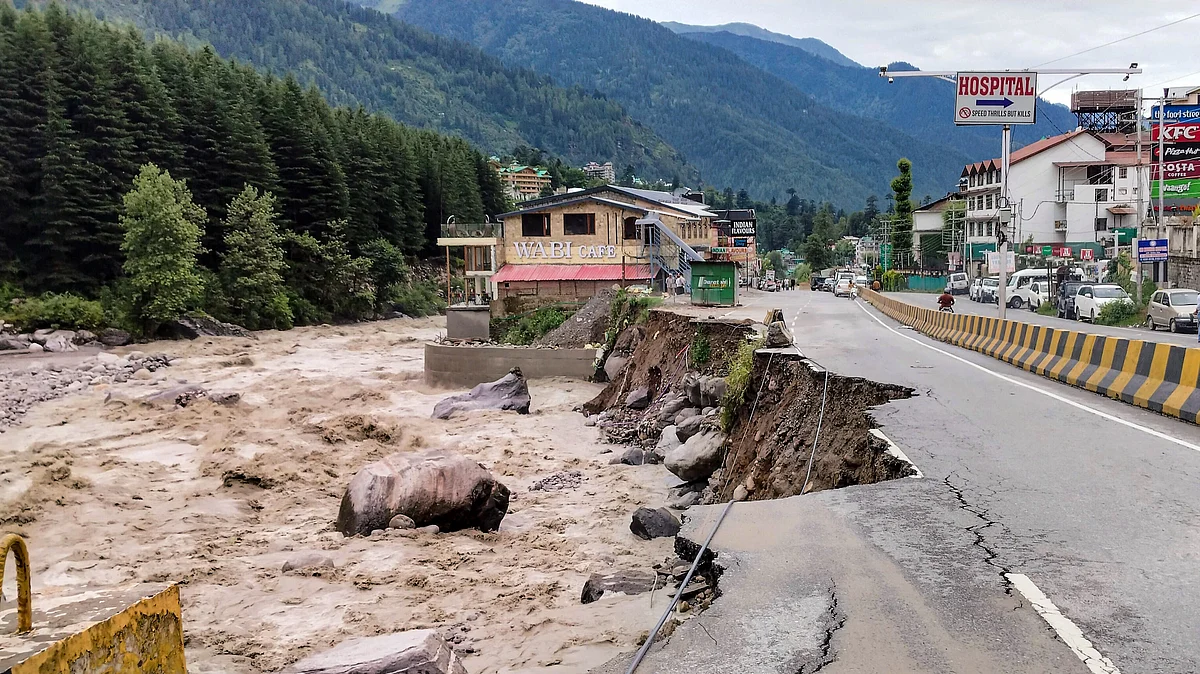
Shimla is reeling under the impact of relentless monsoon rains, with 355 roads including three national highways blocked and more than 1,000 electricity transformers disrupted across Himachal Pradesh. The disruptions have brought transport and essential services to a standstill, highlighting once again the fragility of mountain infrastructure in the face of intensifying weather events.
According to the State Emergency Operation Centre, Mandi district has been the worst hit, where 202 roads including NH-21 remain impassable. Kullu reported 64 road closures including NH-305, while Sirmaur saw 28 blockages, Kangra 27, Chamba nine, Shimla eight, Una seven, and Lahaul and Spiti six. Even the high-altitude Kinnaur region has been cut off in parts, with NH-5 blocked. Smaller disruptions were reported from Bilaspur and Hamirpur.
Electricity supply has taken a severe hit as 1,067 transformers across multiple districts remain out of service. Kullu accounts for more than half of the outages with 557 transformers down, while Mandi reported 385, Lahaul and Spiti 112, Kinnaur 11, and Chamba two. Officials confirmed that restoration efforts are under way, but accessibility to remote areas continues to delay the process. The rains have also crippled water distribution systems, with 116 schemes knocked out. Among them, 44 were affected in Mandi, 41 in Kangra, 14 in Hamirpur, nine in Kullu, four in Shimla, three in Lahaul and Spiti, and one in Solan. Experts warn that prolonged disruption of water supply in vulnerable districts may deepen the hardship of local communities already battling repeated climate shocks.
The Meteorological Department has forecast more rainfall across the state, issuing a yellow warning for 18, 21, 22 and 23 August. It has cautioned of heavy to very heavy showers in isolated pockets, alongside widespread light to moderate rain. Officials indicated that districts such as Mandi, Kangra and Kullu are likely to remain under particular stress given the ongoing road and power shutdowns. Over the past 24 hours, rainfall intensity has varied across Himachal. Mandi’s Kataula village received the heaviest downpour at 120 mm, while Kangra logged 110.8 mm and Nahan 103 mm. Other major centres including Paonta Sahib, Bhuntar, Palampur, Manali and Dharamshala also recorded significant precipitation, leading to rising concerns over slope stability and flash floods.
Experts underline that the crisis exposes the urgent need to climate-proof Himachal’s infrastructure. Expanding reliance on fragile hill roads and overburdened power lines leaves communities vulnerable to even moderate weather disturbances. While authorities rush to restore essential services, planners argue that the state must adopt long-term resilience strategies, including eco-sensitive road design, decentralised renewable power grids and stronger water harvesting systems. For now, residents await relief as rains continue to batter the state, underscoring how Himalayan cities and towns stand at the frontline of climate vulnerability.