


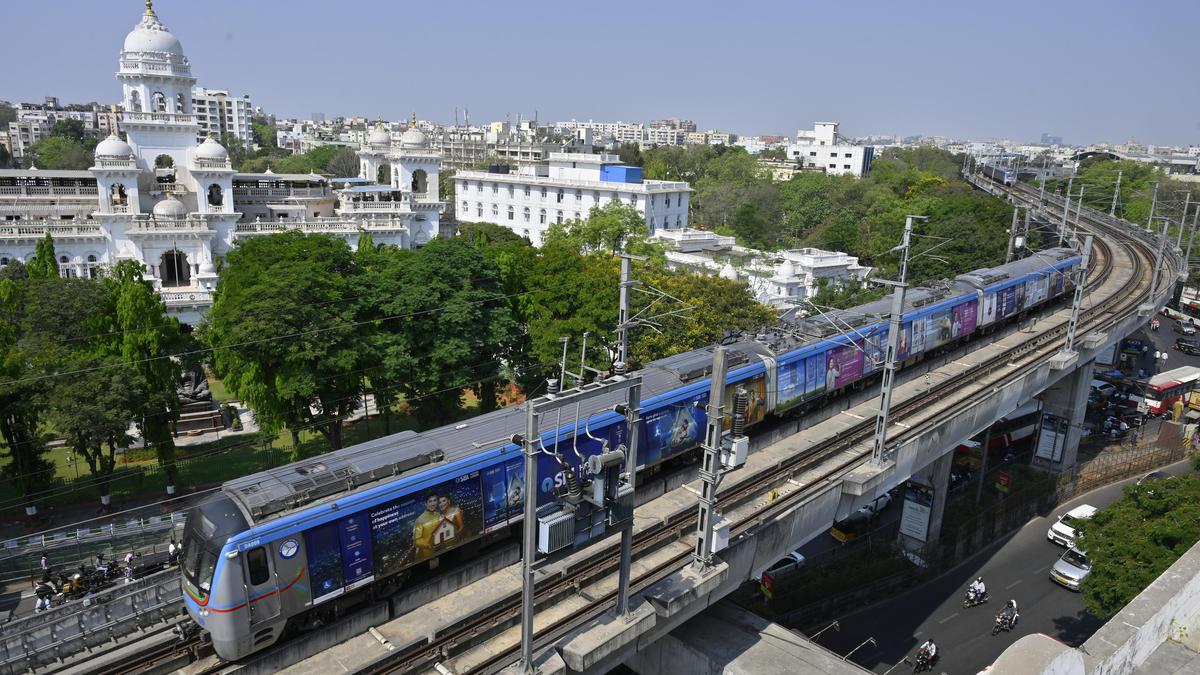
A ₹345 crore flyover proposed between Mailardevpally, Shamshabad and Katedan has reignited debate over the long-pending Shamshabad airport rail link, with mobility experts questioning whether road expansion should take precedence over rail-based connectivity to the city’s international gateway.
The six-lane elevated structure, planned by the Greater Hyderabad Municipal Corporation under the Hyderabad City Innovation and Transformative Infrastructure (HCITI) programme, is intended to streamline traffic heading towards Rajiv Gandhi International Airport and decongest key intersections along the corridor. Officials indicate that the project aims to ensure uninterrupted vehicular movement for airport passengers and freight traffic using the national highway network.However, the announcement has revived calls from transport planners and railway advocates for a direct suburban rail extension from Umdanagar to the airport terminal — a missing link of roughly six kilometres that could enable seamless integration with the existing MMTS suburban system operated by South Central Railway.
Urban mobility analysts argue that while flyovers offer short-term relief, they often struggle to keep pace with induced traffic demand. In contrast, a rail spur forming part of a broader Shamshabad airport rail link could provide high-capacity, lower-emission connectivity aligned with Hyderabad’s long-term climate and congestion mitigation goals.Umdanagar station already functions as a suburban node within the city’s rail network. Extending track infrastructure to the airport precinct, subject to right-of-way clearances and land allocation from airport authorities, could create a multimodal interchange model similar to metro-airport integrations seen in other global cities. Industry observers suggest such a connection could be delivered at comparatively lower capital expenditure than elevated road corridors, particularly if cost-sharing arrangements mirror earlier suburban rail phases.
The debate also intersects with the performance of Hyderabad’s Multi-Modal Transport System (MMTS), which has faced service frequency challenges despite infrastructure upgrades under Phase II. Strengthening the case for an airport-bound rail link could potentially catalyse broader service rationalisation and network expansion, improving daily commuter access across the metropolitan region.Critics of the flyover proposal caution that prioritising vehicle throughput may lock in higher carbon emissions and increased dependence on private cars and airport taxis. They point out that surface transport to the airport remains dominated by road-based modes, leaving cost-sensitive passengers with limited alternatives.
State officials maintain that both road and rail investments are being examined within a larger integrated transport framework. Yet the renewed push for a Shamshabad airport rail link underscores a familiar policy dilemma: how to balance immediate congestion relief with durable, low-carbon mobility solutions.As Hyderabad expands outward and airport passenger numbers continue to rise, the choice between asphalt and rail steel will shape not only travel times, but also the environmental and economic resilience of the city’s transport future.
Shamshabad Infrastructure Push Revives Rail Demand
