


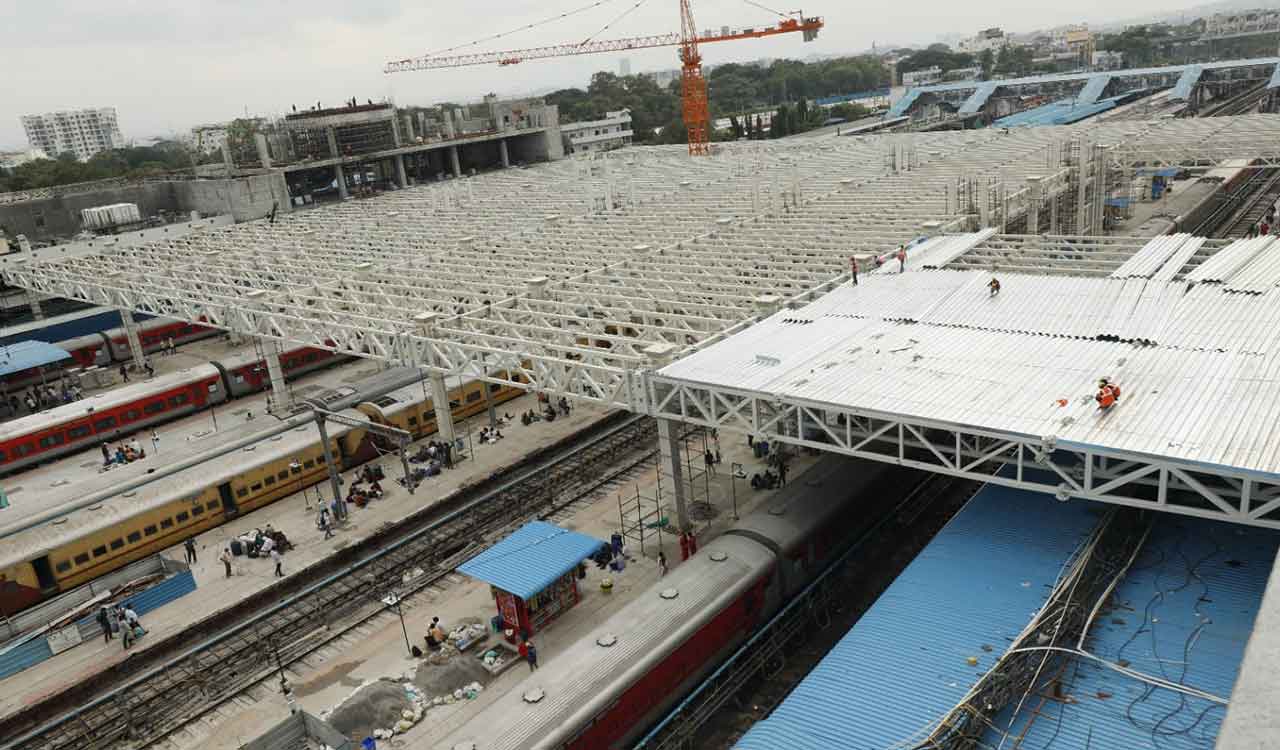
Redevelopment work at Secunderabad railway station has moved into a closely monitored execution stage as senior railway officials conducted a detailed review of construction progress across the terminal. The large-scale upgrade, backed by an investment of over ₹700 crore, is aimed at repositioning one of Hyderabad’s busiest stations as a modern, high-capacity transit hub aligned with future urban mobility demands.
Secunderabad station functions as a critical interchange for long-distance, suburban and regional rail services, serving daily commuters, migrant workers and intercity travellers. With passenger volumes steadily increasing alongside Hyderabad’s outward urban expansion, the redevelopment is intended to address long-standing congestion, accessibility gaps and operational inefficiencies that affect both travellers and railway operations.Officials overseeing the project reviewed works at multiple access points of the station, where structural upgrades are underway to improve circulation and reduce platform-level crowding. New foot overbridges, vertical mobility systems such as escalators and lifts, and expanded waiting areas are being integrated to streamline passenger movement and improve inclusivity for elderly passengers, persons with disabilities and families.
Beyond platform infrastructure, progress has also been assessed on supporting facilities that influence the station’s role within the wider city. These include redesigned booking areas, reorganised entry and exit zones, and multi-level parking facilities intended to reduce surface congestion and improve last-mile connectivity. Urban planners note that such investments are increasingly vital as major railway stations evolve into multimodal nodes rather than standalone transport assets.Project supervisors have been instructed to maintain a balance between construction speed and engineering quality, particularly given the station’s continuous operation during redevelopment. Large infrastructure upgrades in live transport environments carry heightened safety and coordination risks, making sequencing, supervision and compliance critical to long-term performance.
Managing commuter inconvenience has emerged as a parallel focus. Temporary circulation plans, improved wayfinding systems and enhanced passenger assistance are being deployed to ensure continuity of services during construction. Transport operations experts observe that transparent communication and visible on-ground support are essential to maintaining public trust during prolonged redevelopment works.From a broader urban development perspective, the Secunderabad station project reflects a national shift towards people-centric, energy-efficient transport infrastructure. Modernised stations can influence surrounding land use, support transit-oriented development and reduce dependence on private vehicles, contributing to lower emissions and more compact city growth.
As construction advances, attention will increasingly turn to how effectively the redeveloped station integrates with Hyderabad’s metro network, bus systems and pedestrian infrastructure. The project’s success will ultimately be measured not just by new buildings, but by smoother daily travel, safer public spaces and stronger connections between transport and the city it serves.
Also Read:Hyderabad Zone Restructuring Slows Local Infrastructure
