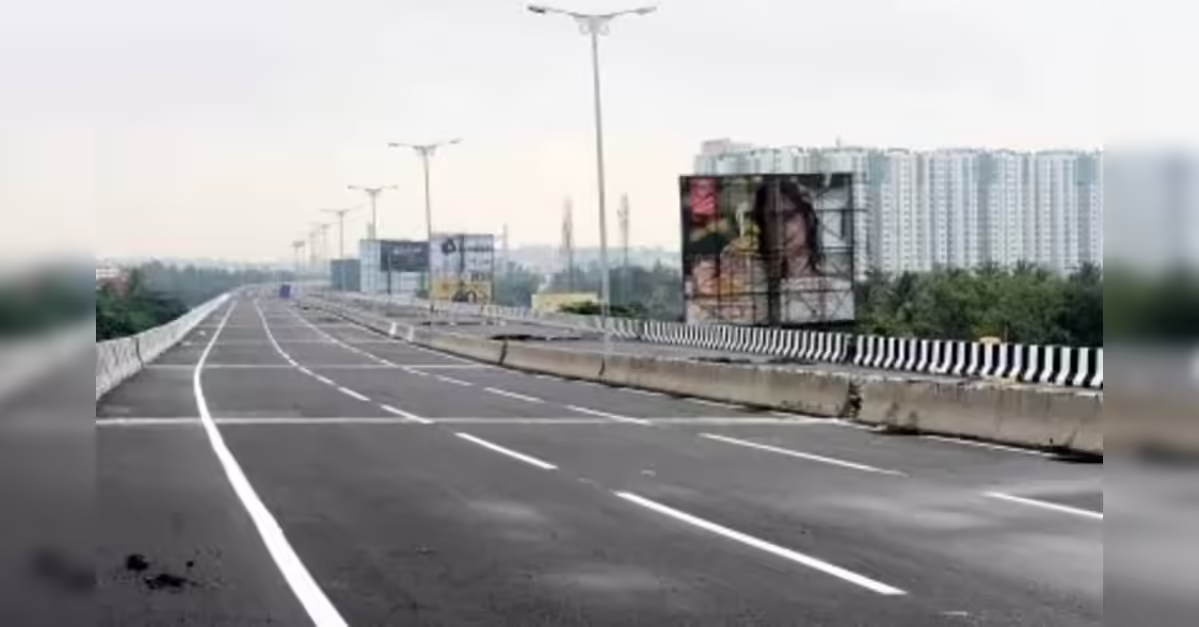
A year-end intercity road journey between Sangli and Hyderabad has offered a revealing snapshot of how uneven highway infrastructure continues to shape mobility choices across the Deccan plateau. Spanning nearly 1,000 kilometres over two days, the cross-state drive highlighted not only stark contrasts in road quality but also the practical realities influencing vehicle adoption, logistics efficiency and regional accessibility.
The Sangli–Hyderabad corridor connects western Maharashtra’s agrarian and industrial districts with Telangana’s capital, a major services and technology hub. While the route is vital for trade, labour mobility and intercity travel, its performance varies sharply by jurisdiction. On the western Maharashtra side, especially up to Solapur, highways remain largely smooth and predictable, supporting higher average speeds and fuel efficiency. This stretch demonstrates the dividends of consistent maintenance and completed four-laning.
Conditions deteriorate significantly east of Solapur towards the state border. Transport planners and frequent highway users have long flagged this zone as a weak link. Poor surface quality, unmarked speed breakers near habitations and uneven bypasses around towns such as Naldurg and Omerga disrupt flow and raise safety risks. For passenger vehicles and freight operators alike, this segment increases travel time variability, vehicle wear and operating costs, undermining the corridor’s economic potential. In contrast, the road experience improves dramatically upon entering Karnataka and Telangana. Wider carriageways, clearer markings and better surface consistency enable smoother cruising and restore predictability. This difference underscores how institutional capacity and sustained investment influence outcomes, even on contiguous national and state highways.
The journey also reflects a broader transition challenge in India’s mobility ecosystem. Despite growing policy emphasis on electric vehicles, long-distance intercity travel remains constrained by charging availability, service reliability and cost structures outside major metros. For many users, particularly those travelling through semi-rural belts, conventional internal combustion vehicles continue to offer greater certainty. This gap points to the need for synchronised planning of highways, charging infrastructure and grid resilience rather than isolated technology adoption.
Urban entry points pose another bottleneck. Approaches to Hyderabad, especially around Sangareddy, remain heavily congested due to ongoing construction and traffic mixing. While orbital roads and expressways have eased movement within the metropolitan region, last-mile integration during expansion phases continues to affect commuter experience and freight turnaround times. From an urban development perspective, the Sangli–Hyderabad drive illustrates how infrastructure quality directly influences regional integration. Reliable highways reduce economic distance, encourage decentralised growth and support climate goals by cutting idling and detours.
Conversely, neglected stretches shift traffic to riskier driving behaviour and increase emissions through stop-start movement. As multiple states invest in expressways and logistics corridors, attention must turn to continuity and maintenance, not just headline projects. Closing these infrastructure gaps will be essential if intercity road networks are to support equitable growth, safer travel and a smoother transition to cleaner mobility across India’s emerging city regions.
Sangli Hyderabad Highway Exposes Infrastructure Gaps