


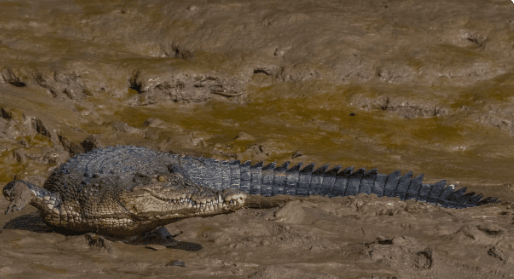
The Indian Sundarbans has shed new light on the habitat preferences and ecological adaptations of saltwater crocodiles. Released recently, the crocodile census report reveals crucial data regarding their population, habitat preferences, and environmental adaptations, offering valuable insights into their conservation and management.
According to the survey findings, the Indian Sundarbans is currently home to an estimated 204-234 saltwater crocodiles. The study highlighted their preference for creeks with widths less than 170 metres, where sightings were most frequent during high tide periods. Conversely, sightings were significantly reduced in creeks and rivers wider than 250 metres, indicating a clear preference for narrower water bodies. Salinity tolerance emerged as another critical factor affecting crocodile distribution, with optimal conditions observed between 14 and 26 parts per thousand (PPT) of salt in the water. The study, conducted over three days in January, also identified an ambient temperature range of 20 to 28°C as most conducive for crocodile basking activities. Notably, maximum sightings occurred when the ambient temperature hovered around 22.7 degrees Celsius, slightly above the water surface temperature of 20-22°C. Field experts emphasized that rising salinity levels due to environmental factors could potentially reduce suitable habitat areas for these crocodiles in the Sundarbans. The survey methodology involved collecting water samples from sighting zones and using refractometers to measure salinity levels accurately.
The forest department has committed to continuing the survey annually for the next three years, spanning the months of November, December, and January. This extended monitoring period aims to track long-term trends in crocodile population dynamics and habitat conditions amidst environmental changes. Commenting on the study’s implications, a seasoned herpetologist involved in the survey underscored the stable population status of Sundarbans crocodiles while raising concerns about future challenges. The expert highlighted the potential impact of global warming on crocodile populations, particularly the skewed male-female ratio due to temperature-dependent sex determination in crocodile embryos. The survey represents a significant milestone in understanding and conserving the unique ecosystem of the Sundarbans, emphasizing the need for ongoing research and proactive conservation measures to safeguard the habitat and population of saltwater crocodiles in this ecologically sensitive region.
