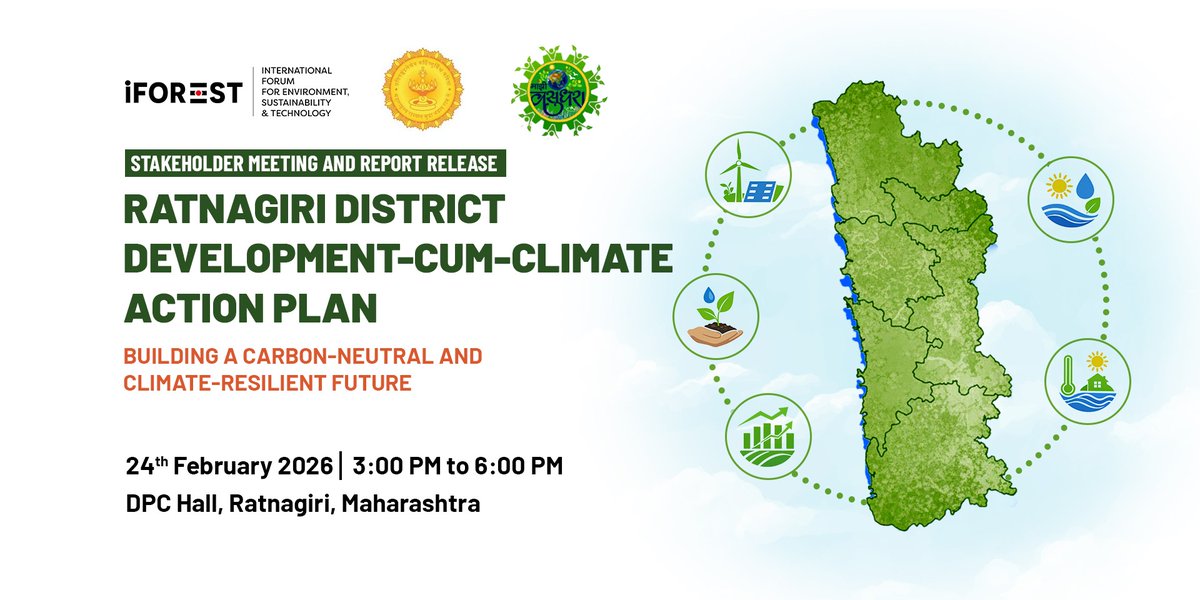
Ratnagiri Unveils Climate Action Development Strategy
In a first-of-its-kind initiative within the state, Ratnagiri district has launched a District Development-cum-Climate Action Plan that places climate resilience and renewable energy at the centre of its economic blueprint, prioritising solar-powered infrastructure, resilient public assets and strengthened agricultural value chains. The strategy seeks to safeguard livelihoods while aligning local development with broader statewide sustainability goals.
The comprehensive plan introduces solar pump deployment to improve energy-efficient irrigation, alongside infrastructure designed to withstand climate-related stresses such as erratic rainfall and coastal weather patterns. District planners have also proposed a dedicated climate cell to monitor evolving climate risks and ensure that sustainability principles are integrated across sectors — from agribusiness to fisheries and transport links.Officials describe the approach as pragmatic and forward-looking. By weaving renewable solutions into public projects, Ratnagiri aims to reduce dependency on conventional energy sources while boosting farm productivity through reliable water access. Solar pumps, for instance, can help electrify irrigation without escalating grid loads, supporting farmers’ resilience against power fluctuations and commodity price volatility.
Urban and rural development experts say this model resonates with emerging climate-adaptive infrastructure trends that anchor economic growth to environmental sustainability. Maharashtra has been building momentum on renewable initiatives, including large-scale solar pump deployment under state schemes that have set records for off-grid installations and reduced energy costs for agriculture.Beyond energy, the plan highlights climate-proofing critical public assets — roads, water systems, market facilities — to reduce vulnerability to extreme weather events and ensure continuity of services for residents and businesses. Strengthening the fisheries value chain is also central given the district’s coastal economy, where climate variability directly affects catch cycles and livelihoods.
Farmers in the region have welcomed moves that could stabilise water supply and reduce input costs, while environmental planners view the climate cell as a tool to coordinate risk assessments and implement targeted adaptation measures. This coordination is vital in regions like the Western Ghats and Konkan coast, where ecological sensitivity and economic activity intersect.However, experts urge attention to financing mechanisms. Long-term sustainability will depend on aligning district initiatives with state and central climate funds, mobilising private investment, and tapping into national renewable programmes. Integrating local climate goals with broader urban-rural infrastructure planning can help attract capital and provide stable returns for investors aware of growing climate risks.
As Ratnagiri steps into this comprehensive development model, stakeholders say the blend of renewables, resilient infrastructure and climate governance could serve as a template for other districts aiming to balance growth with environmental stewardship. The next phase will involve detailed implementation roadmaps, stakeholder consultations and monitoring frameworks to track progress against climate and development benchmarks.