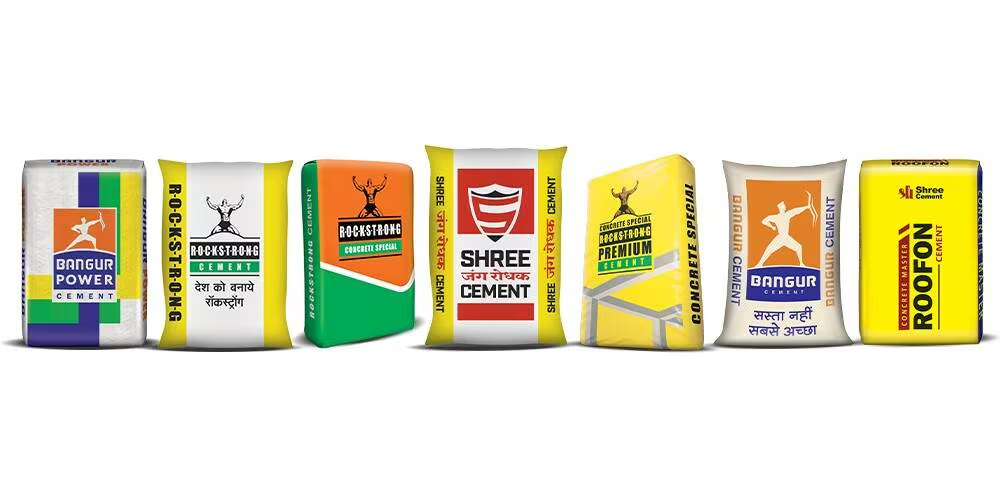
A unit of one of India’s largest cement manufacturers has clinched a top state-level energy efficiency accolade, underscoring how industrial decarbonisation and resource optimisation are gaining traction within heavy manufacturing. Shree Cement’s Khushkhera Grinding Unit in Rajasthan was recognised with the Rajasthan Energy Conservation Award 2026 for achieving the lowest specific energy consumption among cement sector peers, reflecting wider industry shifts toward sustainability and operational excellence.
The award, conferred by the Rajasthan Renewable Energy Corporation at Jaipur’s Vidhan Sabha auditorium, signals a strategic pivot across the built environment sectors as companies embed energy management into core production processes. For urban planners, infrastructure developers and real estate markets, more efficient cement production helps lower embedded energy in buildings and infrastructure assets — a key lever in meeting net-zero targets and controlling lifecycle costs. Shree Cement’s Khushkhera facility, located in the industrial belt of Alwar district, was singled out for its performance in lowering specific energy use — a metric that measures the energy consumed per tonne of cement produced. Reductions in specific energy consumption directly cut operational costs and greenhouse gas emissions, benefitting both company margins and environmental performance.
While India’s cement industry remains energy-intensive, the recognition highlights progress on efficiency fronts. Sector analysts point out that meeting rising demand from housing, transport infrastructure and commercial construction increasingly depends on technology upgrades, smarter process control and adoption of alternative fuels. Improved energy efficiency not only enhances competitiveness but also supports compliance with stricter emissions standards emerging across states. Shree Cement has been advancing multiple sustainability measures in recent years, including scaling renewable energy use and waste-heat recovery systems as part of its broader decarbonisation strategy. Industry data shows that the company’s renewable energy generation capacity has been growing, with renewable sources contributing a significant share of overall power consumption — a trend that aligns with industry peers’ moves to reduce carbon footprints and strengthen resilience against fossil fuel price volatility.
For Rajasthan’s industrial ecosystem, awards such as the Energy Conservation recognition serve as both a benchmark and an incentive. State authorities have been promoting energy efficiency across sectors to reduce energy intensity and support climate goals. Cement producers operating in the state are now under increasing pressure to align with these aims, especially as construction activity accelerates in tier-II and tier-III cities, driving demand for building materials. Critically, improved energy performance also has socio-economic implications. Lower production costs can ease pricing pressures for housing and urban infrastructure projects, indirectly influencing affordability. Meanwhile, enhanced energy management supports grid stability in energy-stressed regions by reducing peak electricity demand from industrial load.
Looking ahead, sustaining gains in energy efficiency will require continued investment in technology, workforce skill development and cross-sector collaboration. As India targets a low-carbon growth trajectory, recognition of industrial energy performance — like that awarded to Shree Cement’s Khushkhera unit — may become a pivotal metric of competitiveness and climate stewardship in the built environment.