


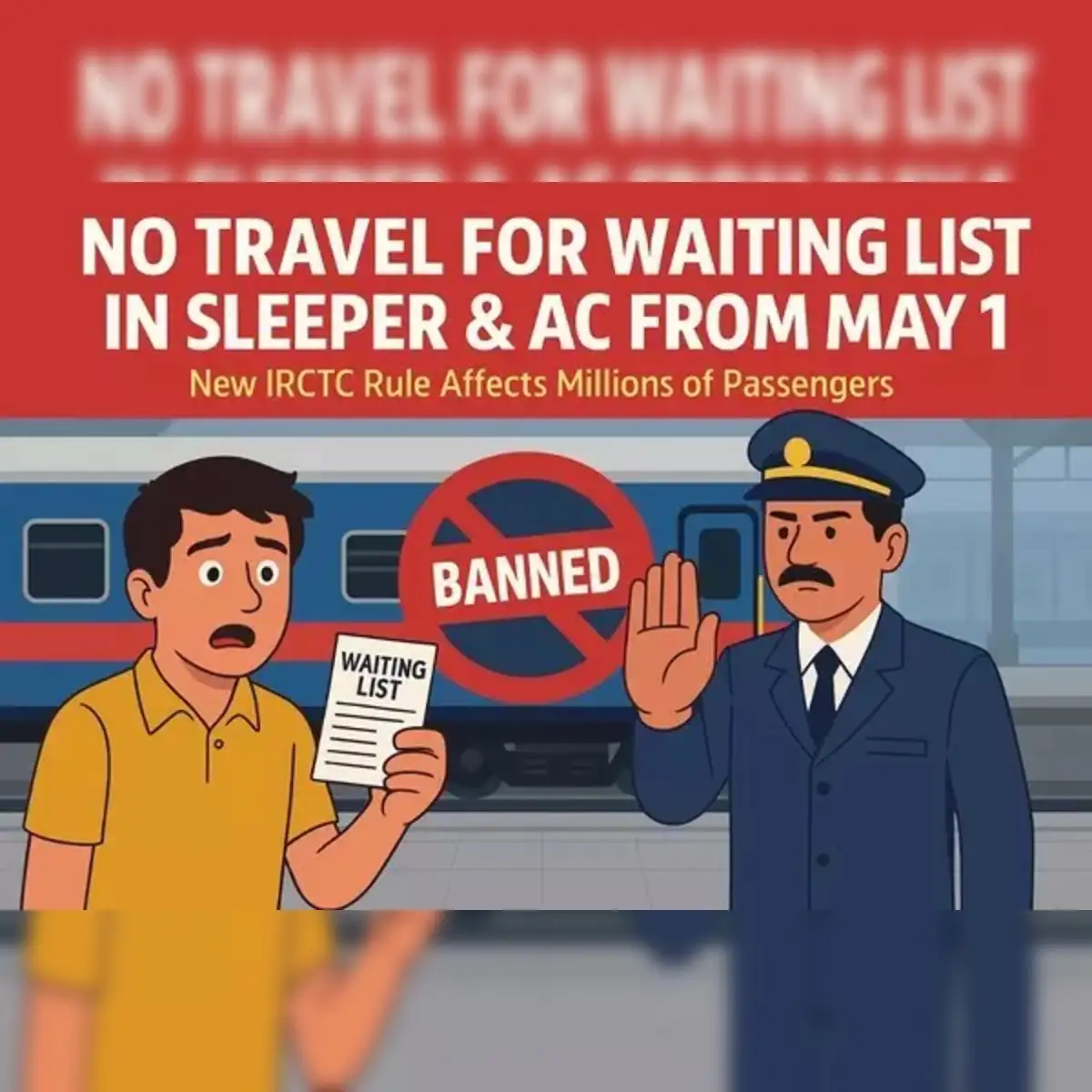
Indian Railways has implemented a sweeping policy shift starting May 2025, barring passengers with waitlisted tickets from entering or occupying seats in reserved Sleeper and Air-Conditioned (AC) coaches.
This strict enforcement measure—backed by financial penalties and intensified ticket verification processes—seeks to curb unauthorised travel, reduce chronic overcrowding, and restore comfort for passengers with confirmed tickets. The revised policy signals a strong administrative intent to reform how reserved coach travel is regulated in the country. From now on, only passengers with confirmed ticket status at the time of boarding will be allowed into Sleeper and AC compartments, with penalties of ₹250 and ₹440 levied on violators in Sleeper and AC classes, respectively. Additionally, fare collection from the point of boarding to the next station will be enforced as part of the deterrent mechanism.
Railway officials confirmed that Travelling Ticket Examiners (TTEs) have been instructed to ensure strict compliance on all trains, including long-distance express services where waiting list ticket holders have traditionally attempted to travel in reserved coaches, especially during peak seasons. The change has prompted a nationwide dialogue on passenger equity and the future of affordable rail travel. For Indian Railways, which ferries over 22 million passengers daily, the priority appears to have decisively shifted toward comfort, orderliness, and a digitally fortified reservation system.
Accompanying the waitlist travel ban is a significant operational shift: the Advance Reservation Period (ARP) has been slashed from 120 days to 60 days. This change is expected to reduce speculative bookings and improve ticket accessibility for genuine travellers planning closer to their date of journey. Officials said that the decision was taken after extensive demand analysis and behavioural study of booking patterns, which showed a sharp rise in last-minute cancellations and fraudulent use of waitlisted tickets. To further bolster the integrity of bookings, Indian Railways has rolled out mandatory One-Time Password (OTP) authentication for all online ticket purchases via the IRCTC platform. This requirement aims to counter ticket scalping and ensure that every reservation is traceable and linked to an authenticated mobile number.
Transport experts have welcomed the move as a decisive attempt to align India’s railway systems with global best practices, particularly in prioritising confirmed passengers’ rights. “This is about asserting the value of a confirmed seat and discouraging the chaotic scramble seen in reserved coaches for years,” said a railway policy analyst based in New Delhi. For decades, the norm in Indian trains has allowed waitlisted passengers to board in the hope of accommodation through chart updates, TTE negotiations, or vacated seats. This ambiguity often led to disputes, overcrowding, and discomfort for ticketed passengers who found their reserved seats already occupied or shared.
Officials from the Ministry of Railways acknowledged that the new regime may be inconvenient for some, particularly daily commuters and budget-conscious travellers who previously banked on waitlisted tickets and onboard negotiations. However, they emphasised that unreserved General coaches will remain accessible without the need for a confirmed reservation, ensuring that travel remains inclusive. The structural shift is particularly relevant at a time when Indian Railways is modernising its network through Vande Bharat semi-high-speed trains, upgraded terminals, electrification drives, and AI-based ticketing systems. These changes underscore a broader transformation from legacy practices to a smarter, tech-driven public transport ecosystem.
Passenger rights groups have largely supported the move, seeing it as a measure that protects the dignity of paid travel while promoting a more predictable journey experience. Yet, concerns linger over the potential impact on economically vulnerable groups who rely on flexibility and affordability in train travel. To address this, experts are urging Indian Railways to launch comprehensive awareness campaigns. “Clarity and communication will be key. Passengers must know their rights and responsibilities under the new rules to avoid conflict and fines,” said a senior advisor from a public transport advocacy organisation.
Digital literacy, too, is coming into focus, with stakeholders encouraging increased familiarity with the IRCTC mobile app, new verification norms, and the ARP revision. Officials advised frequent travellers to adopt proactive travel planning strategies and to remain informed of dynamic seat allocation mechanisms, which aim to redistribute vacant seats more efficiently during the booking lifecycle. The broader shift towards disciplined occupancy in reserved compartments is also seen as a step toward more sustainable and equitable rail operations. Overcrowded trains not only present safety concerns but also strain energy use, operational efficiency, and on-board services like sanitation and air-conditioning—impacting both the passenger experience and carbon footprint.
As Indian Railways moves toward carbon-neutral goals through electrification and increased renewable energy usage, streamlining passenger flow is an essential part of sustainable transport planning. Removing unauthorised occupancy in reserved coaches is, therefore, not merely a matter of order but one of environmental accountability as well. While public reaction to the rules remains mixed, with some travellers wary of the reduced flexibility, the overarching sentiment among confirmed passengers is one of relief. “It’s about getting what you paid for,” said a passenger rights consultant. “You cannot promote equity by allowing chaos in a system that’s meant to be structured.”
Industry observers suggest this could be the beginning of a larger recalibration of how public transport services in India are delivered—moving away from informal practices toward data-backed, service-oriented models. In this light, the policy may serve as a blueprint for reforms in other sectors, including bus services, urban metros, and regional air travel. As the transition unfolds, all eyes will remain on the ability of Indian Railways to enforce these rules uniformly across zones, educate passengers effectively, and retain its core promise of accessibility, affordability, and efficiency—values deeply ingrained in the nation’s public transport ethos.
If executed with consistency and compassion, this change could redefine Indian Railways not just as a transport provider, but as a symbol of modern, citizen-centric infrastructure in a rapidly urbanising India.
Also Read : Western Railway Cancels Trains for Bridge Work in Gujarat
Railways Bans Waitlisted Travel in AC Coaches
