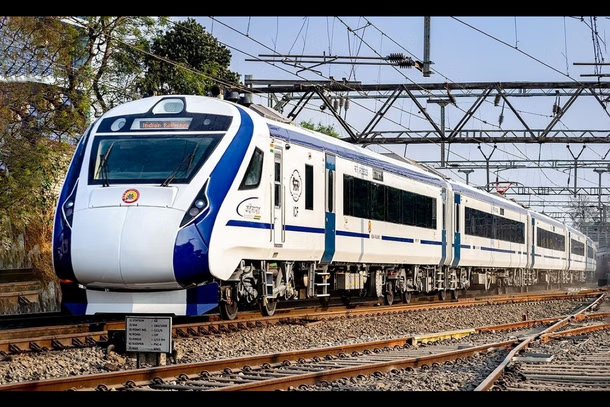
A newly sanctioned rail corridor in Punjab is expected to deliver ripple effects across the National Capital Region (NCR), easing congestion on key north Indian rail arteries that feed into Delhi. While the project is geographically located between Rajpura and Mohali, railway planners see it as a strategic intervention that strengthens the wider network serving Delhi, Gurugram, Noida and Ghaziabad.
The 18-kilometre rail link creates a direct alignment between southern Punjab and the Chandigarh region, allowing long-distance trains to bypass the overburdened Ambala junction. Ambala remains one of the most critical gateways into NCR-bound routes, handling heavy passenger and freight volumes daily. By diverting select services away from this choke point, capacity is expected to free up on tracks that ultimately connect to Delhi and surrounding NCR cities.
Transport analysts say such decongestion has outsized benefits for NCR commuters. Delays at upstream junctions often cascade into platform overcrowding and timetable disruptions in Delhi, particularly during peak seasons and festival periods. Reducing pressure before trains reach NCR can improve punctuality and operational resilience across the region’s already saturated rail system. The project has been classified as a priority rail scheme, enabling faster administrative clearances and accelerated land acquisition. Railway authorities have initiated acquisition processes, signalling intent to avoid the execution delays that have historically affected infrastructure projects influencing NCR mobility. Officials involved in network planning describe the corridor as part of a shift from city-centric upgrades to corridor-level solutions that address congestion at its source.
Beyond passenger movement, the rail link is expected to improve freight circulation into NCR markets. Industrial and agricultural goods from Punjab often move through Ambala before heading towards Delhi consumption centres. A more direct routing improves turnaround times and reduces fuel usage, aligning with broader goals of lowering emissions associated with long-haul road transport into NCR. Urban planners note that the NCR’s sustainability challenge cannot be solved only within its administrative boundaries. Investments in surrounding states play a critical role in managing commuter inflows, logistics traffic and environmental stress. By strengthening rail infrastructure outside NCR, authorities can reduce pressure on roads, cut pollution exposure and support more balanced regional growth.
The project also complements a wider programme of rail surveys and capacity planning underway in Punjab, covering new lines, track doubling and gauge upgrades. This network-wide approach is increasingly seen as essential for cities like Delhi, where transport demand is shaped by migration and economic linkages far beyond the region itself. As construction timelines and coordination mechanisms take shape, attention will focus on how quickly network-level benefits materialise. If executed as planned, the corridor could serve as a model for how targeted rail investments outside NCR can deliver tangible mobility, economic and environmental gains for India’s largest urban region.
Railway Upgrade Outside NCR Eases Delhi Corridor Load