


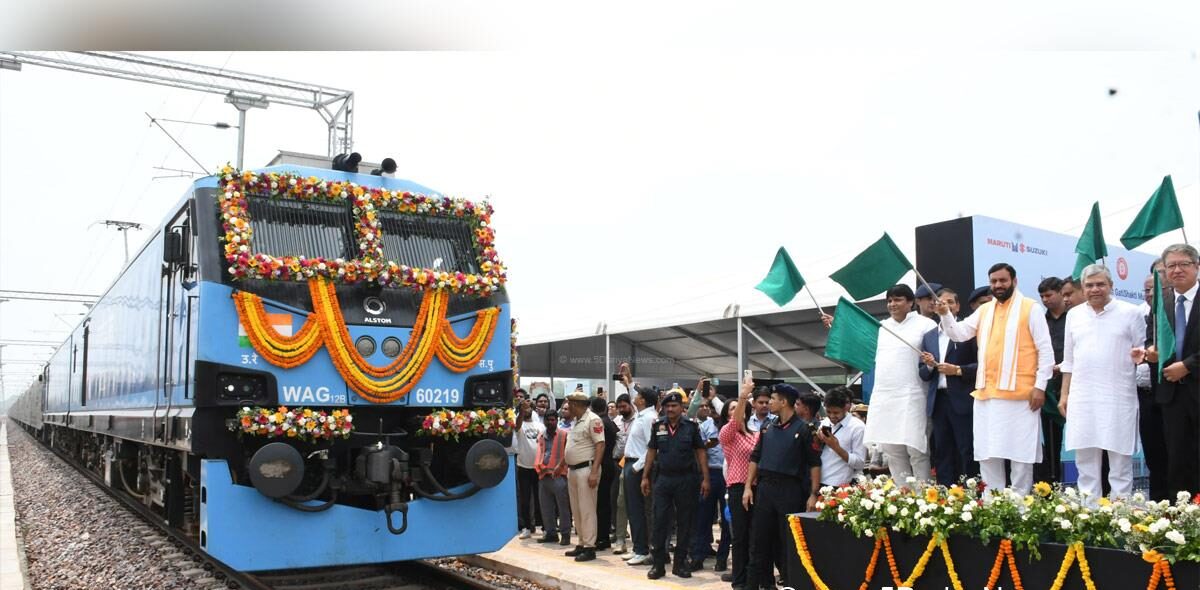
India’s largest Gati Shakti Multi‑Modal Cargo Terminal was officially inaugurated this week at Maruti Suzuki’s Manesar plant, marking a major leap in freight logistics under the national Gati Shakti Master Plan. The new hub, opened by the Union Railway Minister and the Haryana Chief Minister, promises to transform vehicle dispatch and green logistics across northern India.
Constructed on 46 acres with ₹11,709.1 crore in capital investment, the terminal includes an 8.2 km in‑plant rail siding connected via a dedicated 6.9–10 km link to Northern Railway at Patli, as part of the Haryana Orbital Rail Corridor (HORC) initiative. This enables direct loading of cars onto rail rakes within the factory, bypassing road transport entirely. With an annual handling capacity of 450,000 vehicles, the hub is expected to significantly reduce road pollution and congestion. By shifting freight to rail, it aims to save 60 million litres of fuel and avoid 175,000 tonnes of CO₂ emissions each year at full capacity.
The terminal will facilitate vehicle transport from Manesar and Gurugram factories to 17 logistics hubs across 380 Indian cities and to export ports, including Mundra and Pipavav, via the Western Dedicated Freight Corridor. Industry leaders emphasise the facility’s role in integrating Haryana’s automotive output into global supply chains. Officials highlighted the move away from trucks towards rail as pivotal to India’s green logistics strategy and fulfilling Net Zero goals by 2070. Maruti plans to shift 35% of its vehicle dispatches onto railways by 2030–31—a notable rise from 24% in the preceding year.
This launch coincided with broader rail network enhancements in Haryana, where recent investments have included full electrification of lines, rollout of 823 km of new track (exceeding the rail network of the UAE), construction of 540 overbridges and underpasses, and redevelopment of 34 Amrit Bharat stations. Additionally, 100 Mainline EMU (MEMU) trains and 50 Namo Bharat passenger trains were announced. The HORC, spanning 121.7 km and due for completion by March 2025, will link industrial centres such as Palwal, Manesar, Sohna and Sonipat, alongside expressways and the WDFC freight corridor—underscoring the terminal’s strategic role in a fully integrated transport ecosystem.
Urban planning analysts note that the Manesar facility exemplifies India’s shift towards sustainable logistics models. By internalising dockside loading and enhancing rail connectivity, the terminal advances both industrial efficiency and environmental stewardship—a dual imperative in modern urban governance. That said, the initiative will test its operational success against coordination challenges, such as synchronising with ports, managing freight tariffs, scheduling rakes, and integrating last-mile infrastructure—without which projected gains may remain aspirational.
Nonetheless, this facility stands as a physical and strategic milestone: a tangible outcome of Gati Shakti’s multimodal ambitions and a template for greener, smarter supply chains. As the first cargo train departed this week, it brought with it both vehicles and a compelling signal—that India’s logistics vision is now being freighted into reality.
Also Read : Navi Mumbai Metro Launches QR Ticket System for Commuters
