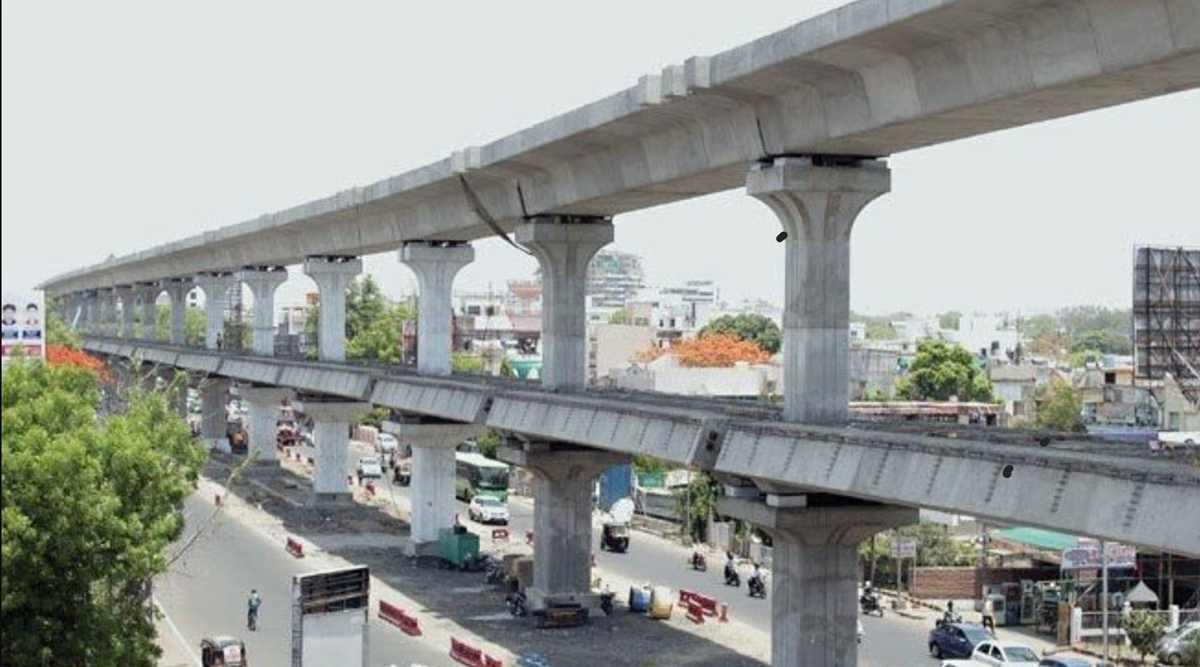
Pune’s western transport corridor received a major infrastructure upgrade on Sunday with the opening of a double decker flyover at the Savitribai Phule Pune University junction one of the city’s busiest traffic intersections. The new structure is designed to streamline vehicle movement while accommodating a parallel metro corridor, reflecting the city’s attempt to combine road and rail infrastructure in limited urban space.
Developed by the regional metropolitan authority, the double decker flyover stretches roughly 1.7 kilometres including approach ramps and forms part of the mobility network connecting Baner, Aundh, Pashan and Shivajinagar. The junction serves thousands of commuters daily, particularly office workers travelling towards the Hinjewadi technology hub and students heading to nearby educational institutions. City officials say the integrated structure combines two layers of urban mobility road traffic on one deck and a metro alignment on the other. The arrangement reduces land acquisition pressures while supporting future public transport expansion along the Hinjewadi–Shivajinagar Metro Line 3 corridor.
Urban planners note that the intersection historically experienced prolonged congestion during peak hours. Vehicles moving between western Pune’s residential neighbourhoods and the city centre often spent up to 30 minutes navigating the junction. Transport engineers involved in the project believe the new flyover system could significantly shorten that delay by separating through traffic from local road movement. The project also illustrates a growing trend in Indian cities where transport infrastructure must accommodate rising vehicle ownership alongside investments in mass transit. Rather than constructing independent structures for each system, integrated engineering solutions are increasingly being adopted to optimise land use in dense urban corridors.
The flyover is supported by a single-pier design capable of carrying both road and metro loads, with a large steel girder installed at the central crossing to support the structure over the busy intersection. Engineers say this approach minimises ground-level obstruction and keeps the junction operational while supporting heavy structural loads. Construction began after an earlier flyover at the site was removed during the pandemic period to make way for the upgraded structure. Work progressed in phases, with parts of the corridor gradually opened before the full integration was completed this month.
Transport specialists say infrastructure upgrades in western Pune are becoming increasingly critical as the region continues to grow as a residential and employment hub. Localities such as Baner, Aundh and Pashan have seen significant real estate development over the past decade, driven partly by their proximity to the IT district of Hinjewadi. However, planners caution that road infrastructure alone cannot resolve long-term congestion challenges. Integrated mobility strategies combining public transport, pedestrian access and climate-conscious urban design will remain essential as Pune expands. With the double decker flyover now operational, authorities expect improved traffic distribution along University Road. The project also signals how future transport infrastructure in rapidly growing cities may need to balance efficiency, land constraints and sustainable urban mobility.
Pune Western Corridor Gains Double Decker Flyover