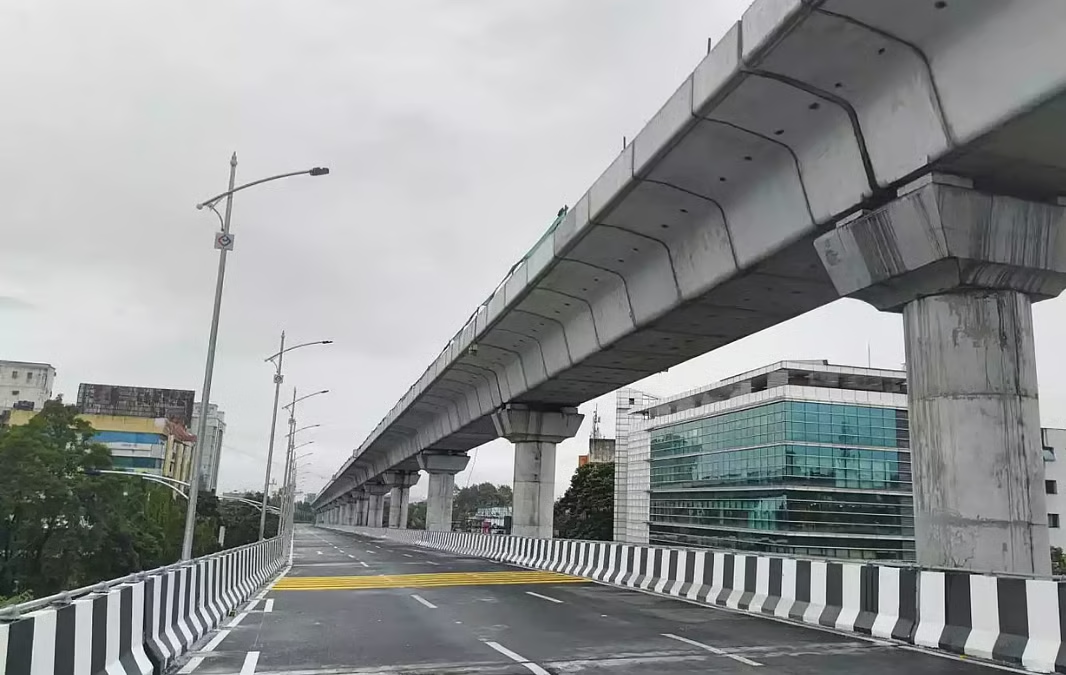
A major transport intervention aimed at easing congestion in western Pune has become operational with the opening of the University Chowk Double Decker Flyover, an integrated road and metro structure located near Savitribai Phule Pune University. The 1.7-kilometre corridor, built by the regional metropolitan authority, is expected to streamline vehicle movement across one of the city’s most congested junctions while preparing the route for a future metro connection linking the IT hub of Hinjewadi with the city centre.
The University Chowk Double Decker Flyover represents a growing trend in urban infrastructure where road and rail systems are layered within a single corridor to maximise space efficiency. In Pune, where rapid expansion of residential neighbourhoods and technology campuses has intensified transport demand, such designs are increasingly being adopted to minimise land acquisition and manage limited urban space.
Located along Ganeshkhind Road, the junction near the university has historically served as a key gateway between several high-density neighbourhoods. Commuters travelling between Baner, Aundh, Pashan and Shivajinagar routinely encountered bottlenecks at traffic signals, particularly during peak office hours when thousands of technology professionals travel toward the Hinjewadi technology corridor.
Officials involved in the project say the University Chowk Double Decker Flyover has been designed to address both present and future mobility needs. The lower deck functions as a multi-lane road flyover allowing vehicles to bypass the signalised intersection, while the upper level has been engineered to carry the viaduct for the upcoming Hinjewadi–Shivajinagar Metro Line 3. Engineers adopted a single-pier structural system capable of supporting both levels of transport infrastructure. The design also includes a central steel span across the intersection and several ramps connecting surrounding roads, allowing vehicles from different directions to merge and disperse more efficiently. According to project officials, the full structure extends roughly 1.7 kilometres when ramps and connecting sections are included.
Urban mobility specialists say integrating metro infrastructure with road flyovers can improve long-term transport resilience in rapidly growing cities. By consolidating infrastructure vertically rather than expanding roads horizontally, authorities can preserve valuable land while preparing corridors for mass transit systems that produce lower emissions compared with private vehicle travel. The project also follows a controversial period when the earlier flyover at the junction was dismantled during the pandemic to allow construction of the new integrated structure. The temporary removal increased traffic pressure across surrounding streets, prompting debate among commuters and local stakeholders.
With the new structure now operational, traffic planners expect signal waiting time at the intersection to reduce significantly once commuting patterns stabilise. However, experts caution that road flyovers alone cannot permanently resolve congestion unless accompanied by stronger public transport adoption.
The future commissioning of the metro corridor above the University Chowk Double Decker Flyover could therefore play a critical role in shaping travel behaviour across western Pune. Once operational, the metro line is expected to link the central city with the Hinjewadi technology district, offering an alternative to car-based commuting. For a city balancing rapid economic growth with rising mobility pressures, the project highlights how integrated infrastructure could help Pune move towards a more coordinated, multimodal transport system while supporting sustainable urban expansion.
Pune University Chowk Double Decker Flyover Opens