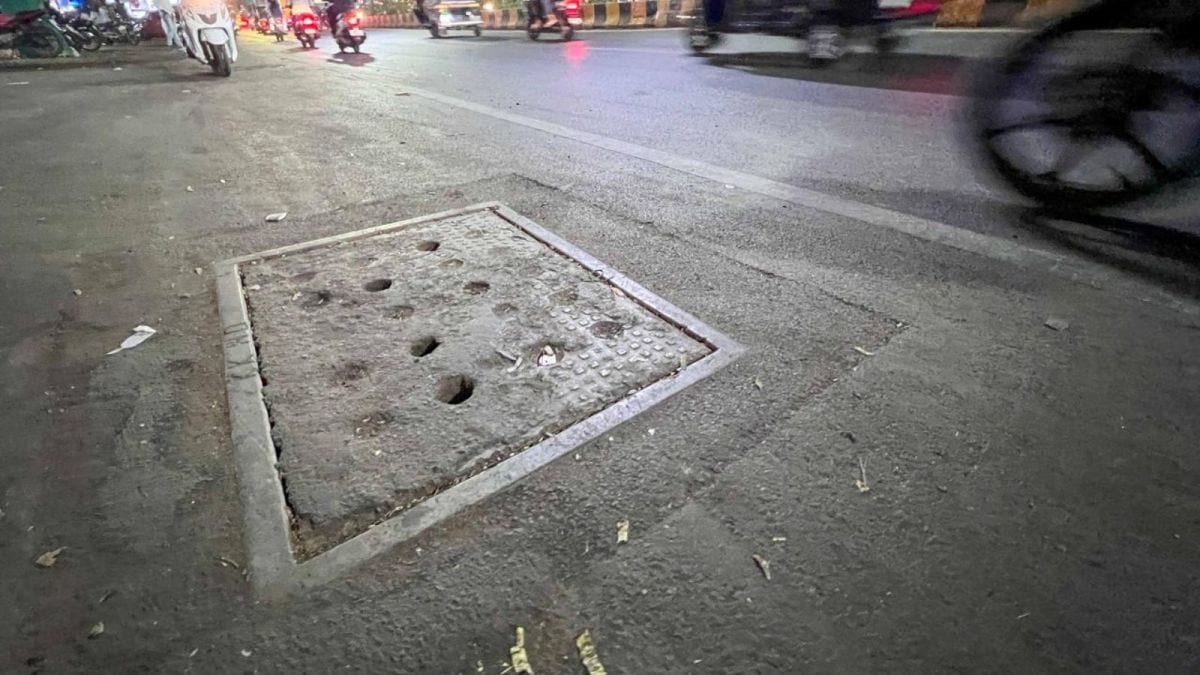
Barely weeks after a major civic road upgrade for an international cycling event, sections of Pune’s newly refurbished carriageways are again under inspection, with multiple road chambers reportedly sinking along the event corridor. The development has triggered questions over construction quality and oversight, particularly given the scale of public expenditure involved.
The Pune Municipal Corporation (PMC) had allocated approximately ₹145 crore to resurface and prepare nearly 75 kilometres of arterial roads ahead of the January cycling showcase. Works included asphalt relaying, levelling of underground utility chambers, repainting of lane markings, pedestrian crossings and medians, and general streetscape improvements intended to meet global event standards.
However, residents and civic observers have since flagged depressions around several chamber covers along the upgraded route. The issue has renewed focus on Pune road chamber repairs, especially on stretches that were recently elevated or re-aligned to create a smoother racing surface.
Municipal officials have acknowledged the complaints and indicated that the contractor responsible for the initial works will be required to rectify defects. A senior civic functionary confirmed that no separate technical inquiry has been ordered, but repairs would be carried out under existing contractual obligations. The administration has also outlined plans to address nearly 1,500 chambers citywide over the coming year. Urban infrastructure specialists say premature settlement of chamber covers typically points to inadequate compaction of surrounding soil, improper bedding, or mismatch between chamber frame levels and the asphalt layer. In high-traffic corridors, even minor depressions can expand quickly due to dynamic loads from buses and heavy vehicles.
Beyond event readiness, the episode raises broader governance concerns. Nearly ₹15 crore of the overall budget was reportedly deployed under urgent provisions to accelerate chamber levelling without a conventional tender process. While expedited procedures are permitted in certain circumstances, public finance experts note that post-completion audits and structural quality checks become even more critical in such cases. The Pune road chamber repairs debate also intersects with the city’s larger mobility ambitions. Pune has positioned itself as a hub for cycling advocacy and low-carbon transport, with investments in non-motorised infrastructure and road safety. For such initiatives to gain public trust, road engineering standards must consistently meet durability benchmarks, not just visual or short-term performance metrics.
Infrastructure economists argue that lifecycle costing factoring in maintenance over 10–15 years is essential for responsible urban expenditure. Repeated surface corrections inflate municipal budgets and increase carbon emissions linked to material use and reconstruction. As PMC moves to undertake further chamber upgrades across the city, the focus will likely shift to quality assurance protocols, independent supervision, and transparent performance guarantees. For a rapidly growing metropolis balancing mobility demands with sustainability commitments, durable execution may prove as important as headline investments.
Pune road chamber repairs spark quality concerns