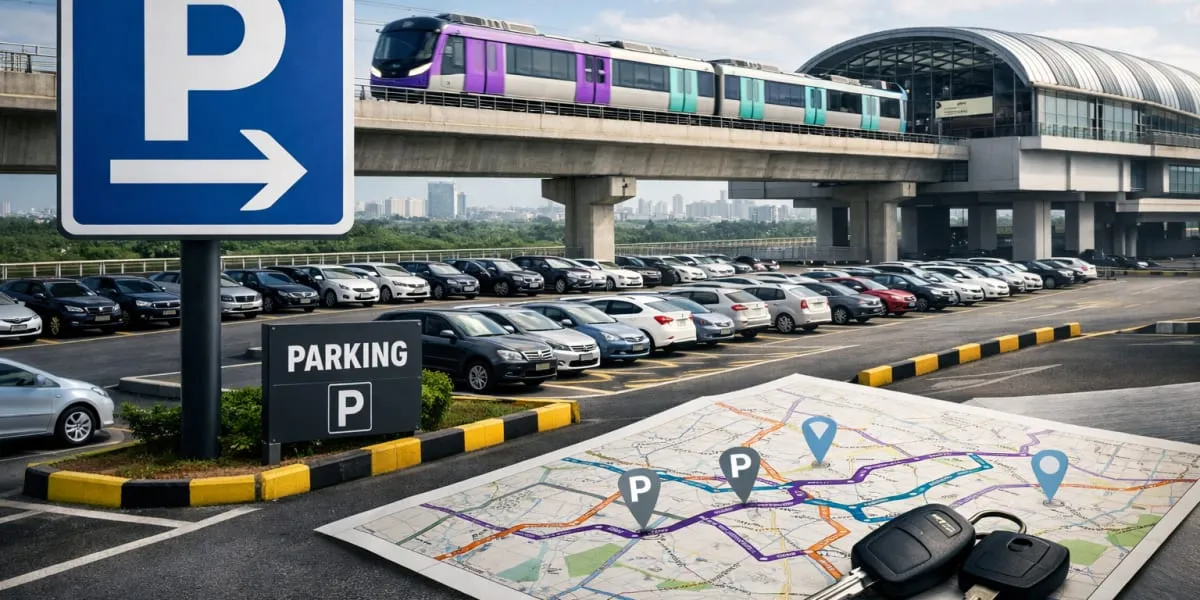
Pune’s civic administration has begun identifying land parcels around metro corridors to create organised vehicle parking facilities, a move aimed at strengthening last-mile connectivity and encouraging greater use of public transport. Municipal officials say around 34 potential sites for Pune Metro parking have been mapped near operational and upcoming stations across the city.
The initiative comes as Pune’s expanding metro network begins attracting higher commuter volumes and authorities look for ways to integrate private mobility with rail-based transport. By enabling park-and-ride facilities close to stations, planners hope to reduce dependence on long car journeys into the city’s busiest areas. According to municipal officials involved in transport planning, the selected sites are spread across multiple metro corridors and have been assessed based on land availability, traffic flow and proximity to station entry points. Some parcels are already under municipal control, while others may require coordination with state agencies or redevelopment of existing open spaces.
Urban mobility specialists say parking infrastructure around rail stations is a critical component of metro systems in rapidly growing cities. Without convenient parking options, commuters living in outer neighbourhoods often continue relying on private vehicles for the entire journey rather than shifting to public transport for the longer segment. The proposed Pune Metro parking network is intended to address this challenge by allowing commuters to drive or ride short distances to stations, park their vehicles safely, and complete the rest of the trip using metro services. Such arrangements are widely used in international transit systems and are increasingly being adopted by Indian cities expanding their urban rail networks.
Transport planners note that Pune’s geography and development pattern make last-mile connectivity particularly important. Many residential clusters are located several kilometres away from metro stations, especially in suburban growth corridors. Organised parking facilities could help bridge that gap until feeder bus routes and other mobility solutions expand. Officials indicate that the facilities may include parking spaces for both cars and two-wheelers, along with designated areas for shared mobility services such as taxis and app-based transport. Some locations may also incorporate bicycle parking to support short-distance commuting and non-motorised transport.
Urban development experts say that well-designed Pune Metro parking facilities must balance convenience with sustainable transport goals. Large parking areas can sometimes encourage additional vehicle use, so planners are increasingly combining them with pedestrian pathways, cycle lanes and feeder bus services to promote a broader mobility ecosystem. The plan also carries implications for land use around metro stations. In several cities, structured parking and mixed-use developments are being integrated with transit-oriented development policies that encourage residential, commercial and retail activity within walking distance of stations.
For Pune, where road congestion and air pollution have been growing concerns, expanding access to the metro network is seen as a key step toward more climate-conscious urban mobility. Experts say the success of the city’s rail infrastructure will depend not only on track length and station coverage but also on how easily commuters can reach the system. Municipal authorities are expected to conduct feasibility studies and detailed planning for the identified sites before construction begins. If implemented effectively, the Pune Metro parking initiative could make metro travel more practical for thousands of commuters while supporting the city’s broader push toward efficient and low-emission urban transport.
Pune Plans Parking Network Around Metro Stations