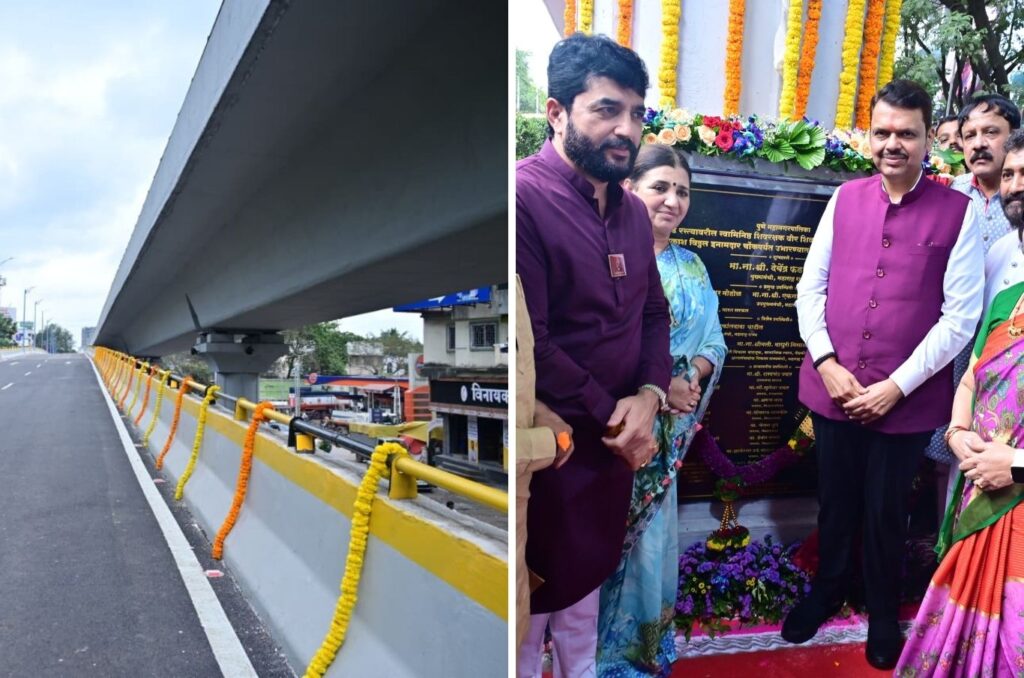
Pune Opens Rs 118 crore Sinhagad Road Flyover Easing Congestion
Pune’s daily commuters finally received long-awaited relief as the 2.6 km Sinhagad Road flyover was officially opened this week, promising faster travel and significantly reduced congestion on one of the city’s busiest stretches.The project, stretching from Rajaram Bridge to Fun Time Theatre, comes at a cost of Rs 118.37 crore and has been executed by the Pune Municipal Corporation (PMC).
For years, traffic bottlenecks along Sinhagad Road have been a persistent issue, with nearly 1.5 lakh vehicles using the corridor daily. With the new flyover now functional, travel time across six previously congested junctions has dropped from 30 minutes to under 6 minutes.According to officials, the flyover is not merely a transport upgrade but also a measure towards reducing vehicular emissions. By cutting long waiting times at intersections, the project is expected to lower fuel consumption and air pollution, directly benefiting residents along the stretch.
Civic authorities described the development as a major milestone in improving mobility and quality of life in the western suburbs.The road has long been considered a lifeline for residential areas such as Dhayri, Narhe, Khadakwasla, Vadgaon Budruk, and Nanded City, while also providing a vital link to the Mumbai–Bengaluru National Highway. With land expansion restricted by the Mutha River on one side and hills on the other, elevated roadways were seen as the only practical solution.Work on the project began in September 2021 and was divided into three phases. The first phase covered Rajaram Pool Chowk with a 520-metre segment, followed by a 2.1 km stretch between Vitthalwadi and Fun Time Theatre in phase two, and a connector between Veer Shivaji Kashid Chowk and Prakash Vitthal Inamdar Chowk in the final phase.
The completed flyover integrates these segments into a continuous elevated corridor.The project also includes ancillary works such as upgraded three-lane service roads beneath the structure, pedestrian-friendly pavements, organised parking, and urban beautification drives. Maintenance for these facilities will be managed under corporate social responsibility (CSR) initiatives for the next five years, ensuring the infrastructure remains in usable condition.
Urban planners note that the project is a step towards building sustainable cities by prioritising smoother transport and reducing congestion-related pollution. Experts have further highlighted that such infrastructure boosts not only improve commuting efficiency but also support economic activities by ensuring uninterrupted connectivity to regional highways.While the flyover may not single-handedly solve Pune’s traffic challenges, it is a significant stride in addressing congestion along one of its most strained corridors. For lakhs of commuters who have long endured gridlocks, the new infrastructure is expected to redefine the daily travel experience and ease the environmental burden of traffic-related emissions.