Pune Mumbai Missing Link Reshapes Expressway Travel
A major realignment of western India’s most heavily used intercity corridor is nearing completion, with the Mumbai–Pune Missing Link poised to alter how people and freight move between the two economic centres. The 13.3-kilometre infrastructure intervention, built to bypass the accident-prone Khandala Ghat section, is expected to become operational in early May, according to officials familiar with the project timeline.
The Mumbai Pune Missing Link addresses a long-standing structural constraint on the expressway, where steep gradients, sharp curves, and lane mergers have historically slowed traffic and increased collision risks. By cutting directly through the Sahyadri range, the new alignment removes a 19-kilometre hill stretch and reduces pressure on both the expressway and the parallel national highway, which together funnel traffic into fewer lanes near the ghat section. At the core of the project are two high-capacity highway tunnels designed for uninterrupted, high-volume movement. One tunnel near the Khopoli interchange spans over 1.6 kilometres, while a significantly longer tunnel extends close to nine kilometres, positioning it among the widest multi-lane road tunnels globally. With up to ten lanes across both directions, the design prioritises traffic dispersion and operational safety rather than speed alone.
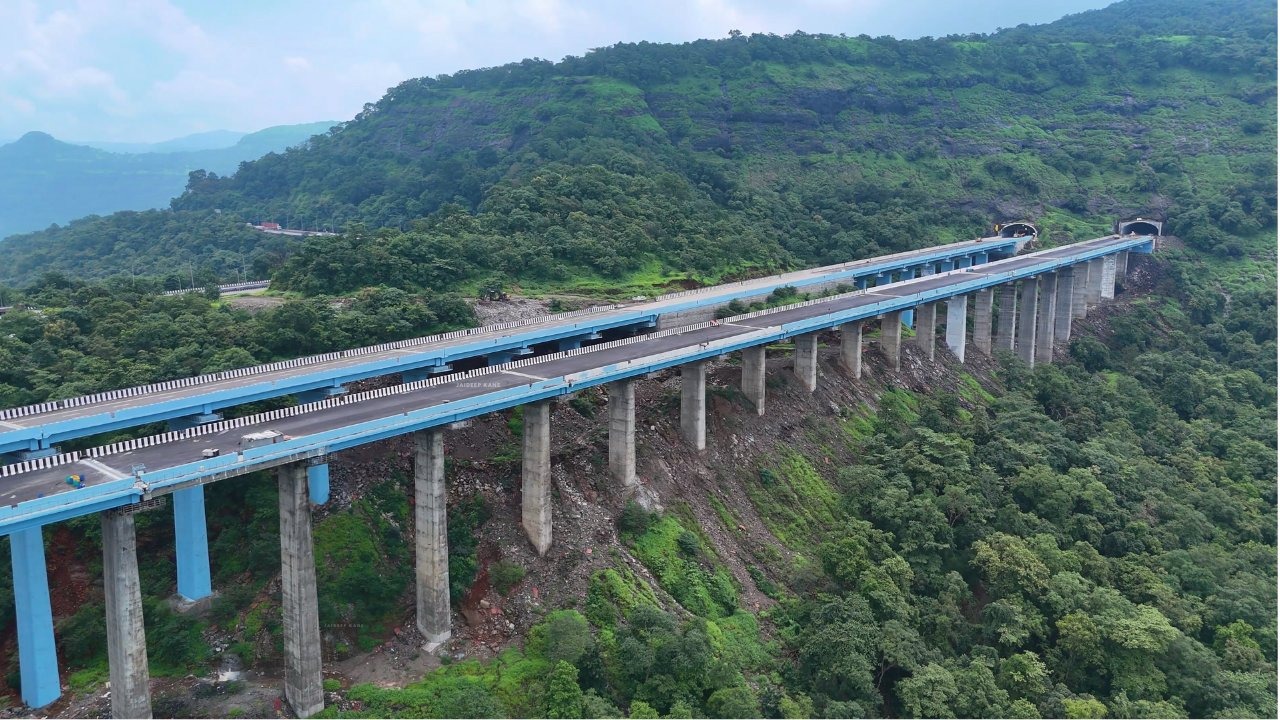
Urban transport planners say the Mumbai Pune Missing Link represents a shift in how Indian expressways are being engineered away from terrain-following roads and towards resilience-led, controlled-access corridors. Emergency cross-passages at regular intervals, advanced ventilation systems, automated fire control, and real-time monitoring infrastructure have been integrated to meet contemporary safety benchmarks. These measures are increasingly seen as essential as traffic volumes rise and climate-related risks intensify in mountainous regions. Beyond tunnelling, the project includes a prominent valley bridge across the Lonavala–Khandala stretch, supported by pylons taller than any previously built for a road project in the country. Additional viaducts span deep ravines, minimising ecological disturbance on slopes while maintaining structural continuity. Engineers involved in the project note that concentrating traffic on elevated and enclosed structures reduces long-term land fragmentation compared to repeated surface widening.
From an economic standpoint, the Mumbai Pune Missing Link is expected to cut travel time by up to half an hour during peak movement, improving reliability for logistics operators, daily commuters, and tourism traffic. Real estate analysts also anticipate a redistribution of development pressure, as reduced congestion could make peripheral nodes more viable without intensifying density in already stressed urban pockets. As the project enters its final commissioning phase, attention will turn to operations, maintenance, and integration with future low-emission transport strategies. For India’s urban corridors, the Missing Link is less about a shorter drive and more about setting a template for safer, climate-conscious infrastructure in complex geographies.