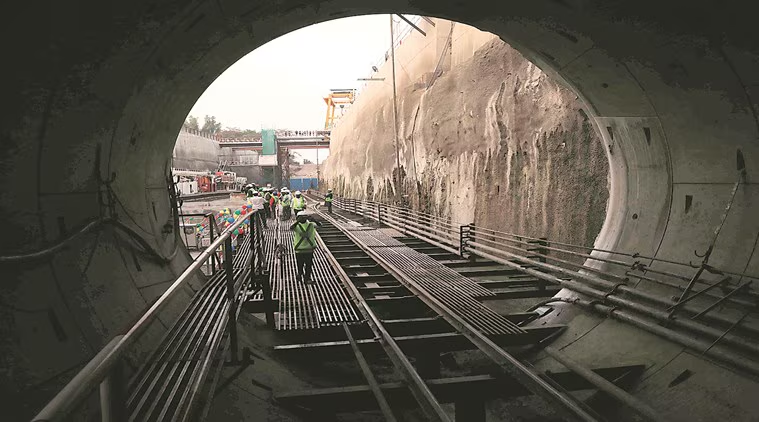
Authorities in Pune have initiated a comprehensive review of construction practices near underground transit infrastructure after structural concerns emerged along a key metro corridor between Swargate and Shivajinagar. The development has prompted a regulatory rethink, with officials moving to tighten oversight of surface-level activities that may affect critical urban systems below ground.
Preliminary assessments indicate that irregularities inside the tunnel — including fissures and moisture ingress — may be linked to nearby drilling work undertaken as part of a private construction project. While detailed technical investigations are ongoing, the incident has raised broader questions about how rapidly expanding cities manage the interface between underground infrastructure and above-ground development.
The affected stretch forms part of a crucial underground alignment designed to ease congestion in Pune’s core areas. Built several metres below the surface and protected by engineered barriers, such tunnels are typically insulated from routine construction activity.
However, urban planners point out that unregulated or poorly monitored interventions — particularly borewell drilling — can disrupt soil stability and groundwater flows, creating indirect stress on subterranean structures.
In response, civic authorities and metro officials are working to establish a more rigorous approval framework for projects located near transit corridors. Under the proposed system, developers may be required to undergo detailed structural impact assessments before undertaking excavation or drilling work. Additional clearances linked to groundwater management are also expected to become mandatory, reflecting the interconnected risks between water tables and underground construction.
The Pune metro tunnel damage has also brought enforcement gaps into sharper focus. Experts suggest that while regulatory provisions often exist on paper, implementation remains uneven due to limited technical capacity and fragmented oversight. Strengthening coordination between municipal departments, transport agencies, and environmental regulators will be essential to prevent recurrence. From an economic perspective, the tightening of norms could introduce new compliance costs for developers operating in central Pune. However, industry observers argue that such safeguards are necessary to protect high-value public infrastructure investments and ensure long-term urban resilience. Infrastructure disruptions, even if localised, can have cascading effects on mobility, productivity, and investor confidence.
There are also environmental considerations. Activities such as borewell excavation can alter subsurface water dynamics, particularly in dense urban zones where natural drainage patterns have already been modified. The Pune metro tunnel damage incident underscores the need for cities to adopt integrated planning approaches that account for geology, hydrology, and built infrastructure in tandem. Going forward, authorities are expected to expand monitoring mechanisms, potentially incorporating real-time tracking and technical audits of high-risk construction zones. For residents, the immediate concern remains safety and service continuity, while for policymakers, the episode serves as a reminder that infrastructure expansion must be matched by equally robust governance frameworks.
As Pune continues to invest in mass transit to support sustainable mobility, ensuring the structural integrity of its underground assets will be critical. The next phase of regulation will likely determine how effectively the city balances growth with safety in an increasingly complex urban landscape.
Pune Metro Tunnel Damage Spurs Safety Overhaul