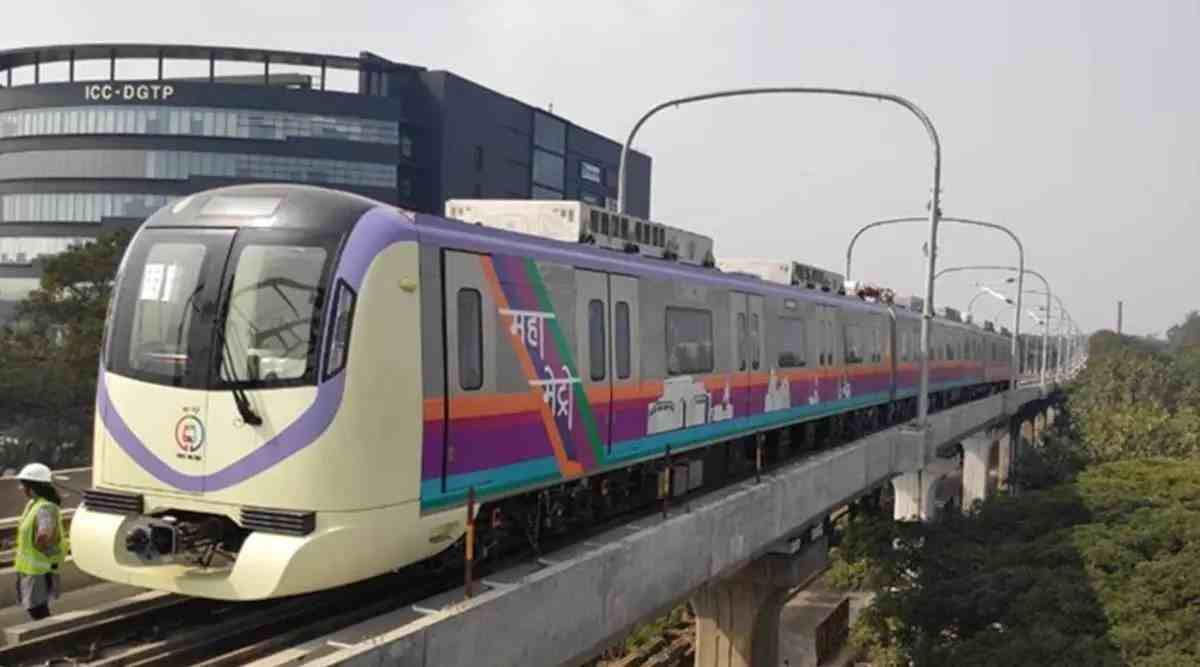
Pune is gearing up to enhance urban mobility by planning a direct metro corridor to Lohegaon Airport, a move expected to significantly improve last-mile connectivity and reduce travel stress for air passengers.
The Pune Municipal Corporation (PMC), in coordination with the Maharashtra Metro Rail Corporation Limited (Maha Metro), has initiated work on the Detailed Project Report (DPR) for this crucial infrastructure addition. According to senior officials in the urban development and transport sectors, the proposed airport link will be part of the larger and strategically important Khadakwasla-Swargate-Hadapsar-Kharadi Metro corridor. A key segment of this plan involves connecting Kharadi—already emerging as an economic and residential hub—to the Pune International Airport. The stretch is expected to span around 3 to 4 kilometres, though final alignment and station locations are subject to the outcome of an ongoing feasibility assessment.
The DPR, which is being funded by PMC and executed by Maha Metro, is expected to be completed within three months. Experts familiar with the project stated that the aim is to ensure seamless multimodal transit by integrating all operational and upcoming Pune Metro routes—including corridors to Nigdi, Hinjawadi, Swargate, Shivajinagar, Vanaz, and Ramwadi—into the new airport connector. The move is part of Pune’s broader strategy to create an equitable, low-carbon, and sustainable urban transportation ecosystem. A direct metro link to Lohegaon is expected to eliminate the reliance on intermediate transport modes such as autos and cabs, thereby reducing vehicular emissions and urban congestion. The absence of robust last-mile solutions at existing stations, particularly Ramwadi, has long been a point of concern for daily commuters and airport travellers alike.
Urban transport planners have noted that metro access to airports has become a global standard for cities aspiring toward carbon neutrality and inclusive infrastructure. The proposed plan for Pune mirrors such international best practices by recognising the need for transit-oriented development and integrated public infrastructure. Meanwhile, infrastructure upgrades at Pune Airport are also under active consideration to support the anticipated increase in passenger traffic. The Airports Authority of India (AAI) is reportedly engaged in land exchange discussions with the Indian Air Force (IAF) for the proposed runway extension, which requires close to 200 acres. Additionally, a new terminal building is on the cards, with improved road networks and access points being planned in parallel.
Land acquisition efforts for the long-pending Purandar Greenfield Airport project have also been reactivated. According to senior officials from the state industrial development agency, land acquisition notifications have been issued, and sub-divisional officers have been assigned to each village within the designated project area. The renewed push suggests that the government remains committed to developing Purandar as a parallel aviation node for the city. Addressing safety and environmental concerns around the airport perimeter, PMC has also committed to wildlife hazard management and enhanced surveillance measures. As part of these efforts, increased patrolling and the installation of security cameras have been planned to reduce risks posed by stray animals and unauthorised access.
In an effort to make airport services more citizen-friendly and economically accessible, an affordable dining facility named ‘Udaan Yatri Cafe’ has been launched at the Pune Airport. Offering essential items like tea and packaged water at Rs 10, and local snacks including samosas and vada pav at Rs 20, the initiative seeks to democratise air travel experiences in line with the Centre’s broader ‘Ude Desh ka Aam Nagrik’ vision. City officials stated that the cafe not only aims to provide pocket-friendly options but also promotes inclusion by catering to budget travellers, senior citizens, and families. Urban mobility experts and civic planners have welcomed the metro-to-airport linkage as a landmark move, one that reflects an evolved understanding of equitable urban transport. “Such integrated transit projects go beyond convenience—they reflect a shift towards climate-responsive planning,” said a senior transport policy advisor. “If implemented efficiently, Pune could become a model for mid-sized Indian cities aiming to align public infrastructure with the UN Sustainable Development Goals.”
However, challenges remain. Timely land acquisition, inter-agency coordination, and sustained public engagement will be key determinants of the project’s long-term success. Moreover, with Pune’s rapid urbanisation, balancing growth with green mobility solutions will be critical to avoiding infrastructure that simply reinforces car dependency or sprawl. The metro-airport link, once operational, is expected to transform the way Pune moves—bringing the city one step closer to a future where transit is seamless, sustainable, and inclusive for all.